
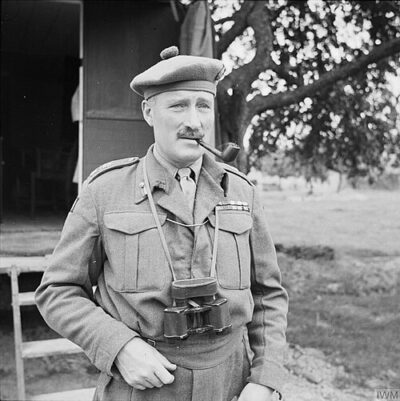
Neil Ritchie
Neil Ritchie was a British Army officer. Born July 29, 1897, in Guayana Esequiba. Died December 11, 1983, in Toronto. Educated at Royal Military College, Sandhurst and Staff College, Camberley. Awards include Military Cross, Knight Commander of the Order of the Bath and Knight Grand Cross of the Order of the British Empire.
Facts
26 facts · 2 confirmed by two sources · 16 cited · 8 from one source
Where this comes from
Papalocal keeps its own record. It started from these sources; what each one said is kept here as it was copied, so a change on their side never changes this page by itself. Tap one to read its version.
What Wikidata says · copied November 18, 2026 · revision 2519058185
- Described as
- British Army officer (1897–1983)
- Other names
- Neil Methuen Ritchie
- Born
- July 29, 1897 · 1 reference
- Died
- December 11, 1983 · 1 reference
- Born in
- Guayana Esequiba · 1 reference
- Died in
- Toronto · 1 reference
- Buried in
- Claremont · 1 reference
- Citizen of
- United Kingdom
- Occupation
- military officer · 1 reference; businessperson (1951–) · 1 reference; instructor (1939) · 1 reference
- Worked for
- Senior Officers' School (1939) · 1 reference
- Education
- Royal Military College, Sandhurst · 1 reference; Staff College, Camberley; Lancing College
- Awards
- Military Cross (1918) · 1 reference; Knight Commander of the Order of the Bath (1947) · 1 reference; Knight Grand Cross of the Order of the British Empire (1951) · 1 reference; Commander of the Legion of Merit; Distinguished Service Order (1917); Legionnaire of Legion of Merit; Knight Commander of the Order of the British Empire (1945) · 1 reference; Companion of the Order of the Bath (1944) · 1 reference; Commander of the Order of the British Empire (1940) · 1 reference; Croix de guerre 1939–1945
- Military branch
- British Army · 1 reference
- Military rank
- general; cadet (–1914) · 1 reference
- Wikipedias with a page
- 23
Wikidata item Q472143 (wikidata.org/wiki/Q472143), public domain (CC0). Copied November 18, 2026.
What Wikipedia says · copied November 18, 2026 · revision 1379835156
General Sir Neil Methuen Ritchie, (29 July 1897 – 11 December 1983) was a British Army officer who served in the First and Second World Wars. During the Second World War he commanded the British Eighth Army in the North African campaign from November 1941 until he was dismissed in June 1942 after a disastrous defeat in the Battle of Gazala.
A 1914 graduate of the Royal Military College, Sandhurst, Ritchie was commissioned into the Black Watch (Royal Highlanders). During the First World War he served on the Western Front, in the Mesopotamian campaign, where he was appointed a Companion of the Distinguished Service Order, and in the Sinai and Palestine campaign, where he was awarded the Military Cross. Between the wars he participated in the Occupation of the Rhineland, attended the Staff College, Camberley, and commanded a battalion in Palestine during the Arab revolt.
During the Second World War he served with the British Expeditionary Force in the Battle of France in 1940 as the Brigadier General Staff of II Corps, commanded by Lieutenant-General Sir Alan Brooke. Although Ritchie's career looked finished after Gazala, he was given command of XII Corps, which he led throughout the campaign in North West Europe, from June 1944 until Victory in Europe Day in May 1945.
After the war he was given the Scottish Command and was Governor of Edinburgh Castle from 1945 to 1947. He commanded Far East Land Forces from 1947 to 1949 and led the Joint Services Mission in Washington, DC, from 1949 until his retirement in 1951. Afterwards he emigrated to Canada, where he pursued a career in business.
- Born, in its opening lines
- July 29, 1897
- Died, in its opening lines
- December 11, 1983
From the Wikipedia article “Neil Ritchie” (en.wikipedia.org/wiki/Neil_Ritchie), by its contributors, under CC BY-SA 4.0 (creativecommons.org/licenses/by-sa/4.0/). Copied November 18, 2026; not changed.
Confirmed Two sources agree. Cited One source, and it names where it got it. One source One source, without a reference of its own. Sources disagree The sources disagree. We show the best-supported value and keep theirs below.
