
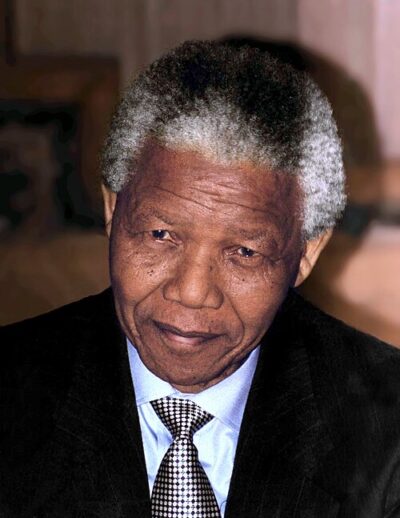
Nelson Mandela
Nelson Mandela was a President of South Africa and anti-apartheid activist. Born July 18, 1918, in Mvezo. Died December 5, 2013, in Houghton Estate. Positions held include President of South Africa (1994–1999), Secretary General of the Non-Aligned Movement (1998–1999) and member of the National Assembly of South Africa. Known for Long Walk to Freedom. Educated at University of the Witwatersrand and University of Fort Hare. Awards include Jawaharlal Nehru Award for International Understanding, International Simón Bolívar Prize and Ludovic-Trarieux International Human Rights Prize.
Facts
56 facts · 2 confirmed by two sources · 14 cited · 40 from one source
Where this comes from
Papalocal keeps its own record. It started from these sources; what each one said is kept here as it was copied, so a change on their side never changes this page by itself. Tap one to read its version.
What Wikidata says · copied November 16, 2026 · revision 2568562679
- Described as
- President of South Africa and anti-apartheid activist (1918–2013)
- Other names
- Father of the Nation, 曼德拉, Mandela, Prisoner 46664, Nelson Rolihlahla Mandela, Rolihllahla Mandela, Madiba, Rolihllahla
- Born
- July 18, 1918 · 10 references
- Died
- December 5, 2013 · 10 references
- Born in
- Mvezo · 5 references
- Died in
- Houghton Estate
- Buried in
- Qunu · 1 reference
- Cause of death
- respiratory disease
- Name at birth
- Rolihllahla Mandela
- Citizen of
- South Africa
- Occupation
- politician · 1 reference; autobiographer; lawyer; political activist; political prisoner; screenwriter · 1 reference; freedom fighter · 1 reference
- Positions held
- President of South Africa (1994–1999); Secretary General of the Non-Aligned Movement (1998–1999); member of the National Assembly of South Africa
- Political party
- African National Congress (1943–); South African Communist Party
- Education
- University of the Witwatersrand; University of Fort Hare; University of South Africa; University of London
- Member of
- American Academy of Arts and Sciences; The Elders (2007–2013) · 1 reference
- Known for
- Long Walk to Freedom · 1 reference
- Awards
- Jawaharlal Nehru Award for International Understanding (1979) · 1 reference; International Simón Bolívar Prize (1983); Ludovic-Trarieux International Human Rights Prize (1985); Sakharov Prize (1988); United Nations Prize in the Field of Human Rights (1988); Grand Star of People's Friendship (1988); Order of Friendship (1988) · 1 reference; Order of Eduardo Mondlane, 1st class (1988) · 2 references; Grandmaster of the Order of Good Hope; Lenin Peace Prize (1990); Order of Lenin (1990); honorary degree from Spelman College (1990) · 1 reference; Félix Houphouët-Boigny Peace Prize (1991) · 1 reference; honorary doctor of the University of Madrid Complutense (1991); Order of José Martí (1991) · 1 reference
- Spouse
- Evelyn Mase (1944–1958) · 1 reference; Winnie Madikizela-Mandela (1958–1996) · 1 reference; Graça Machel (1998–2013) · 1 reference
- Children
- Makgatho Mandela; Makaziwe Mandela; Zenani Mandela-Dlamini; Thembekile Mandela; Zindzi Mandela; Makaziwe Mandela
- Father
- Gadla Henry Mphakanyiswa · 1 reference
- Mother
- Nosekeni Fanny · 1 reference
- Religion
- Methodism
- Lived in
- Houghton Estate
- Website
- https://www.nelsonmandela.org
- Wikipedias with a page
- 297
Wikidata item Q8023 (wikidata.org/wiki/Q8023), public domain (CC0). Copied November 16, 2026.
What Wikipedia says · copied November 16, 2026 · revision 1383801313
Nelson Rolihlahla Mandela (18 July 1918 – 5 December 2013) was a South African anti-apartheid revolutionary, politician, and philanthropist, who served as President of South Africa from 1994 to 1999. He was the country's first black head of state and the first elected in a fully representative democratic election. His government focused on dismantling the legacy of apartheid by tackling institutionalised racism and fostering racial reconciliation. Ideologically an African nationalist and socialist, he served as President of the African National Congress (ANC) party from 1991 to 1997.
A Xhosa, Mandela was born in Mvezo to the Thembu royal family. He studied law at the University of Fort Hare and the University of the Witwatersrand before working as a lawyer in Johannesburg. There he became involved in anti-colonial and African nationalist politics, joining the ANC in 1943 and co-founding its Youth League in 1944. After the National Party's white-only government established apartheid—a system of racial segregation that privileged whites—he and the ANC committed themselves to its overthrow. Mandela was appointed President of the ANC's Transvaal branch, rising to prominence for his involvement in the 1952 Defiance Campaign and the 1955 Congress of the People. He was repeatedly arrested for seditious activities and was unsuccessfully prosecuted in the 1956 Treason Trial. Influenced by Marxism, he secretly joined the South African Communist Party (SACP). Although initially committed to non-violent protest, in association with the SACP he co-founded the militant Umkhonto we Sizwe in 1961 and led a sabotage campaign against the government. In 1962, he was arrested for conspiring to overthrow the state and sentenced to life imprisonment in the Rivonia Trial.
Mandela served 27 years in prison, initially on Robben Island, and later in Pollsmoor Prison and Victor Verster Prison. Amid growing domestic and international pressure, and with fears of a racial civil war, President F. W. de Klerk released him in 1990. Mandela and de Klerk negotiated an end to apartheid and organised the 1994 multiracial general election in which Mandela led the ANC to victory and became President. Leading a broad coalition government which promulgated a new constitution, Mandela emphasised reconciliation between the country's racial groups and created the Truth and Reconciliation Commission to investigate past human rights abuses. Economically, Mandela's administration retained its predecessor's liberal framework despite his own socialist beliefs, also introducing measures to encourage land reform, combat poverty, and expand healthcare services. Internationally, he acted as mediator in the Pan Am Flight 103 bombing trial and served as Secretary-General of the Non-Aligned Movement from 1998 to 1999. He declined a second presidential term and in 1999 was succeeded by his deputy, Thabo Mbeki. Mandela became an elder statesman and focused on combating poverty and HIV/AIDS through the charitable Nelson Mandela Foundation.
Mandela was a controversial figure for much of his life. Although critics on the right denounced him as a communist terrorist and those on the radical left deemed him too eager to negotiate and reconcile with apartheid's supporters, he gained international acclaim for his activism. Widely regarded as an icon of moral leadership, democracy and social justice, he received more than 250 honours—including the Nobel Peace Prize—and became the subject of a cult of personality. He is held in deep respect within South Africa, where he is often referred to by his Xhosa clan name, Madiba, and described as the Father of the Nation.
- Born, in its opening lines
- July 18, 1918
- Died, in its opening lines
- December 5, 2013
From the Wikipedia article “Nelson Mandela” (en.wikipedia.org/wiki/Nelson_Mandela), by its contributors, under CC BY-SA 4.0 (creativecommons.org/licenses/by-sa/4.0/). Copied November 16, 2026; not changed.
Confirmed Two sources agree. Cited One source, and it names where it got it. One source One source, without a reference of its own. Sources disagree The sources disagree. We show the best-supported value and keep theirs below.
