
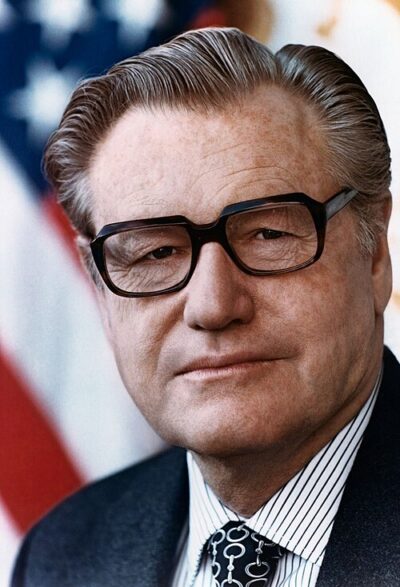
Nelson Rockefeller
Nelson Rockefeller was a Vice President of the United States from 1974 to 1977. Born July 8, 1908, in Bar Harbor. Died January 26, 1979, in New York City. Positions held include Vice President of the United States (1974–1977) and Governor of New York (1959–1973). Educated at Dartmouth College and New Lincoln School. Awards include Presidential Medal of Freedom, Knight Grand Cross of the Order of Leopold II and Commander First Class of the Order of the White Rose of Finland.
Facts
47 facts · 2 confirmed by two sources · 19 cited · 25 from one source · 1 where the sources disagree
What’s different
- Buried in: we show Rockefeller Family Cemetery (Sources disagree). Wikidata also lists Sleepy Hollow Cemetery
Where this comes from
Papalocal keeps its own record. It started from these sources; what each one said is kept here as it was copied, so a change on their side never changes this page by itself. Tap one to read its version.
What Wikipedia says · copied November 13, 2026 · revision 1379250913
Nelson Aldrich Rockefeller (July 8, 1908 – January 26, 1979) was the 41st vice president of the United States, serving from 1974 to 1977 under President Gerald Ford. A member of the Republican Party and the wealthy Rockefeller family, he was the 49th governor of New York from 1959 to 1973. He was the leader of the moderate faction of his party, known as the Rockefeller Republicans.
After graduating from Dartmouth College in 1930, Rockefeller worked at various businesses connected to his family. He served as Assistant Secretary of State for American Republic Affairs for presidents Franklin D. Roosevelt and Harry S. Truman (1944–1945), and as Undersecretary of Health, Education and Welfare (HEW) under Dwight D. Eisenhower from 1953 to 1954. He was first elected governor of New York in 1958, and was re-elected in 1962, 1966, and 1970. As governor of New York, Rockefeller's achievements included the expansion of the State University of New York (SUNY), efforts to protect the environment, the construction of the Empire State Plaza in Albany, increased facilities and personnel for medical care, and the creation of the New York State Council on the Arts. Rockefeller was often considered to be liberal, progressive, or moderate. In an agreement that was termed the Treaty of Fifth Avenue, he persuaded Richard Nixon to alter the Republican Party platform just before the 1960 Republican National Convention.
After unsuccessfully seeking the Republican presidential nomination in 1960, 1964, and 1968, Rockefeller was appointed vice president of the United States by President Gerald Ford in December 1974. Rockefeller was the second vice president appointed to the position under the 25th Amendment, following Ford himself. Rockefeller did not seek a full term in the 1976 election with Ford, who named Kansas senator Bob Dole as his running mate instead of Rockefeller that year. Rockefeller retired from politics in 1977 and died two years later from a heart attack.
As a businessman, Rockefeller was president and later chair of Rockefeller Center, Inc. He also formed the International Basic Economy Corporation in 1947. Rockefeller assembled a significant art collection and promoted public access to the arts. He served as trustee, treasurer, and president of the Museum of Modern Art and founded the Museum of Primitive Art in 1954. In the area of philanthropy, he founded the Rockefeller Brothers Fund in 1940 with his four brothers and established the American International Association for Economic and Social Development in 1946.
- Born, in its opening lines
- July 8, 1908
- Died, in its opening lines
- January 26, 1979
From the Wikipedia article “Nelson Rockefeller” (en.wikipedia.org/wiki/Nelson_Rockefeller), by its contributors, under CC BY-SA 4.0 (creativecommons.org/licenses/by-sa/4.0/). Copied November 13, 2026; not changed.
What Wikidata says · copied November 14, 2026 · revision 2569081361
- Described as
- Vice President of the United States from 1974 to 1977
- Other names
- Nelson A. Rockefeller, Nelson Aldrich Rockefeller
- Born
- July 8, 1908 · 10 references
- Died
- January 26, 1979 · 10 references
- Born in
- Bar Harbor · 1 reference
- Died in
- New York City · 2 references
- Buried in
- Rockefeller Family Cemetery; Sleepy Hollow Cemetery
- Cause of death
- myocardial infarction
- Name at birth
- Nelson Aldrich Rockefeller
- Citizen of
- United States
- Occupation
- politician · 1 reference; art collector · 1 reference; businessperson · 1 reference; philanthropist · 1 reference
- Positions held
- Vice President of the United States (1974–1977); Governor of New York (1959–1973)
- Political party
- Republican Party
- Education
- Dartmouth College; New Lincoln School
- Awards
- Presidential Medal of Freedom (1977) · 1 reference; Knight Grand Cross of the Order of Leopold II (1959); Commander First Class of the Order of the White Rose of Finland (1962); Order of the Southern Cross (1946); Knight Grand Officer of the Order of the Dannebrog (1960); Grand Officer of the Order of Merit of the Italian Republic (1962); Grand Cross of the Order of Orange-Nassau (1960); Grand Cross of the Order of the White Elephant (1960); Order of Brilliant Star; Order of the Aztec Eagle (1949); Order of Merit (1945); Commandeur des Arts et des Lettres (1958); Ramon Magsaysay Award; Commander of the Legion of Honour (1960)
- Spouse
- Mary Rockefeller (1930–1962) · 1 reference; Happy Rockefeller (1963–1979) · 2 references
- Children
- Rodman Rockefeller · 1 reference; Steven Clark Rockefeller · 1 reference; Michael Rockefeller · 1 reference; Mark Rockefeller · 1 reference; Nelson Aldrich Rockefeller Jr. · 1 reference; Ann Rockefeller Roberts · 1 reference
- Father
- John D. Rockefeller Jr. · 1 reference
- Mother
- Abigail Greene Aldrich · 1 reference
- Siblings
- Abby Rockefeller Mauzé; David Rockefeller · 1 reference; John D. Rockefeller III · 1 reference; Laurance Rockefeller · 1 reference; Winthrop Rockefeller · 1 reference
- Religion
- Baptists
- Wikipedias with a page
- 74
Wikidata item Q11237 (wikidata.org/wiki/Q11237), public domain (CC0). Copied November 14, 2026.
Confirmed Two sources agree. Cited One source, and it names where it got it. One source One source, without a reference of its own. Sources disagree The sources disagree. We show the best-supported value and keep theirs below.
