
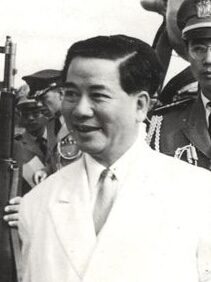
Ngô Đình Diệm
Ngô Đình Diệm was a South Vietnamese politician; President of South Vietnam from 1955 to 1963. Born January 3, 1901, in Phong Thủy. Died November 2, 1963, in Ho Chi Minh City. Positions held include President of South Vietnam (1955–1963). Educated at Quốc Học – Huế High School for the Gifted and University of Michigan. Awards include Order of Merit for National Foundation, Order of Sikatuna and Order of the Southern Cross.
Facts
39 facts · 2 confirmed by two sources · 4 cited · 32 from one source · 1 where the sources disagree
What’s different
- Buried in: we show Mạc Đĩnh Chi Cemetery (Sources disagree). Wikidata also lists Lái Thiêu Cemetery
Where this comes from
Papalocal keeps its own record. It started from these sources; what each one said is kept here as it was copied, so a change on their side never changes this page by itself. Tap one to read its version.
What Wikidata says · copied November 16, 2026 · revision 2569707929
- Described as
- South Vietnamese politician; President of South Vietnam from 1955 to 1963
- Other names
- Ngo Dinh Diem, Diệm
- Born
- January 3, 1901 · 8 references
- Died
- November 2, 1963 · 8 references
- Born in
- Phong Thủy
- Died in
- Ho Chi Minh City · 1 reference
- Buried in
- Mạc Đĩnh Chi Cemetery; Lái Thiêu Cemetery
- Cause of death
- gunshot wound
- Citizen of
- South Vietnam (1955–); State of Vietnam (1954–1955); French Indochina (–1954)
- Occupation
- politician · 1 reference
- Positions held
- President of South Vietnam (1955–1963)
- Political party
- Personalist Labor Revolutionary Party
- Education
- Quốc Học – Huế High School for the Gifted; University of Michigan; École d'Apprentis Mandarins
- Awards
- Order of Merit for National Foundation; Order of Sikatuna; Order of the Southern Cross; Order of the White Lion; Order of the Crown of the Realm; Order of the Netherlands Lion; Order of St. Olav; National Order of Vietnam · 1 reference; Order of the Liberator General San Martín · 1 reference; Order of Chula Chom Klao · 1 reference; Order of the Chrysanthemum · 1 reference; Order of Isabella the Catholic · 1 reference; Order of Saint Michael and Saint George · 1 reference; Order of the Million Elephants and the White Parasol · 1 reference
- Father
- Ngô Đình Khả
- Siblings
- Ngo Dinh Nhu · 1 reference; Ngô Đình Thục · 1 reference; Ngô Đình Cẩn; Ngô Đình Luyện; Ngô Đình Khôi; Ngô Đình Thị Giao; Ngô Đình Thị Hiệp
- Religion
- Catholic Church
- Lived in
- National Archives Centre
- Wikipedias with a page
- 72
Wikidata item Q192502 (wikidata.org/wiki/Q192502), public domain (CC0). Copied November 16, 2026.
What Wikipedia says · copied November 16, 2026 · revision 1384711614
Ngô Đình Diệm ( dyem, YEE-əm or zeem; Vietnamese: [ŋō ɗìn jîəmˀ] ; 3 January 1901 – 2 November 1963) was a South Vietnamese politician. He was the final prime minister of the State of Vietnam (1954–1955), and later the first president of South Vietnam (Republic of Vietnam) from 1955 until his capture and assassination during the CIA-backed 1963 coup d'état.
Diệm was born into a prominent Catholic family with his father, Ngô Đình Khả, being a high-ranking mandarin for Emperor Thành Thái during the French colonial era. Diệm was educated at French-speaking schools and considered following his brother Ngô Đình Thục into the priesthood, but eventually chose to pursue a career in the civil service. He progressed rapidly in the court of Emperor Bảo Đại, becoming governor of Bình Thuận Province in 1929 and interior minister in 1933. However, he resigned from the latter position after three months and publicly denounced the emperor as a tool of France. Diệm came to support Vietnamese nationalism, promoting both anti-communism, in opposition to Ho Chi Minh, and decolonization, in opposition to Bảo Đại. He established the Cần Lao Party to support his political doctrine of Person Dignity Theory, which was a blend of the philosophies of Personalism, especially as understood by French philosopher Emmanuel Mounier, and of Confucianism, which Diệm and his father had greatly admired. Diệm supported the Confucian concept of "Mandate of Heaven", and wished to make it the basis of political theory that would emerge in Vietnam.
After several years in exile in Japan, the United States, and Europe, Diệm returned home in July 1954 and was appointed prime minister by Bảo Đại. The 1954 Geneva Conference took place soon after he took office, formally partitioning Vietnam along the 17th parallel. Diệm, with the aid of his younger brother Ngô Đình Nhu, soon consolidated power in South Vietnam. After the 1955 State of Vietnam referendum, he proclaimed the creation of the Republic of Vietnam, with himself as president. His government was supported by other anti-communist countries, most notably the United States. Diệm pursued a series of nation-building projects, promoting industrial and rural development. From 1957 onward, as part of the Vietnam War, he faced several assassination and coup attempts, and a communist insurgency backed by North Vietnam. This insurgency eventually formally organized under the banner of the Viet Cong. In 1962, Diệm established the Strategic Hamlet Program as the cornerstone of his counterinsurgency effort.
In 1963, Diệm's favoritism towards Catholics and persecution of practitioners of Buddhism in Vietnam led to the Buddhist crisis. The event damaged relations with the United States and other previously sympathetic countries, and his organization lost favor with the leadership of the Army of the Republic of Vietnam. On 1 November 1963, the country's leading generals launched a coup d'état with assistance from the Central Intelligence Agency. Diệm and his brother, Nhu, initially escaped, but were recaptured the following day and assassinated on the orders of Dương Văn Minh, who succeeded him as president.
Diệm has been a controversial historical figure. Some have considered him a tool of the United States, while others have portrayed him as an anti-capitalist and traditionalist. At the time of his assassination, Western media widely considered him a dictator, though South Vietnamese offered a variety of views, generally acknowledging that he strongly opposed American interference.
- Born, in its opening lines
- January 3, 1901
- Died, in its opening lines
- November 2, 1963
From the Wikipedia article “Ngo Dinh Diem” (en.wikipedia.org/wiki/Ngo_Dinh_Diem), by its contributors, under CC BY-SA 4.0 (creativecommons.org/licenses/by-sa/4.0/). Copied November 16, 2026; not changed.
Confirmed Two sources agree. Cited One source, and it names where it got it. One source One source, without a reference of its own. Sources disagree The sources disagree. We show the best-supported value and keep theirs below.
