
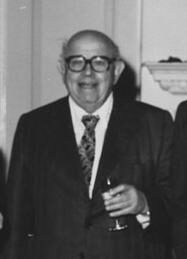
Nicholas Kaldor
Nicholas Kaldor was a Hungarian-British economist. Born May 12, 1908, in Budapest. Died September 30, 1986, in Cambridge. Positions held include member of the House of Lords (1974–1986). Educated at London School of Economics and Political Science. Awards include Fellow of the Econometric Society and doctor honoris causa from the University of Dijon.
Facts
20 facts · 2 confirmed by two sources · 9 cited · 9 from one source
Where this comes from
Papalocal keeps its own record. It started from these sources; what each one said is kept here as it was copied, so a change on their side never changes this page by itself. Tap one to read its version.
What Wikidata says · copied November 16, 2026 · revision 2565544382
- Described as
- Hungarian-British economist
- Born
- May 12, 1908 · 7 references
- Died
- September 30, 1986 · 6 references
- Born in
- Budapest · 2 references
- Died in
- Cambridge · 1 reference
- Citizen of
- Hungary; United Kingdom (1934–) · 1 reference
- Occupation
- economist · 2 references; politician · 1 reference; university teacher
- Positions held
- member of the House of Lords (1974–1986)
- Worked for
- London School of Economics and Political Science
- Education
- London School of Economics and Political Science (–1930)
- Member of
- Hungarian Academy of Sciences; American Academy of Arts and Sciences; Econometric Society (1945–) · 1 reference
- Awards
- Fellow of the Econometric Society (1945) · 1 reference; doctor honoris causa from the University of Dijon (1962) · 1 reference
- Field
- economics; economy
- Children
- Mary Kaldor · 1 reference
- Wikipedias with a page
- 32
Wikidata item Q335153 (wikidata.org/wiki/Q335153), public domain (CC0). Copied November 16, 2026.
What Wikipedia says · copied November 16, 2026 · revision 1379941791
Nicholas Kaldor, Baron Kaldor (12 May 1908 – 30 September 1986), born Káldor Miklós, was a Hungarian-born British economist. He developed the "compensation" criteria called Kaldor–Hicks efficiency for welfare comparisons (1939), derived the cobweb model, and argued for certain regularities observable in economic growth, which are called Kaldor's growth laws. Kaldor worked alongside Gunnar Myrdal to develop the key concept Circular Cumulative Causation, a multicausal approach where the core variables and their linkages are delineated.
- Born, in its opening lines
- May 12, 1908
- Died, in its opening lines
- September 30, 1986
From the Wikipedia article “Nicholas Kaldor” (en.wikipedia.org/wiki/Nicholas_Kaldor), by its contributors, under CC BY-SA 4.0 (creativecommons.org/licenses/by-sa/4.0/). Copied November 16, 2026; not changed.
Confirmed Two sources agree. Cited One source, and it names where it got it. One source One source, without a reference of its own. Sources disagree The sources disagree. We show the best-supported value and keep theirs below.
