
Nicholas Mercator
Nicholas Mercator was a German mathematician (c.1620 – 1687). Born 1620, in Eutin. Died January 14, 1687, in Versailles. Known for Mercator series. Educated at University of Rostock and Leiden University. Awards include Fellow of the Royal Society.
Facts
25 facts · 0 confirmed by two sources · 20 cited · 5 from one source
Where this comes from
Papalocal keeps its own record. It started from these sources; what each one said is kept here as it was copied, so a change on their side never changes this page by itself. Tap one to read its version.
What Wikidata says · copied November 17, 2026 · revision 2564785185
- Described as
- German mathematician (c.1620 – 1687)
- Other names
- Nikolaus Mercator, Nicholas Kauffmann, Nikolaus Kauffman, Niklaus Kauffmann, Mercator, Nicolai Mercatoris, Niklaus Kauffman
- Born
- 1620 · 9 references
- Died
- January 14, 1687 · 3 references
- Born in
- Eutin · 1 reference
- Died in
- Versailles
- Name at birth
- Niklaus Kauffman · 1 reference
- Citizen of
- Holy Roman Empire
- Occupation
- mathematician · 1 reference; astronomer · 1 reference; music theorist; scientist · 1 reference; university teacher · 1 reference; musicologist · 1 reference
- Worked for
- University of Copenhagen (1648–1654) · 1 reference; University of Rostock (1642–1648) · 1 reference
- Education
- University of Rostock (1632–1641) · 1 reference; Leiden University (1641–1642) · 1 reference
- Member of
- Royal Society of London (1666–)
- Known for
- Mercator series
- Awards
- Fellow of the Royal Society · 1 reference
- Field
- mathematics · 1 reference; music theory · 2 references; astronomy · 1 reference; trigonometry · 1 reference; chronometer · 1 reference; trigonometric function · 1 reference
- Wikipedias with a page
- 27
Wikidata item Q362753 (wikidata.org/wiki/Q362753), public domain (CC0). Copied November 17, 2026.
What Wikipedia says · copied November 17, 2026 · revision 1344850015
Nicholas (Nikolaus) Mercator (c. 1620, Prince-Bishopric of Lübeck – 1687, Versailles), also known by his German name Kauffmann, was a 17th-century mathematician.
He was born in Eutin, Prince-Bishopric of Lübeck, Holy Roman Empire and educated at Rostock and Leyden after which he lived from 1642 to 1648 in the Dutch Republic. He lectured at the University of Copenhagen during 1648–1654 and lived in Paris from 1655 to 1657. He was mathematics tutor to Joscelyne Percy, son of the 10th Earl of Northumberland, at Petworth, Sussex (1657). He taught mathematics in London (1658–1682). On 3 May 1661 he observed a transit of Mercury with Christiaan Huygens and Thomas Streete from Long Acre, London. On 14 November 1666 he was elected a Fellow of the Royal Society. He designed a marine chronometer for Charles II.
In 1682 Jean Colbert invited Mercator to assist in the design and construction of the fountains at the Palace of Versailles, so he relocated there, but a falling-out with Colbert followed.
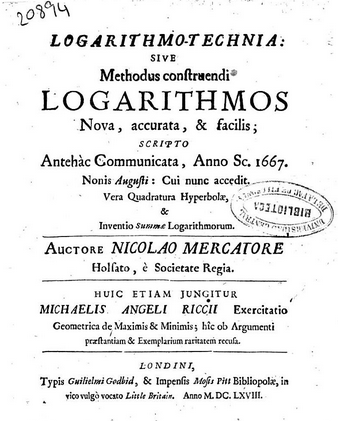
Mathematically, he is most well known for his treatise Logarithmo-technia on logarithms, published in 1668. In this treatise he described the Mercator series:ln(1+x)=x−12x2+13x3−14x4+⋯for x∈ ]−1,1].
Nicholas Mercator was the first person to use the term natural logarithm.
To the field of music, Mercator contributed the first precise account of 53 equal temperament, which was of theoretical importance, but not widely practised.
He died at Versailles in 1687.
From the Wikipedia article “Nicholas Mercator” (en.wikipedia.org/wiki/Nicholas_Mercator), by its contributors, under CC BY-SA 4.0 (creativecommons.org/licenses/by-sa/4.0/). Copied November 17, 2026; not changed.
Confirmed Two sources agree. Cited One source, and it names where it got it. One source One source, without a reference of its own. Sources disagree The sources disagree. We show the best-supported value and keep theirs below.
