
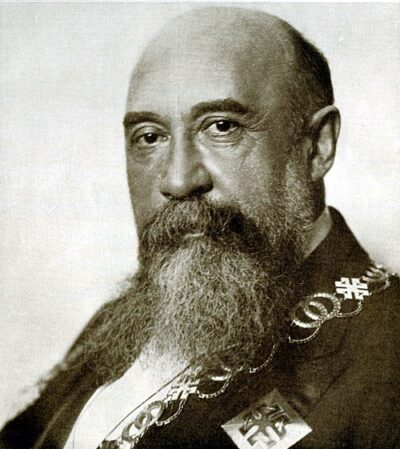
Nicolae Iorga
Nicolae Iorga was a Romanian historian, politician, literary critic, memoirist, poet and playwright. Born June 5, 1871, in Botoșani. Died November 27, 1940, in Strejnicu. Positions held include Prime Minister of Romania (1931–1932), member of the Chamber of Deputies of Romania and President of the Senate of Romania. Educated at Alexandru Ioan Cuza University and Leipzig University. Awards include Legion of Honour, doctor honoris causa from the University of Lyon and honorary doctorate from the University of Strasbourg.
Facts
50 facts · 1 confirmed by two sources · 17 cited · 31 from one source · 1 where the sources disagree
What’s different
- Born: we show June 5, 1871 (Sources disagree). Wikipedia says January 17, 1871
Where this comes from
Papalocal keeps its own record. It started from these sources; what each one said is kept here as it was copied, so a change on their side never changes this page by itself. Tap one to read its version.
What Wikidata says · copied November 16, 2026 · revision 2569269104
- Described as
- Romanian historian, politician, literary critic, memoirist, poet and playwright (1871–1940)
- Born
- June 5, 1871 · 1 reference
- Died
- November 27, 1940 · 5 references
- Born in
- Botoșani · 2 references
- Died in
- Strejnicu · 1 reference
- Buried in
- Bellu Cemetery
- Cause of death
- gunshot wound
- Citizen of
- United Principalities of Moldavia and Wallachia; Kingdom of Romania
- Occupation
- politician · 1 reference; linguist; geopolitical analyst; poet · 1 reference; historian of Eastern Europe; historian · 2 references; philosopher; literary historian
- Positions held
- Prime Minister of Romania (1931–1932); member of the Chamber of Deputies of Romania; President of the Senate of Romania
- Political party
- Democratic Nationalist Party
- Worked for
- University of Paris; University of Bucharest · 1 reference; Alexandru Ioan Cuza University · 1 reference
- Education
- Alexandru Ioan Cuza University; Leipzig University; Humboldt-Universität zu Berlin · 1 reference; École pratique des hautes études · 1 reference
- Member of
- Serbian Academy of Sciences and Arts; Romanian Academy; Lwów Scientific Society; Royal Swedish Academy of Letters, History and Antiquities; Académie des Inscriptions et Belles-Lettres (1932–1940) · 1 reference; Accademia Nazionale dei Lincei (1932–) · 1 reference
- Awards
- Legion of Honour; doctor honoris causa from the University of Lyon (1923) · 1 reference; honorary doctorate from the University of Strasbourg (1925) · 1 reference; doctor honoris causa from the University of Paris (1931) · 1 reference; doctor honoris causa from the University of Alger (1939) · 1 reference; honorary doctor of Comenius University (1932) · 1 reference
- Field
- history · 1 reference; politics · 1 reference; creative and professional writing · 1 reference; literary criticism · 1 reference; memoir literature · 1 reference; poetry · 1 reference
- Spouse
- Ecaterina Iorga
- Children
- Liliana Iorga
- Mother
- Zulnia Iorga
- Siblings
- George Iorga
- Religion
- Romanian Orthodox Church
- Wikipedias with a page
- 49
Wikidata item Q313581 (wikidata.org/wiki/Q313581), public domain (CC0). Copied November 16, 2026.
What Wikipedia says · copied November 16, 2026 · revision 1385624060
Nicolae Iorga (17 January 1871 – 27 November 1940) was a Romanian historian, politician, literary critic, memoirist, albanologist, poet and playwright. Co-founder (in 1910) of the Democratic Nationalist Party (PND), he served as a member of Parliament, President of the Deputies' Assembly and Senate, cabinet minister and briefly (1931–32) as Prime Minister. A child prodigy, polymath and polyglot, Iorga produced an unusually large body of scholarly works, establishing his international reputation as a medievalist, Byzantinist, Latinist, Slavist, art historian and philosopher of history. Holding teaching positions at the University of Bucharest, the University of Paris and several other academic institutions, Iorga was founder of the International Congress of Byzantine Studies and the Institute of South-East European Studies (ISSEE). His activity also included the transformation of Vălenii de Munte town into a cultural and academic center.
In parallel with his academic contributions, Nicolae Iorga was a prominent right-of-centre activist, whose political theory bridged conservatism, Romanian nationalism, and agrarianism. From Marxist beginnings, he switched sides and became a maverick disciple of the Junimea movement. Iorga later became a leadership figure at Sămănătorul, the influential literary magazine with populist leanings, and militated within the League for the Cultural Unity of All Romanians, founding vocally conservative publications such as Neamul Românesc, Drum Drept, Cuget Clar and Floarea Darurilor. His support for the cause of ethnic Romanians in Austria-Hungary made him a prominent figure in the pro-Entente camp by the time of World War I, and ensured him a special political role during the interwar existence of Greater Romania. Initiator of large-scale campaigns to defend Romanian culture in front of perceived threats, Iorga sparked most controversy with his antisemitic rhetoric, and was for long an associate of the far-right ideologue A. C. Cuza. He was an adversary of the dominant National Liberals, later involved with the opposition Romanian National Party.
Later in his life, Iorga opposed the radically fascist Iron Guard, and, after much oscillation, came to endorse its rival King Carol II. Involved in a personal dispute with the Guard's leader Corneliu Zelea Codreanu, and indirectly contributing to his killing, Iorga was also a prominent figure in Carol's corporatist and authoritarian party, the National Renaissance Front. He remained an independent voice of opposition after the Guard inaugurated its own National Legionary dictatorship, but was ultimately assassinated by a Guardist commando.
- Born, in its opening lines
- January 17, 1871
- Died, in its opening lines
- November 27, 1940
From the Wikipedia article “Nicolae Iorga” (en.wikipedia.org/wiki/Nicolae_Iorga), by its contributors, under CC BY-SA 4.0 (creativecommons.org/licenses/by-sa/4.0/). Copied November 16, 2026; not changed.
Confirmed Two sources agree. Cited One source, and it names where it got it. One source One source, without a reference of its own. Sources disagree The sources disagree. We show the best-supported value and keep theirs below.
