
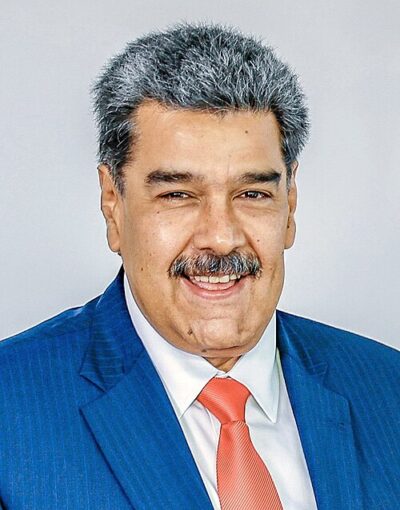
Nicolás Maduro
Nicolás Maduro is a Venezuelan politician. Born November 23, 1962, in Caracas. Positions held include President of Venezuela (2013–2026), member of the 1999 National Constituent Assembly of Venezuela (1998–2001) and Secretary General of the Non-Aligned Movement (2016–2019). Awards include Grand Collar of the Order of the Andes' Condor, Order of José Martí and Order of the Liberator.

Facts
38 facts · 1 confirmed by two sources · 14 cited · 23 from one source
Where this comes from
Papalocal keeps its own record. It started from these sources; what each one said is kept here as it was copied, so a change on their side never changes this page by itself. Tap one to read its version.
What Wikidata says · copied November 16, 2026 · revision 2562718421
- Described as
- Venezuelan politician
- Other names
- Nicolás Maduro Moros, Nicolas Maduro Moros, Nicolas Maduro, Maduro
- Born
- November 23, 1962 · 3 references
- Born in
- Caracas · 1 reference
- Citizen of
- Venezuela
- Occupation
- diplomat; politician · 1 reference; trade unionist; bus driver; member of parliament · 1 reference; foreign minister · 1 reference
- Positions held
- President of Venezuela (2013–2026) · 1 reference; member of the 1999 National Constituent Assembly of Venezuela (1998–2001) · 2 references; Secretary General of the Non-Aligned Movement (2016–2019); President pro tempore of the Union of South American Nations (2016–2017); Vice President of Venezuela (2012–2013); President of the National Assembly of Venezuela (2005–2006) · 1 reference; Minister of Foreign Affairs of Venezuela (2006–2012) · 1 reference
- Political party
- Fifth Republic Movement (1997–2007) · 1 reference; United Socialist Party of Venezuela (2007–) · 2 references; Revolutionary Bolivarian Movement-200 (1994–1997) · 1 reference; Liga Socialista de Venezuela (1977–1994) · 1 reference
- Awards
- Grand Collar of the Order of the Andes' Condor · 1 reference; Order of José Martí (2013–2017) · 2 references; Order of the Liberator · 1 reference; Order of the Liberator General San Martín (–2017) · 1 reference; Order of Augusto César Sandino; Person of the Year in Organized Crime and Corruption (Ironic denominación, not a real award) (2016) · 1 reference; Order of Francisco de Miranda · 1 reference; Order of the Condor of the Andes · 1 reference; Order of the Star of Palestine · 1 reference; Order of Francisco Morazán · 1 reference
- Field
- political activity · 1 reference; politician · 1 reference; state socialism · 1 reference
- Spouse
- Cilia Flores (2013–)
- Children
- Nicolás Maduro Guerra
- Religion
- Catholic Church
- Lived in
- Miraflores Palace (2013–2026); Metropolitan Detention Center, Brooklyn
- Wikipedias with a page
- 141
Wikidata item Q58132 (wikidata.org/wiki/Q58132), public domain (CC0). Copied November 16, 2026.
What Wikipedia says · copied November 16, 2026 · revision 1385655923
Nicolás Maduro Moros (born 23 November 1962) is a Venezuelan politician and former union leader who served as the 53rd president of Venezuela from 2013 until his capture in 2026 to face drug trafficking charges to which he pleaded not guilty. Originally elected democratically following the death of Hugo Chávez, he shifted toward authoritarian rule, with political analysts eventually classifying his government as a dictatorship in 2017. A member of the United Socialist Party of Venezuela (PSUV), he served as the vice president of Venezuela from 2012 to 2013 and as minister of foreign affairs from 2006 to 2012. Ideologically a Chavista, his developments to the ideology are called Madurismo.
Initially a bus driver, Maduro rose to become a trade union leader before being elected to the National Assembly in 2000. He was appointed to a number of positions under Chávez, serving as President of the National Assembly, Minister of Foreign Affairs, and vice president under Chávez. Maduro assumed the presidency after Chávez's death and won the 2013 special presidential election, becoming the 53rd president of Venezuela. He ruled Venezuela by decree after 2015 through powers granted to him by the ruling party legislature.
Maduro's popularity declined following shortages in Venezuela and a drop in living standards which led to a wave of protests in 2014 that escalated into daily marches nationwide and repression of dissent. An opposition-led National Assembly was elected in 2015, but Maduro maintained power through the Supreme Tribunal, the National Electoral Council (CNE) and the military. The Supreme Tribunal stripped the elected National Assembly of power and authority, resulting in a constitutional crisis and another wave of protests in 2017. In response to the protests, the Constituent Assembly of Venezuela was elected in 2017 under voting conditions that the opposition alleged were irregular.
In 2018, Maduro was reelected and sworn in. The president of the National Assembly, Juan Guaidó, was declared interim president by the opposition legislative body, starting a presidential crisis. In 2024, Maduro was reelected for a third term, though evidence showed that he lost the election by a wide margin. In 2026, he was seized in a U.S. military raid at his residence and transported to the U.S. to face drug trafficking charges. Delcy Rodríguez assumed power as acting president, though both she and Maduro insist that he is still the de jure president.
Maduro was accused of leading an authoritarian government, characterized by electoral fraud, human rights abuses, corruption, censorship and severe economic hardship. The United Nations (UN) and Human Rights Watch have alleged that under Maduro's administration, thousands of people died in extrajudicial killings and seven million Venezuelans fled the country due to economic collapse.
- Born, in its opening lines
- November 23, 1962
From the Wikipedia article “Nicolás Maduro” (en.wikipedia.org/wiki/Nicolás_Maduro), by its contributors, under CC BY-SA 4.0 (creativecommons.org/licenses/by-sa/4.0/). Copied November 16, 2026; not changed.
Confirmed Two sources agree. Cited One source, and it names where it got it. One source One source, without a reference of its own. Sources disagree The sources disagree. We show the best-supported value and keep theirs below.
