
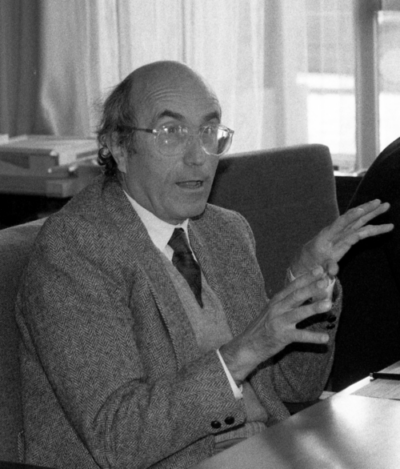
Niklas Luhmann
Niklas Luhmann was a German sociologist, administration expert, and social systems theorist. Born December 8, 1927, in Lüneburg. Died November 6, 1998, in Oerlinghausen. Known for Luhmann's systems theory. Educated at University of Freiburg and Bielefeld University. Awards include Hegel Prize, European Amalfi Prize for Sociology and Social Sciences and honorary doctor of the University of Trier.
Facts
29 facts · 1 confirmed by two sources · 11 cited · 16 from one source · 1 where the sources disagree
What’s different
- Died: we show November 6, 1998 (Sources disagree). Wikipedia says November 11, 1998
Where this comes from
Papalocal keeps its own record. It started from these sources; what each one said is kept here as it was copied, so a change on their side never changes this page by itself. Tap one to read its version.
What Wikidata says · copied November 16, 2026 · revision 2569210966
- Described as
- German sociologist, administration expert, and social systems theorist (1927-1998)
- Other names
- Niklas Luhrmann
- Born
- December 8, 1927 · 7 references
- Died
- November 6, 1998 · 6 references
- Born in
- Lüneburg · 2 references
- Died in
- Oerlinghausen · 2 references
- Buried in
- Lipperreihe
- Citizen of
- Germany · 1 reference
- Occupation
- cyberneticist; sociologist; university teacher · 2 references; lawyer; social scientist · 2 references; jurist · 2 references; philosopher · 1 reference
- Political party
- Social Democratic Party of Germany · 1 reference
- Worked for
- Bielefeld University
- Education
- University of Freiburg; Bielefeld University; Harvard University
- Member of
- Royal Netherlands Academy of Arts and Sciences
- Known for
- Luhmann's systems theory
- Awards
- Hegel Prize (1988) · 1 reference; European Amalfi Prize for Sociology and Social Sciences (1997) · 1 reference; honorary doctor of the University of Trier (1993) · 1 reference; Honorary doctors of Ghent University; Honorary doctor of the University of Bologna; Honorary degree of the University of Macerata
- Field
- sociology; organizational theory; sociology of law
- Wikipedias with a page
- 48
Wikidata item Q57238 (wikidata.org/wiki/Q57238), public domain (CC0). Copied November 16, 2026.
What Wikipedia says · copied November 16, 2026 · revision 1385649936
Niklas Luhmann (; German: [ˈluːman]; December 8, 1927 – November 11, 1998) was a German sociologist, philosopher of social science, and systems theorist.
Niklas Luhmann is one of the most influential German sociologists of the 20th century. His thinking was based on the philosophical tradition and at the same time the reception of a wide variety of concepts from modern science. From this foundation he developed a functionalist-oriented systems theory, which claims to be able to describe all social phenomena in a theoretically consistent language.
Social systems are understood as communication contexts that have autonomy from the actors involved in them. On this basis, three types of social systems can be distinguished: interaction, organization and society.
On his general theory he developed a social theory, which describes modern society as a global society that is characterized by an internal differentiation into various autonomously working functional areas such as politics, law, economics, science, religion and art. According to Luhmann, their operations can not be coordinated centrally.
- Born, in its opening lines
- December 8, 1927
- Died, in its opening lines
- November 11, 1998
From the Wikipedia article “Niklas Luhmann” (en.wikipedia.org/wiki/Niklas_Luhmann), by its contributors, under CC BY-SA 4.0 (creativecommons.org/licenses/by-sa/4.0/). Copied November 16, 2026; not changed.
Confirmed Two sources agree. Cited One source, and it names where it got it. One source One source, without a reference of its own. Sources disagree The sources disagree. We show the best-supported value and keep theirs below.
