
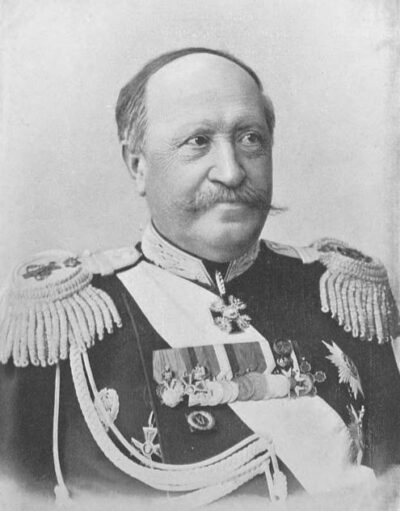
Nikolay Pavlovich Ignatyev
Nikolay Pavlovich Ignatyev was a Russian politician. Born January 17, 1832, in Saint Petersburg. Died June 20, 1908, in Krupoderyntsi. Positions held include Representative of the Russian Empire to China (1859–1861), Minister of Internal Affairs of Russia (1881–1882) and member of the State Council of the Russian Empire. Educated at Page Corps. Awards include Officer of the Legion of Honour, Knight of the Order of St. Alexander Nevsky and Order of Saint Anna, 1st class.
Facts
39 facts · 0 confirmed by two sources · 4 cited · 34 from one source · 1 where the sources disagree
What’s different
- Died: we show June 20, 1908 (Sources disagree). Wikipedia says July 3, 1908
Where this comes from
Papalocal keeps its own record. It started from these sources; what each one said is kept here as it was copied, so a change on their side never changes this page by itself. Tap one to read its version.
What Wikidata says · copied November 16, 2026 · revision 2562769628
- Described as
- Russian politician (1832-1908)
- Other names
- Nicholas Ignatieff, Count Nikolay Pavlovich Ignatyev
- Born
- January 17, 1832 · 2 references; January 17, 1832 · 1 reference
- Died
- June 20, 1908 · 2 references
- Born in
- Saint Petersburg · 1 reference
- Died in
- Krupoderyntsi
- Buried in
- Krupoderyntsi
- Citizen of
- Russian Empire
- Occupation
- diplomat · 1 reference; politician · 1 reference
- Positions held
- Representative of the Russian Empire to China (1859–1861); Minister of Internal Affairs of Russia (1881–1882); member of the State Council of the Russian Empire; Ministry of State Property (1881); list of ambassadors of Russia to Turkey (1864–1877)
- Education
- Page Corps
- Member of
- Hellenic Philological Society of Constantinople (1865–)
- Awards
- Officer of the Legion of Honour; Knight of the Order of St. Alexander Nevsky; Order of Saint Anna, 1st class; Order of Saint Anna, 2nd class; Order of the White Eagle; Order of Saint Stanislaus, 1st class; Order of St. Vladimir, 4th class; Order of St. Vladimir, 3rd class; Order of St. Vladimir, 2nd class; Order of St. Vladimir, 1st class; Order of the Star of Romania; Order of St. Andrew; Order of the Crown; Military Merit Order (Bavaria); Order of the Cross of Takovo
- Spouse
- Yekaterina Ignatyeva
- Children
- Paul Ignatieff; Nikolai Ignatev; Aleksey Ignatyev
- Father
- Pavel Ignatyev
- Mother
- Mariya Ignatyeva
- Siblings
- Aleksei Ignatiev
- Religion
- Eastern Orthodoxy · 1 reference
- Military rank
- General of the Infantry
- Wikipedias with a page
- 29
Wikidata item Q455205 (wikidata.org/wiki/Q455205), public domain (CC0). Copied November 16, 2026.
What Wikipedia says · copied November 16, 2026 · revision 1382881774
Count Nikolay Pavlovich Ignatyev (Russian: Никола́й Па́влович Игна́тьев; 29 January [O.S. 17 January] 1832 – 3 July [O.S. 20 June] 1908) was a Russian Imperial statesman and diplomat who is best known for his policy of aggressive expansionism as the Russian ambassador to China and the Ottoman Empire. He was also the minister of the interior from 1881 to 1882, where he promoted ultraconservative and Slavic-nationalist policies.
In dealing with China, he secured a large slice of Chinese territory by the multi-lateral Treaty of Peking in 1860. As the Russian ambassador to the Ottoman Empire from 1864 to 1877, he worked to stir up pan-Slavic feeling and nationalism against the Ottomans. He encouraged his government to declare war on Turkey in 1877, and after the decisive Russian victory, he negotiated the Treaty of San Stefano in 1878. It heralded greatly strengthened Russian influence in the Balkans. However, Britain and Austria-Hungary intervened and forced the retraction of the treaty.
- Born, in its opening lines
- January 29, 1832
- Died, in its opening lines
- July 3, 1908
From the Wikipedia article “Nikolay Pavlovich Ignatyev” (en.wikipedia.org/wiki/Nikolay_Pavlovich_Ignatyev), by its contributors, under CC BY-SA 4.0 (creativecommons.org/licenses/by-sa/4.0/). Copied November 16, 2026; not changed.
Confirmed Two sources agree. Cited One source, and it names where it got it. One source One source, without a reference of its own. Sources disagree The sources disagree. We show the best-supported value and keep theirs below.
