
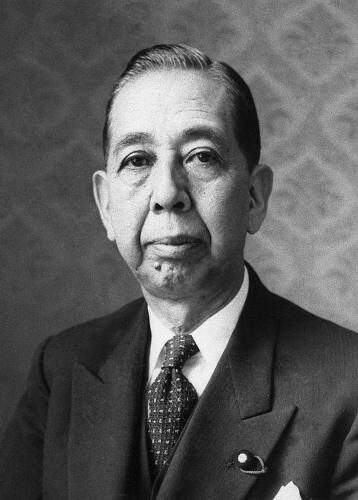
Nobusuke Kishi
Nobusuke Kishi was the 56th and 57th Prime Minister of Japan. Born November 13, 1896, in Yamaguchi. Died August 7, 1987, in Tokyo Medical University Hospital. Positions held include member of the House of Representatives of Japan (1953–1979), Prime Minister of Japan (1957–1960) and Director General of the Defence Agency (1957). Educated at Tokyo Imperial University and First Higher School. Awards include Order of the Rising Sun with Paulownia Flowers, 1st class, Grand Cordon of the Supreme Order of the Chrysanthemum and United Nations Peace Medal.
Facts
45 facts · 2 confirmed by two sources · 6 cited · 36 from one source · 1 where the sources disagree
What’s different
- Buried in: we show Tabuse (Sources disagree). Wikidata also lists Fuji Cemetery
Where this comes from
Papalocal keeps its own record. It started from these sources; what each one said is kept here as it was copied, so a change on their side never changes this page by itself. Tap one to read its version.
What Wikidata says · copied November 16, 2026 · revision 2567619925
- Described as
- 56th and 57th Prime Minister of Japan (1896–1987)
- Other names
- Apparition of Shōwa, Kisi Nobusuke, Kishi Nobusuke, Nobusuke Kiishi, Monster of the Shōwa era, Kishi Nosobuke
- Born
- November 13, 1896 · 5 references
- Died
- August 7, 1987 · 5 references
- Born in
- Yamaguchi
- Died in
- Tokyo Medical University Hospital
- Buried in
- Tabuse; Fuji Cemetery
- Name at birth
- 佐藤信介
- Citizen of
- Japan; Empire of Japan (–1947)
- Occupation
- politician · 1 reference; diplomat; spy · 2 references; bureaucrat; beamter · 1 reference; jurist · 1 reference; head of government · 1 reference
- Positions held
- member of the House of Representatives of Japan (1953–1979); Prime Minister of Japan (1957–1960); Director General of the Defence Agency (1957) · 1 reference; Minister for Foreign Affairs (1956–1957) · 1 reference; Minister without portfolio (1943–1944) · 1 reference
- Political party
- Liberal Democratic Party
- Worked for
- Ministry of Commerce and Industry
- Education
- Tokyo Imperial University; First Higher School; Yamaguchi Prefectural Yamaguchi High School
- Awards
- Order of the Rising Sun with Paulownia Flowers, 1st class; Grand Cordon of the Supreme Order of the Chrysanthemum; United Nations Peace Medal (1979); Great Cross with Star and Sash of the Order of Merit of the Federal Republic of Germany; Grand Cross 1st class of the Order of Merit of the Federal Republic of Germany; Order of the Sacred Treasure, 5th Class · 1 reference; Military Medal of Honor · 1 reference; Order of the Aztec Eagle · 1 reference; Order of Propitious Clouds · 1 reference; Grand Cross of the Order of the Southern Cross
- Spouse
- Yoshiko Kishi (1919–1980) · 1 reference
- Children
- Yōko Kishi; Nobukazu Kishi
- Father
- Hidesuke Satō
- Mother
- Shigeyo Satō
- Siblings
- Eisaku Satō; Ichirō Satō
- Lived in
- Gotemba Higashiyama Museum Park; Nanpeidaichō (1966) · 1 reference; Gotemba (1978) · 2 references
- Wikipedias with a page
- 53
Wikidata item Q315572 (wikidata.org/wiki/Q315572), public domain (CC0). Copied November 16, 2026.
What Wikipedia says · copied November 16, 2026 · revision 1383794070
Nobusuke Kishi (岸 信介, Kishi Nobusuke; 13 November 1896 – 7 August 1987) was a Japanese bureaucrat and politician who served as prime minister of Japan from 1957 to 1960. As a prominent reform bureaucrat, he directed the exploitative economic management of the Japanese puppet state of Manchukuo in China in the 1930s, and later served in the wartime cabinet. Following World War II, he was imprisoned as a suspected war criminal. After his release, he helped found the Liberal Democratic Party. As Prime Minister, Kishi forcefully revised the U.S.–Japan Security Treaty, but was compelled to resign following the massive Anpo protests the unpopular treaty had provoked.
For his behind-the-scenes role in numerous important events, Kishi retrospectively received the nickname "Yōkai of the Shōwa era" (昭和の妖怪; Shōwa no yōkai). Kishi was the founder of the Satō–Kishi–Abe dynasty in Japanese politics, with his younger brother Eisaku Satō and his grandson Shinzo Abe both later serving as prime ministers of Japan.
Born in Yamaguchi Prefecture, Kishi graduated from Tokyo Imperial University in 1920. He rose through the ranks at the Ministry of Commerce and Industry, and during the 1930s led the industrial development of Manchukuo, where he exploited Chinese slave labor. Kishi served in the wartime cabinet of Hideki Tōjō as minister of commerce and industry from 1941 to 1943 and vice minister of munitions from 1943 to 1944. At the end of the war in 1945, Kishi was imprisoned as a suspected Class A war criminal, but U.S. occupation authorities did not charge, try, or convict him, and released him in 1948 during the Reverse Course. At the end of the occupation in 1952, Kishi was de-purged, enabling his election to the National Diet in 1953. With overt and covert U.S. support, he consolidated Japanese conservatives against perceived threats from the Japan Socialist Party, and in 1955 was instrumental in forming the Liberal Democratic Party (LDP). Kishi was thus key in establishing the "1955 System" under which the LDP remains Japan's dominant party.
Kishi served as the first secretary-general of the LDP and as foreign minister under Prime Minister Tanzan Ishibashi before succeeding Ishibashi in 1957. During his tenure, Kishi had the strong backing of business, and promoted domestic industry and commercial interests in Southeast Asia. In 1958, he introduced a bill which would have granted police vastly expanded powers, but withdrew it under heavy opposition. Kishi's mishandling of the 1960 revision of the U.S.–Japan Security Treaty led to the Anpo protests, the largest protests in Japan's modern history, and he resigned in disgrace. He remained a member of the House of Representatives until 1979 as a staunch anti-communist and conservative with links to right-wing groups.
- Born, in its opening lines
- November 13, 1896
- Died, in its opening lines
- August 7, 1987
From the Wikipedia article “Nobusuke Kishi” (en.wikipedia.org/wiki/Nobusuke_Kishi), by its contributors, under CC BY-SA 4.0 (creativecommons.org/licenses/by-sa/4.0/). Copied November 16, 2026; not changed.
Confirmed Two sources agree. Cited One source, and it names where it got it. One source One source, without a reference of its own. Sources disagree The sources disagree. We show the best-supported value and keep theirs below.
