
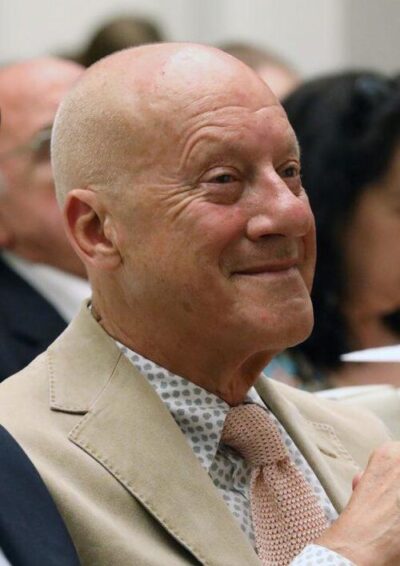
Norman Foster
Norman Foster is a British architect. Born June 1, 1935, in Stockport. Positions held include member of the House of Lords (1999–2010). Known for Commerzbank Tower, Gerling Ring-Karree and Canary Wharf. Educated at University of Manchester and Yale School of Architecture. Awards include Pour le Mérite for Sciences and Arts order, Order of Merit of North Rhine-Westphalia and Order of Merit.
Facts
52 facts · 1 confirmed by two sources · 15 cited · 36 from one source
Where this comes from
Papalocal keeps its own record. It started from these sources; what each one said is kept here as it was copied, so a change on their side never changes this page by itself. Tap one to read its version.
What Wikidata says · copied November 16, 2026 · revision 2569116902
- Described as
- British architect (born 1935)
- Other names
- Norman Foster, Baron Foster of Thames Bank, Norman Robert Foster, Lord Foster of Thames Bank, Sir Norman Foster, Nōman Fosutā, Norman Robert Foster, Baron Foster of Thames Bank, Baron Foster of Thames Bank Norman Foster
- Born
- June 1, 1935 · 9 references
- Born in
- Stockport
- Name at birth
- Norman Robert Foster
- Citizen of
- United Kingdom · 3 references
- Occupation
- architect · 7 references; politician · 1 reference; designer · 2 references; film actor · 1 reference
- Positions held
- member of the House of Lords (1999–2010)
- Education
- University of Manchester (1956–1961); Yale School of Architecture (1961–1962); Burnage Academy for Boys; Yale University · 1 reference
- Member of
- European Academy of Sciences and Arts; Academy of Arts, Berlin; Royal Academy of Arts; Royal Swedish Academy of Fine Arts; American Academy of Arts and Sciences; American Academy of Arts and Letters; Académie d'architecture · 1 reference; Académie des beaux-arts
- Known for
- Commerzbank Tower; Gerling Ring-Karree; Canary Wharf; Carré d'art; Old City Hall; 2 World Trade Center; Willis Building; The Glasshouse; New Holland Island; Palace of Peace and Reconciliation
- Awards
- Pour le Mérite for Sciences and Arts order (2002) · 1 reference; Order of Merit of North Rhine-Westphalia (1995) · 1 reference; Order of Merit; Pritzker Architecture Prize (1999) · 1 reference; Knight Commander's Cross of the Order of Merit of the Federal Republic of Germany (1999) · 1 reference; Prince Philip Designers Prize (2004) · 1 reference; Princess of Asturias Award for the Arts (2015); Praemium Imperiale (2002) · 1 reference; Stirling Prize (1998); AIA Gold Medal (1994); Royal Gold Medal (1983) · 1 reference; Berliner Kunstpreis (1989); Fellow of the Royal Academy of Engineering; honorary doctor of the University of Hong Kong (2003) · 1 reference; European Union Prize for Contemporary Architecture (1975)
- Field
- architecture
- Spouse
- Wendy Cheesman (1964–1989) · 1 reference; Elena Ochoa (1996–) · 1 reference
- Father
- Robert Foster
- Mother
- Lillian Smith · 1 reference
- Website
- http://www.normanfosterfoundation.org/
- Wikipedias with a page
- 68
Wikidata item Q104898 (wikidata.org/wiki/Q104898), public domain (CC0). Copied November 16, 2026.
What Wikipedia says · copied November 16, 2026 · revision 1384603728
Norman Robert Foster, Baron Foster of Thames Bank (born 1 June 1935), is an English architect and urbanist. He is widely recognised as a seminal pioneer of high-tech architecture and a defining figure in British modernism. His structural steel-and-glass designs have fundamentally shaped late 20th- and early 21st-century urban landscapes worldwide.
Born into a working class family in Stockport, Foster studied architecture at the University of Manchester before earning a master's degree from the Yale School of Architecture. Upon returning to England, he co-founded the short-lived but highly influential architectural collective Team 4 alongside Richard Rogers. In 1967, he established Foster Associates—later rebranded as Foster + Partners—which has grown into the largest and most commercially successful architectural practice in the UK.
Foster achieved critical acclaim for early industrial and corporate structures, most notably the Willis Faber and Dumas Headquarters in Ipswich and the Sainsbury Centre for Visual Arts in Norwich. These projects pioneered open-plan internal structural grids and innovative curtain walling. His international breakthrough came in 1985 with the HSBC Building in Hong Kong, a revolutionary high-tech tower featuring a suspended structural steel framework. His subsequent portfolio includes some of the world's most recognisable post-modern landmarks, including the reconstructed glass Reichstag dome in Berlin, 30 St Mary Axe ("The Gherkin") and the Queen Elizabeth II Great Court of the British Museum in London, and the solar-powered Apple Park corporate campus in Cupertino, California.
In his later career, his focus has shifted significantly toward green urban density and urban planning through the Norman Foster Foundation and the Norman Foster Institute. He has received nearly every major accolade in the discipline, winning the RIBA Royal Gold Medal in 1983, the AIA Gold Medal in 1994, and the Pritzker Architecture Prize in 1999. He was knighted in 1990 and created a life peer in 1999.
His current works are required within the Design and Technology AQA GCSE syllabus
- Born, in its opening lines
- June 1, 1935
From the Wikipedia article “Norman Foster” (en.wikipedia.org/wiki/Norman_Foster), by its contributors, under CC BY-SA 4.0 (creativecommons.org/licenses/by-sa/4.0/). Copied November 16, 2026; not changed.
Confirmed Two sources agree. Cited One source, and it names where it got it. One source One source, without a reference of its own. Sources disagree The sources disagree. We show the best-supported value and keep theirs below.
