
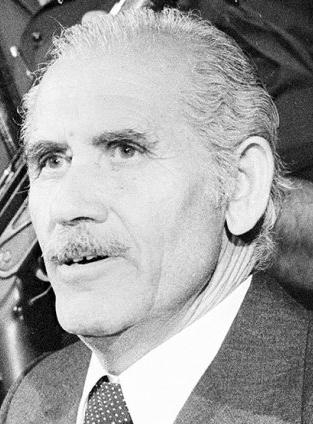
Nur Muhammad Taraki
Nur Muhammad Taraki was the 1st General Secretary of the People's Democratic Party of Afghanistan. Born July 15, 1917, in Nawa District. Died October 9, 1979, in Kabul. Positions held include Chairman of the Revolutionary Council of Afghanistan (1978–1979). Educated at Lomonosov Moscow State University and University of Oxford.
Facts
16 facts · 1 confirmed by two sources · 0 cited · 14 from one source · 1 where the sources disagree
What’s different
- Born: we show July 15, 1917 (Sources disagree). Wikipedia says July 14, 1917
Where this comes from
Papalocal keeps its own record. It started from these sources; what each one said is kept here as it was copied, so a change on their side never changes this page by itself. Tap one to read its version.
What Wikidata says · copied November 16, 2026 · revision 2565327714
- Described as
- 1st General Secretary of the People's Democratic Party of Afghanistan
- Other names
- Taraki
- Born
- July 15, 1917 · 2 references
- Died
- October 9, 1979 · 1 reference
- Born in
- Nawa District
- Died in
- Kabul
- Buried in
- Kabul · 1 reference
- Cause of death
- asphyxia
- Citizen of
- Afghanistan
- Occupation
- politician; poet; writer; journalist
- Positions held
- Chairman of the Revolutionary Council of Afghanistan (1978–1979)
- Political party
- People’s Democratic Party of Afghanistan
- Education
- Lomonosov Moscow State University; University of Oxford
- Siblings
- Jan Mohammad Taraki
- Wikipedias with a page
- 56
Wikidata item Q299559 (wikidata.org/wiki/Q299559), public domain (CC0). Copied November 16, 2026.
What Wikipedia says · copied November 16, 2026 · revision 1385557588
Nur Muhammad Taraki (Pashto: نور محمد ترکی; 14 July 1917 – 9 October 1979) was an Afghan communist politician, revolutionary, journalist and writer. He was a founding member of the People's Democratic Party of Afghanistan (PDPA) who served as its General Secretary from 1965 to 1979 and Chairman of the Revolutionary Council from 1978 to 1979.
Taraki was born in Nawa, Ghazni Province. He received his primary and secondary education in Pishin district in Balochistan and graduated from Kabul University, after which he started his political career as a journalist. From the 1940s onward Taraki also wrote novels and short stories in the socialist realism style. Forming the PDPA at his residence in Kabul along with Babrak Karmal, he was elected as the party's General Secretary at its first congress. He ran as a candidate in the 1965 Afghan parliamentary election but failed to win a seat. In 1966 he published the Khalq, a party newspaper advocating for class struggle, but the government closed it down shortly afterward. In 1978 he, Hafizullah Amin and Babrak Karmal initiated the Saur Revolution and established the Democratic Republic of Afghanistan.
Taraki's leadership was short-lived and marked by controversies. The government was divided between two PDPA factions: the Khalqists (led by Taraki), the majority, and the Parchamites. Taraki along with his "protégé" Amin started a purge of the government and party that led to several high-ranking Parchamite members being sent into de facto exile by being assigned to serve overseas as ambassadors, and later started jailing domestic Parchamites. His regime locked up dissidents and oversaw massacres of villagers, citing the necessity of Red Terror by the Bolsheviks in Soviet Russia, that opponents of the Saur Revolution had to be eliminated. These factors, among others, triggered a popular backlash that led to a full-blown rebellion. Despite repeated attempts, Taraki was unable to persuade the Soviet Union to intervene in support of the restoration of civil order. Amin initiated most of these policies behind the scenes.
Taraki's reign was marked by a cult of personality centered around him that Amin had cultivated. The state press and subsequent propaganda started to refer to him as the "Great Leader" and "Great Teacher", and his portrait became a common sight throughout the country. His relationship with Amin turned sour during his rule, ultimately resulting in Taraki's overthrow on 14 September 1979 and subsequent murder on 8 October, on Amin's orders, with Kabul press reporting that he died of illness. His death was a factor that led to the Soviet intervention in December 1979.
- Born, in its opening lines
- July 14, 1917
- Died, in its opening lines
- October 9, 1979
From the Wikipedia article “Nur Muhammad Taraki” (en.wikipedia.org/wiki/Nur_Muhammad_Taraki), by its contributors, under CC BY-SA 4.0 (creativecommons.org/licenses/by-sa/4.0/). Copied November 16, 2026; not changed.
Confirmed Two sources agree. Cited One source, and it names where it got it. One source One source, without a reference of its own. Sources disagree The sources disagree. We show the best-supported value and keep theirs below.
