
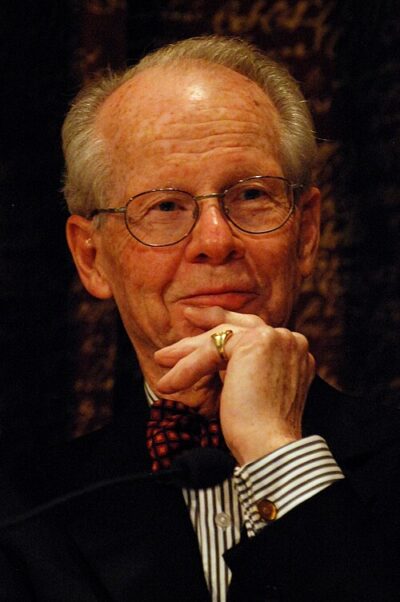
Oliver E. Williamson
Oliver E. Williamson was an American economist. Born September 27, 1932, in Superior. Died May 21, 2020, in Berkeley. Known for Theory of transaction costs and bounded rationality. Educated at MIT Sloan School of Management and Stanford Graduate School of Business. Awards include Guggenheim Fellowship, H. C. Recktenwald Prize in Economics and Prize in Economic Sciences in Memory of Alfred Nobel.
Facts
37 facts · 2 confirmed by two sources · 17 cited · 18 from one source
Where this comes from
Papalocal keeps its own record. It started from these sources; what each one said is kept here as it was copied, so a change on their side never changes this page by itself. Tap one to read its version.
What Wikidata says · copied November 13, 2026 · revision 2563199099
- Described as
- American economist (1932–2020)
- Other names
- Oliver Williamson, Oliver Eaton Williamson, Williamson, Oliver E., O. Williamson, OE Williamson
- Born
- September 27, 1932 · 4 references
- Died
- May 21, 2020 · 1 reference
- Born in
- Superior · 1 reference
- Died in
- Berkeley · 1 reference
- Buried in
- Greenwood Cemetery · 1 reference
- Cause of death
- pneumonia · 1 reference
- Citizen of
- United States · 1 reference
- Occupation
- economist; university teacher
- Worked for
- Yale University; University of California, Berkeley · 1 reference; University of Pennsylvania · 1 reference
- Education
- MIT Sloan School of Management; Stanford Graduate School of Business; Carnegie Mellon University · 1 reference; Tepper School of Business · 1 reference; Superior High School · 1 reference
- Member of
- National Academy of Sciences; American Academy of Arts and Sciences; Econometric Society (1976–) · 1 reference
- Known for
- Theory of transaction costs; bounded rationality
- Awards
- Guggenheim Fellowship (1977) · 1 reference; H. C. Recktenwald Prize in Economics (2004); Prize in Economic Sciences in Memory of Alfred Nobel (2009) · 1 reference; Global Economy Prize (2016) · 2 references; John von Neumann Award (1999) · 1 reference; Distinguished Fellow of the American Economic Association; Fellow of the Econometric Society (1976) · 1 reference; honorary doctor of the University of Valencia (2004) · 1 reference; Clarivate Citation Laureates (2006) · 1 reference; honorary doctorate from the University of Nice-Sophia Antipolis (2005) · 1 reference; honorary doctor of Paris Dauphine University (2012) · 1 reference
- Field
- microeconomics · 1 reference; contract law · 1 reference; transactional analysis · 1 reference
- Website
- http://groups.haas.berkeley.edu/bpp/oew/
- Wikipedias with a page
- 59
Wikidata item Q232062 (wikidata.org/wiki/Q232062), public domain (CC0). Copied November 13, 2026.
What Wikipedia says · copied November 13, 2026 · revision 1379420665
Oliver Eaton Williamson (September 27, 1932 – May 21, 2020) was an American economist, a professor at the University of California, Berkeley, and recipient of the 2009 Nobel Memorial Prize in Economic Sciences, which he shared with Elinor Ostrom.
His contributions to transaction cost economics and the theory of the firm have been influential in the social sciences, law and economics. Williamson described his work as "a blend of soft social science and abstract economic theory".
- Born, in its opening lines
- September 27, 1932
- Died, in its opening lines
- May 21, 2020
From the Wikipedia article “Oliver E. Williamson” (en.wikipedia.org/wiki/Oliver_E._Williamson), by its contributors, under CC BY-SA 4.0 (creativecommons.org/licenses/by-sa/4.0/). Copied November 13, 2026; not changed.
Confirmed Two sources agree. Cited One source, and it names where it got it. One source One source, without a reference of its own. Sources disagree The sources disagree. We show the best-supported value and keep theirs below.
