
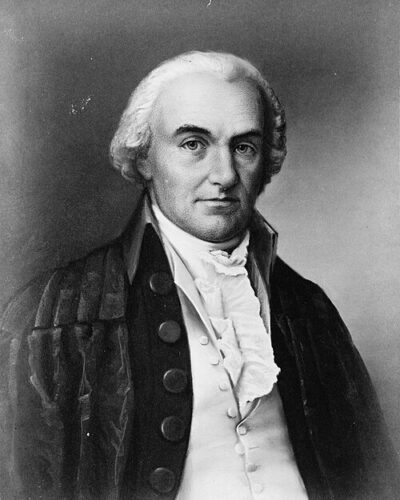
Oliver Ellsworth
Oliver Ellsworth was a chief justice of the United States from 1796 to 1800. Born April 29, 1745, in Windsor. Died November 26, 1807, in Windsor. Positions held include Chief Justice of the United States (1796–1800), United States senator (1789–1796) and Delegate to the United States Constitutional Convention (1787). Educated at Yale College and Princeton University. Awards include Fellow of the American Academy of Arts and Sciences.
Facts
27 facts · 2 confirmed by two sources · 10 cited · 15 from one source
Where this comes from
Papalocal keeps its own record. It started from these sources; what each one said is kept here as it was copied, so a change on their side never changes this page by itself. Tap one to read its version.
What Wikidata says · copied November 15, 2026 · revision 2558175714
- Described as
- chief justice of the United States from 1796 to 1800
- Other names
- Justice Ellsworth
- Born
- April 29, 1745 · 2 references
- Died
- November 26, 1807 · 3 references
- Born in
- Windsor
- Died in
- Windsor
- Buried in
- Palisado Cemetery · 1 reference
- Citizen of
- United States
- Occupation
- politician · 1 reference; judge; lawyer; jurist · 1 reference
- Positions held
- Chief Justice of the United States (1796–1800); United States senator (1789–1796) · 1 reference; Delegate to the United States Constitutional Convention (1787) · 1 reference
- Political party
- Federalist Party
- Education
- Yale College; Princeton University
- Member of
- American Academy of Arts and Sciences; Phi Beta Kappa Society
- Awards
- Fellow of the American Academy of Arts and Sciences
- Spouse
- Abigail Wolcott Ellsworth · 1 reference
- Children
- Henry Leavitt Ellsworth · 1 reference; William W. Ellsworth · 1 reference; Oliver Ellsworth; Martin Ellsworth
- Father
- David Ellsworth · 1 reference
- Mother
- Jemima Leavitt · 1 reference
- Religion
- Congregational churches
- Wikipedias with a page
- 29
Wikidata item Q515858 (wikidata.org/wiki/Q515858), public domain (CC0). Copied November 15, 2026.
What Wikipedia says · copied November 15, 2026 · revision 1383937402
Oliver Ellsworth (April 29, 1745 – November 26, 1807) was a Founding Father of the United States, attorney, jurist, politician, and diplomat. Ellsworth was a framer of the United States Constitution, United States senator from Connecticut, and the third chief justice of the United States. Additionally, he received 11 electoral votes in the 1796 presidential election.
Born in Windsor, Connecticut, Ellsworth attended the College of New Jersey where he helped found the American Whig–Cliosophic Society. In 1777, he became the state attorney for Hartford County, Connecticut, and was selected as a delegate to the Continental Congress, serving during the remainder of the American Revolutionary War. He served as a state judge during the 1780s and was selected as a delegate to the 1787 Philadelphia Convention, which produced the United States Constitution. While at the convention, Ellsworth played a role in fashioning the Connecticut Compromise between the more populous states and the less populous states. He also served on the Committee of Detail, which prepared the first draft of the Constitution, but he left the convention and did not sign the document.
His influence helped ensure that Connecticut ratified the Constitution, and he was elected as one of Connecticut's inaugural pair of senators, serving from 1789 to 1796. He was the chief author of the Judiciary Act of 1789, which shaped the federal judiciary of the United States and established the Supreme Court's power to overturn state supreme court decisions that were contrary to the United States Constitution. Ellsworth served as a key Senate ally to Alexander Hamilton and aligned with the Federalist Party. He led the Senate passage of Hamiltonian proposals such as the Funding Act of 1790 and the Bank Bill of 1791. He also advocated in favor of the United States Bill of Rights and the Jay Treaty.
In 1796, after the Senate rejected the nomination of John Rutledge to serve as Chief Justice, President George Washington nominated Ellsworth to the position. Ellsworth was near-unanimously confirmed by the Senate, and served until 1800, when he resigned due to poor health. Few cases came before the Ellsworth Court, and he is chiefly remembered for his discouragement of the previous practice of seriatim opinion writing. He simultaneously served as an envoy to France from 1799 to 1800, signing the Convention of 1800 to settle the hostilities of the Quasi-War. He was succeeded as chief justice by John Marshall. He subsequently served on the Connecticut Governor's Council until his death in 1807.
- Born, in its opening lines
- April 29, 1745
- Died, in its opening lines
- November 26, 1807
From the Wikipedia article “Oliver Ellsworth” (en.wikipedia.org/wiki/Oliver_Ellsworth), by its contributors, under CC BY-SA 4.0 (creativecommons.org/licenses/by-sa/4.0/). Copied November 15, 2026; not changed.
Confirmed Two sources agree. Cited One source, and it names where it got it. One source One source, without a reference of its own. Sources disagree The sources disagree. We show the best-supported value and keep theirs below.
