
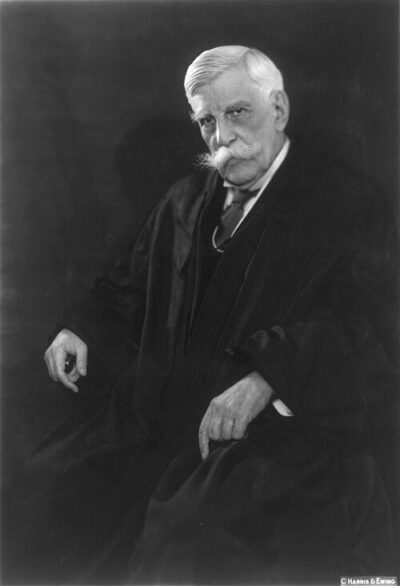
Oliver Wendell Holmes
Oliver Wendell Holmes was an American jurist (1841–1935); US Supreme Court justice from 1902 to 1932. Born March 8, 1841, in Boston. Died March 6, 1935, in Washington, D.C.. Positions held include Associate Justice of the Supreme Court of the United States (1902–1932). Known for The Path of the Law. Educated at Harvard Law School and Harvard College.
Facts
29 facts · 2 confirmed by two sources · 7 cited · 20 from one source
Where this comes from
Papalocal keeps its own record. It started from these sources; what each one said is kept here as it was copied, so a change on their side never changes this page by itself. Tap one to read its version.
What Wikidata says · copied November 13, 2026 · revision 2568752756
- Described as
- American jurist (1841–1935); US Supreme Court justice from 1902 to 1932
- Other names
- Oliver Wendell Holmes Jr., Oliver Wendell Holmes Jr, Holmes, Oliver Wendell, Jr., Oliver Wendell, Jr. Holmes, Oliver Wendell Holmes, Jr, Oliver Wendell Holmes, jr., Oliver Wendell Holmes, Jr., Oliver W. Holmes Jr., Oliver Holmes Jr., Oliver Holmes, Oliver W. Holmes
- Born
- March 8, 1841 · 8 references
- Died
- March 6, 1935 · 8 references
- Born in
- Boston · 3 references
- Died in
- Washington, D.C. · 3 references
- Buried in
- Arlington National Cemetery
- Cause of death
- pneumonia
- Citizen of
- United States
- Occupation
- jurist · 1 reference; judge · 1 reference; lawyer; university teacher · 1 reference; politician; philosopher · 1 reference; editor · 1 reference; author · 1 reference
- Positions held
- Associate Justice of the Supreme Court of the United States (1902–1932)
- Political party
- Republican Party
- Worked for
- Harvard University
- Education
- Harvard Law School (1864–); Harvard College
- Member of
- American Academy of Arts and Sciences; Phi Beta Kappa Society; bar association (1866–)
- Known for
- The Path of the Law
- Spouse
- Fanny Bowditch Dixwell Holmes (1872–1929)
- Father
- Oliver Wendell Holmes
- Mother
- Amelia Lee Jackson
- Lived in
- London (1866–1872); Mattapoisett
- Wikipedias with a page
- 44
Wikidata item Q360574 (wikidata.org/wiki/Q360574), public domain (CC0). Copied November 13, 2026.
What Wikipedia says · copied November 13, 2026 · revision 1380698789
Oliver Wendell Holmes Jr. (March 8, 1841 – March 6, 1935) was an American jurist who served as an associate justice of the U.S. Supreme Court from 1902 to 1932. Holmes is one of the most widely cited and influential Supreme Court justices in American history, noted for his long tenure on the Court and for his pithy opinions – particularly those on civil liberties and American constitutional democracy – and deference to the decisions of elected legislatures. Holmes retired from the Court at the age of 90, an unbeaten record for oldest justice on the Supreme Court. He previously served the Union as a brevet colonel in the American Civil War (in which he was wounded three times), as an associate justice and chief justice of the Massachusetts Supreme Judicial Court, and as Weld Professor of Law at his alma mater, Harvard Law School. His positions, distinctive personality, and writing style made him a popular figure, especially with American progressives.
During his tenure on the U.S. Supreme Court, to which he was appointed by President Theodore Roosevelt in 1902, he supported the constitutionality of state economic regulation and came to advocate broad freedom of speech under the First Amendment, after, in Schenck v. United States (1919), having upheld for a unanimous court criminal sanctions against draft protestors with the memorable maxim that "free speech would not protect a man in falsely shouting fire in a theatre and causing a panic" and formulating the groundbreaking "clear and present danger" test. Later that same year, in his famous dissent in Abrams v. United States (1919), he wrote that "the best test of truth is the power of the thought to get itself accepted in the competition of the market. ... That, at any rate, is the theory of our Constitution. It is an experiment, as all life is an experiment." He added that "we should be eternally vigilant against attempts to check the expression of opinions that we loathe and believe to be fraught with death...."
The University of Chicago Law Review has identified Holmes as the sixth-most-cited American legal scholar of all time. Holmes was a legal realist, as summed up in his maxim, "The life of the law has not been logic: it has been experience". He was also a moral skeptic and an opponent of the doctrine of natural law. His jurisprudence and academic writing influenced much subsequent American legal thinking, including the judicial consensus upholding New Deal regulatory law, "sociological jurisprudence in the early twentieth century, and ... much of Legal Realism a generation later".
- Born, in its opening lines
- March 8, 1841
- Died, in its opening lines
- March 6, 1935
From the Wikipedia article “Oliver Wendell Holmes Jr.” (en.wikipedia.org/wiki/Oliver_Wendell_Holmes_Jr.), by its contributors, under CC BY-SA 4.0 (creativecommons.org/licenses/by-sa/4.0/). Copied November 13, 2026; not changed.
Confirmed Two sources agree. Cited One source, and it names where it got it. One source One source, without a reference of its own. Sources disagree The sources disagree. We show the best-supported value and keep theirs below.
