
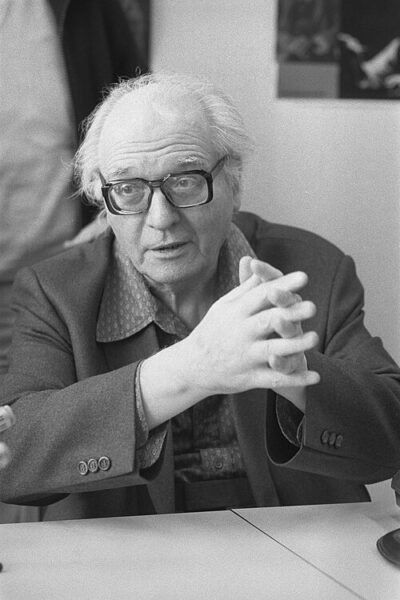
Olivier Messiaen
Olivier Messiaen was a French composer, organist and ornithologist. Born December 10, 1908, in Avignon. Died April 27, 1992, in Clichy. Known for Saint François d'Assise, Éclairs sur l'au-delà... and Thème et variations. Educated at Conservatoire de Paris. Awards include Grand Cross of the Legion of Honour, Commander's Cross of the Order of Merit of the Federal Republic of Germany and Commander of the Order of the Crown.
Facts
61 facts · 2 confirmed by two sources · 14 cited · 45 from one source
Where this comes from
Papalocal keeps its own record. It started from these sources; what each one said is kept here as it was copied, so a change on their side never changes this page by itself. Tap one to read its version.
What Wikidata says · copied November 16, 2026 · revision 2568283627
- Described as
- French composer, organist and ornithologist (1908–1992)
- Other names
- Oliver Messiaen, Olivier Eugène Charles Prosper Messiaen, Messiaen, Olivier Eugène Charles Prosper
- Born
- December 10, 1908 · 15 references
- Died
- April 27, 1992 · 9 references
- Born in
- Avignon · 1 reference
- Died in
- Clichy
- Buried in
- Saint-Théoffrey
- Name at birth
- Olivier Eugène Charles Prosper Messiaen · 1 reference
- Citizen of
- France
- Occupation
- composer · 1 reference; organist · 2 references; ornithologist · 1 reference; music educator; musicologist; music theorist; pianist; university teacher
- Worked for
- Conservatoire de Paris (1941–); École Normale de Musique de Paris Alfred Cortot (1934–1939); Schola Cantorum de Paris
- Education
- Conservatoire de Paris (1919–)
- Member of
- Academy of Arts of the GDR; Jeune France; Royal Academy of Science, Letters and Fine Arts of Belgium; American Academy of Arts and Sciences; Bavarian Academy of Fine Arts; American Academy of Arts and Letters; Académie des beaux-arts; Consilium ad exsequendam Constitutionem de Sacra Liturgia
- Genre
- opera; symphony
- Instrument
- organ
- Record label
- Deutsche Grammophon; Erato Records; Decca; EMI Classics
- Known for
- Saint François d'Assise; Éclairs sur l'au-delà...; Thème et variations; Quatuor pour la fin du temps; Trois Petites Liturgies de la Présence Divine; Quatre Études de rythme
- Awards
- Grand Cross of the Legion of Honour (1986); Commander's Cross of the Order of Merit of the Federal Republic of Germany; Commander of the Order of the Crown (1990); Bach Prize of the Free and Hanseatic City of Hamburg (1979); Erasmus Prize (1971) · 1 reference; Léonie Sonning Music Prize (1977); Royal Philharmonic Society Gold Medal (1975) · 2 references; Berliner Kunstpreis (1984); Wihuri Sibelius Prize (1971); Kyoto Prize in Arts and Philosophy (1985) · 1 reference; Ernst von Siemens Music Prize (1975) · 1 reference; honorary doctor of the University of Sydney; Commandeur des Arts et des Lettres (1980) · 1 reference; Honorary Member of the International Society for Contemporary Music; Royal Philharmonic Society Award (Large-Scale Composition) (1990) · 1 reference
- Spouse
- Claire Delbos (1932–1959) · 1 reference; Yvonne Loriod (1961–1992) · 1 reference
- Children
- Pascal Messiaen
- Father
- Pierre Messiaen
- Mother
- Cécile Sauvage · 1 reference
- Siblings
- Alain Messiaen · 1 reference
- Wikipedias with a page
- 66
Wikidata item Q151593 (wikidata.org/wiki/Q151593), public domain (CC0). Copied November 16, 2026.
What Wikipedia says · copied November 16, 2026 · revision 1385777468
Olivier Eugène Prosper Charles Messiaen (UK: , US: ; French: [ɔlivje øʒɛn pʁɔspɛʁ ʃaʁl mɛsjɑ̃]; 10 December 1908 – 27 April 1992) was a French composer, organist, and ornithologist. One of the major composers of the 20th century, he was also an outstanding teacher of composition and musical analysis.
Messiaen entered the Conservatoire de Paris at age 11 and studied with Paul Dukas, Maurice Emmanuel, Charles-Marie Widor and Marcel Dupré, among others. He was appointed organist at the Église de la Sainte-Trinité, Paris, in 1931, a post he held for 61 years, until his death. He taught at the Schola Cantorum de Paris during the 1930s. After the fall of France in 1940, Messiaen was interned for nine months in the German prisoner of war camp Stalag VIII-A, where he composed his Quatuor pour la fin du temps (Quartet for the End of Time) for the four instruments available in the prison—piano, violin, cello and clarinet. The piece was first performed by Messiaen and fellow prisoners for an audience of inmates and prison guards. Soon after his release in 1941, Messiaen was appointed professor of harmony at the Paris Conservatoire. In 1966, he was appointed professor of composition there, and he held both positions until retiring in 1978. His many distinguished pupils included Iannis Xenakis, Mikis Theodorakis, George Benjamin, Alexander Goehr, Pierre Boulez, Jacques Hétu, Gérard Grisey, Tristan Murail, Karlheinz Stockhausen, György Kurtág, and Yvonne Loriod, who became his second wife.
Messiaen perceived colours when he heard certain musical chords (a phenomenon known as chromaesthesia); according to him, combinations of these colours were important in his compositional process. He travelled widely and wrote works inspired by diverse influences, including Japanese music, the landscape of Bryce Canyon in Utah, and the life of St. Francis of Assisi. His style absorbed many global musical influences, such as Indonesian gamelan (tuned percussion often features prominently in his orchestral works). He found birdsong fascinating, notating bird songs worldwide and incorporating birdsong transcriptions into his music.
Messiaen's music is rhythmically complex. Harmonically and melodically, he employed a system he called modes of limited transposition, which he abstracted from the systems of material his early compositions and improvisations generated. He wrote music for chamber ensembles and orchestra, voice, solo organ, and piano, and experimented with the use of novel electronic instruments developed in Europe during his lifetime. For a short period he experimented with the parametrisation associated with "total serialism", in which field he is often cited as an innovator. His innovative use of colour, his conception of the relationship between time and music, and his use of birdsong are among the features that make Messiaen's music distinctive.
- Born, in its opening lines
- December 10, 1908
- Died, in its opening lines
- April 27, 1992
From the Wikipedia article “Olivier Messiaen” (en.wikipedia.org/wiki/Olivier_Messiaen), by its contributors, under CC BY-SA 4.0 (creativecommons.org/licenses/by-sa/4.0/). Copied November 16, 2026; not changed.
Confirmed Two sources agree. Cited One source, and it names where it got it. One source One source, without a reference of its own. Sources disagree The sources disagree. We show the best-supported value and keep theirs below.
