
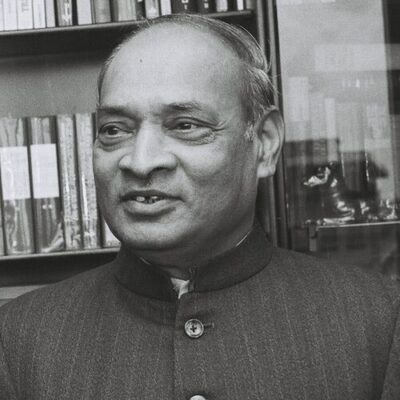
P. V. Narasimha Rao
P. V. Narasimha Rao was a Prime Minister of India. Born June 28, 1921, in Laknepalli. Died December 23, 2004, in Delhi. Positions held include Prime Minister of India (1991–1996), Chief Minister of Andhra Pradesh (1971–1973) and Member of the Andhra Pradesh Legislative Assembly (1957–1977). Educated at Osmania University and Rashtrasant Tukadoji Maharaj Nagpur University.
Facts
38 facts · 2 confirmed by two sources · 6 cited · 30 from one source
Where this comes from
Papalocal keeps its own record. It started from these sources; what each one said is kept here as it was copied, so a change on their side never changes this page by itself. Tap one to read its version.
What Wikidata says · copied November 16, 2026 · revision 2562812850
- Described as
- Prime Minister of India (1991-1996)
- Other names
- Pamulaparti Venkata Narasimha Rao, Pamulaparthi Venkata Narasimha Rao
- Born
- June 28, 1921 · 6 references
- Died
- December 23, 2004 · 8 references
- Born in
- Laknepalli
- Died in
- Delhi
- Cause of death
- myocardial infarction
- Citizen of
- British Raj (–1947); India (1950–); Dominion of India (1947–1950)
- Occupation
- politician · 2 references; novelist; freedom fighter; poet; jurist · 1 reference; minister · 1 reference; writer
- Positions held
- Prime Minister of India (1991–1996); Chief Minister of Andhra Pradesh (1971–1973); Member of the Andhra Pradesh Legislative Assembly (1957–1977); Minister of Defence (2 times) (1984–1996); Minister of External Affairs (3 times) (1980–1993); Minister of Home Affairs (2 times) (1984–1986) · 1 reference; Member of the 10th Lok Sabha; Member of the 11th Lok Sabha; Member of the 9th Lok Sabha (1989–1991); Member of the 8th Lok Sabha; Member of the 7th Lok Sabha
- Political party
- Indian National Congress
- Education
- Osmania University; Rashtrasant Tukadoji Maharaj Nagpur University; University of Mumbai; North-Eastern Hill University; Fergusson College · 1 reference
- Field
- law · 1 reference; politics · 1 reference; economics · 1 reference
- Children
- P. V. Ranga Rao; Surabhi Vani Devi
- Religion
- Hinduism
- Wikipedias with a page
- 64
Wikidata item Q275146 (wikidata.org/wiki/Q275146), public domain (CC0). Copied November 16, 2026.
What Wikipedia says · copied November 16, 2026 · revision 1380541150
Pamulaparthi Venkata Narasimha Rao (28 June 1921 – 23 December 2004) was an Indian independence activist, lawyer, and politician from the Indian National Congress who served as the prime minister of India from 1991 to 1996. He was the first person from South India and the second person from a non-Hindi speaking background to be prime minister. He is known for his role in initiating India's economic liberalisation following an economic crisis in 1991, a process that has been sustained and expanded by every successive prime minister of the country.
Prior to his premiership, he served as the chief minister of Andhra Pradesh, and later also held high-order portfolios of the union government, such as Defence, Home Affairs and External Affairs. In 1991 Indian general election, the Indian National Congress led by him, won 244 seats, and thereafter, he, along with external support from other parties, formed a minority government with him being the prime minister.As prime minister, Rao adopted to avert the impending 1991 economic crisis, the reforms progressed furthest in the areas of opening up to foreign investment, reforming capital markets, deregulating domestic business, and reforming the trade regime. Trade reforms and changes in the regulation of foreign direct investment were introduced to open India to foreign trade while stabilising external loans.
In 2024, he was posthumously awarded the Bharat Ratna, India's highest civilian award, by the government of India. In 2025, his portrait was unveiled at Raj Bhavan on the eve of his birth anniversary by the Governor of Telangana Jishnu Dev Varma.
- Born, in its opening lines
- June 28, 1921
- Died, in its opening lines
- December 23, 2004
From the Wikipedia article “P. V. Narasimha Rao” (en.wikipedia.org/wiki/P._V._Narasimha_Rao), by its contributors, under CC BY-SA 4.0 (creativecommons.org/licenses/by-sa/4.0/). Copied November 16, 2026; not changed.
Confirmed Two sources agree. Cited One source, and it names where it got it. One source One source, without a reference of its own. Sources disagree The sources disagree. We show the best-supported value and keep theirs below.
