
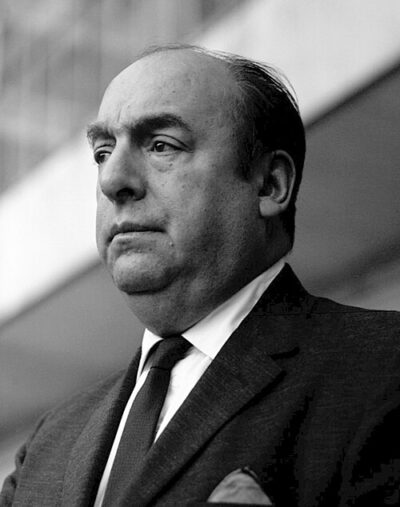
Pablo Neruda
Pablo Neruda was a Chilean poet and politician. Born July 12, 1904, in Parral. Died September 23, 1973, in Santiago. Positions held include senator of Chile (1945–1948) and ambassador of Chile to France (1971–1972). Known for Crepusculario, Twenty Love Poems and a Song of Despair and Residence on Earth. Educated at University of Chile. Awards include Nobel Prize in Literature, National Prize for Literature (Chile) and World Peace Council prizes.
Facts
55 facts · 2 confirmed by two sources · 23 cited · 30 from one source
Where this comes from
Papalocal keeps its own record. It started from these sources; what each one said is kept here as it was copied, so a change on their side never changes this page by itself. Tap one to read its version.
What Wikidata says · copied November 16, 2026 · revision 2567305674
- Described as
- Chilean poet and politician (1904-1973)
- Other names
- Nieluda, Neftalí Reyes Basualto, Neftalí Reyespeneto, Pāplō Nerūda, Neftali Ricardo Reyes, Pamplo Nerouda, Nieh-lu-ta, Neftali Reyes Basualto, Neftalí Ricardo Reyes, Bāblū Nīrūdā, Neftali Ricardo Reyes Basoalto, Neftali Reyes Basoalto
- Born
- July 12, 1904 · 15 references
- Died
- September 23, 1973 · 16 references
- Born in
- Parral · 3 references
- Died in
- Santiago · 3 references
- Buried in
- Isla Negra
- Cause of death
- poisoning · 1 reference
- Name at birth
- Ricardo Eliécer Neftalí Reyes Basoalto
- Citizen of
- Chile
- Occupation
- poet · 2 references; diplomat · 1 reference; politician · 1 reference; lyricist; autobiographer; writer · 3 references; ambassador · 1 reference; consul · 1 reference
- Positions held
- senator of Chile (1945–1948); ambassador of Chile to France (1971–1972)
- Political party
- Communist Party of Chile (1945–) · 1 reference
- Education
- University of Chile
- Member of
- Modern Language Association (1950) · 1 reference; Academy of Arts of the GDR; American Academy of Arts and Sciences
- Genre
- poetry; prose
- Known for
- Crepusculario · 1 reference; Twenty Love Poems and a Song of Despair · 1 reference; Residence on Earth · 1 reference; Spain in Our Hearts · 1 reference; Canto General · 1 reference; Estravagario · 1 reference; Arte de pájaros · 1 reference; Splendor and Death of Joaquin Murieta · 1 reference
- Awards
- Nobel Prize in Literature (1971) · 2 references; National Prize for Literature (Chile) (1945) · 1 reference; World Peace Council prizes (1955); International Stalin Prize for Peace (1953); honorary doctorate of the National University of San Marcos; Atenea Award (1964); Commander of the Order of the Sun of Peru; Viareggio-Versilia International Prize (1967) · 1 reference; Grawemeyer Award for Music Composition (2008); honorary doctor of the Pontifical Catholic University of Chile; Golden Wreath (1972); Order of the Aztec Eagle · 1 reference
- Field
- literature · 1 reference; diplomacy · 1 reference; politics · 1 reference
- Spouse
- Delia del Carril (1943–1966); Marijke Antonieta Hagenaar Vogelzang (1930–); Matilde Urrutia (1965–1973)
- Children
- Malva Marina Reyes Hagenaar
- Father
- José del Carmen Reyes Morales
- Mother
- Rosa Neftalí Basoalto Opazo
- Religion
- atheism
- Wikipedias with a page
- 168
Wikidata item Q34189 (wikidata.org/wiki/Q34189), public domain (CC0). Copied November 16, 2026.
What Wikipedia says · copied November 16, 2026 · revision 1383752133
Pablo Neruda ( nə-ROO-də; Spanish: [ˈpaβlo neˈɾuða] ; born Ricardo Eliécer Neftalí Reyes Basoalto; 12 July 1904 – 23 September 1973) was a Chilean poet-diplomat and politician who won the 1971 Nobel Prize in Literature. Neruda became known as a poet when he was 13 years old and wrote in a variety of styles, including surrealist poems, historical epics, political manifestos, a prose autobiography, and passionate love poems such as the ones in his collection Twenty Love Poems and a Song of Despair (1924).
Neruda occupied many diplomatic positions in various countries during his lifetime and served a term as a senator for the Chilean Communist Party. When President Gabriel González Videla outlawed communism in Chile in 1948, a warrant was issued for Neruda's arrest. Friends hid him for months, and in 1949 he escaped through a mountain pass near Maihue Lake into Argentina; he would not return to Chile for more than three years. He was a close advisor to Chile's socialist president Salvador Allende; Neruda served as Chile's ambassador to France under his presidency. When he went back to Chile after accepting his Nobel Prize in Stockholm, Allende invited him to read at the Estadio Nacional before 70,000 people.
In September 1973, Neruda was diagnosed with prostate cancer. The same month, after the coup d'état led by Augusto Pinochet overthrew Allende's government and resulted in Allende's suicide, Neruda made plans to flee to Mexico in exile. On 23 September, the day before he was to leave the country, Neruda died at the Santa María medical clinic in Santiago, where he had been receiving cancer treatment. While the official cause of death was listed as complications from prostate cancer, the cause and circumstances of his death have been a subject of intense debate, controversy, and investigation ever since.
In 2011, an investigation was opened after Manuel Araya, Neruda's former personal assistant and driver, came forward with claims that Neruda had been murdered at the direction of Pinochet. According to Araya Neruda called him from the clinic hours before he died and said that a doctor had injected him in the stomach with an unknown substance. In 2013, Judge Mario Carroza ordered Neruda's remains exhumed for forensic testing. Initial results did not find any evidence to indicate Neruda had been poisoned. However, the Chilean government issued a statement in 2015 acknowledging that "it was clearly possible and highly likely" that Neruda was killed as a result of "the intervention of third parties". In 2017, it was reported that an international panel of 13 forensic experts had determined that there was no indication Neruda had died of cancer, and that they had identified evidence of a potentially "laboratory cultivated bacteria". In 2023, a toxicology report confirmed the presence of Clostridium botulinum in Neruda's teeth, indicating that he had in fact been poisoned. A court of appeals ruling reopened the official inquiry into his death in February 2024.
Neruda is often considered the national poet of Chile, and his works have been popular and influential worldwide. The Colombian novelist Gabriel García Márquez once called him "the greatest poet of the 20th century in any language", and the critic Harold Bloom included Neruda as one of the writers central to the Western tradition in his book The Western Canon.
- Born, in its opening lines
- July 12, 1904
- Died, in its opening lines
- September 23, 1973
From the Wikipedia article “Pablo Neruda” (en.wikipedia.org/wiki/Pablo_Neruda), by its contributors, under CC BY-SA 4.0 (creativecommons.org/licenses/by-sa/4.0/). Copied November 16, 2026; not changed.
Confirmed Two sources agree. Cited One source, and it names where it got it. One source One source, without a reference of its own. Sources disagree The sources disagree. We show the best-supported value and keep theirs below.
