
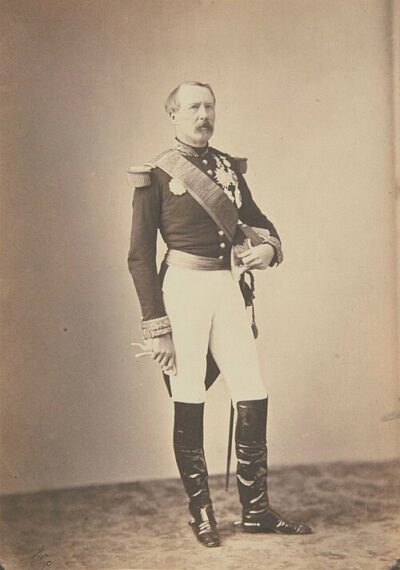
Patrice de MacMahon
Patrice de MacMahon was a third President of the French Republic. Born June 13, 1808, in Château de Sully. Died October 17, 1893, in Montcresson. Positions held include Governor of Algeria (1864–1870), President of the French Republic (1873–1879) and French co-prince of Andorra (1873–1879). Educated at École Spéciale Militaire de Saint-Cyr and Lycée Saint-Louis. Awards include Grand Cross of the Legion of Honour, Grand Officer of the Legion of Honour and Commander of the Legion of Honour.
Facts
41 facts · 2 confirmed by two sources · 11 cited · 28 from one source
Where this comes from
Papalocal keeps its own record. It started from these sources; what each one said is kept here as it was copied, so a change on their side never changes this page by itself. Tap one to read its version.
What Wikidata says · copied November 16, 2026 · revision 2559707221
- Described as
- third President of the French Republic (1808–1893)
- Other names
- Maurice de MacMahon, 1st Duc de Magenta, Mac Mahon, Patrice
- Born
- June 13, 1808 · 2 references
- Died
- October 17, 1893 · 3 references
- Born in
- Château de Sully · 1 reference
- Died in
- Montcresson
- Buried in
- Vault of Governors
- Cause of death
- chronic renal insufficiency · 1 reference
- Citizen of
- France
- Occupation
- military officer; politician · 1 reference; military personnel
- Positions held
- Governor of Algeria (1864–1870); President of the French Republic (1873–1879); French co-prince of Andorra (1873–1879); Second Empire senator · 1 reference
- Political party
- Legitimism
- Education
- École Spéciale Militaire de Saint-Cyr (1825–1827); Lycée Saint-Louis
- Awards
- Grand Cross of the Legion of Honour (1855) · 1 reference; Grand Officer of the Legion of Honour (1853) · 1 reference; Commander of the Legion of Honour (1849) · 1 reference; Officer of the Legion of Honour (1837) · 1 reference; Knight of the Legion of Honour (1831) · 1 reference; Médaille militaire (1857) · 1 reference; Knight of the Order of the Golden Fleece (1875); Marshal of France; Knight Grand Cross of the Order of the Bath; Order of the Black Eagle; Order of St. Andrew; Grand Master of the Legion of Honour; Royal Order of the Seraphim (1861) · 1 reference; Order of the Most Holy Annunciation; Order of Saint Alexander Nevsky
- Spouse
- Élisabeth de Mac Mahon (1854–) · 1 reference
- Children
- Emmanuel de Mac Mahon; Marie Armand Patrice de Mac Mahon · 1 reference
- Father
- Maurice-François de Mac-Mahon
- Mother
- Pélagie de Riquet de Caraman · 3 references
- Siblings
- Charles Marie de Mac-Mahon
- Religion
- Catholic Church
- Military branch
- French Armed Forces · 1 reference
- Military rank
- Marshal of France
- Wikipedias with a page
- 78
Wikidata item Q158838 (wikidata.org/wiki/Q158838), public domain (CC0). Copied November 16, 2026.
What Wikipedia says · copied November 16, 2026 · revision 1378378521
Marie Edme Patrice Maurice de MacMahon, marquis de MacMahon, duc de Magenta (French: [patʁis də makma.ɔ̃]; 13 June 1808 – 17 October 1893), was a French general and politician who served as President of France from 1873 to 1879. He was elevated to the dignity of Marshal of France by Napoleon III.
MacMahon led the main French army in the Franco-Prussian War in 1870. He was trapped and wounded at the Battle of Sedan in September 1870, in part because of his confused and indecisive strategic planning. The army, including MacMahon and Emperor Napoleon III, surrendered to the Germans. Thus the Emperor was deposed and the French Third Republic was proclaimed. After convalescing, MacMahon was appointed head of the Versailles army, which suppressed the Paris Commune revolt in May 1871 and set the stage for his political career.
According to David Bell, after Adolphe Thiers' resignation in May 1873, the royalist majority in the National Assembly drafted MacMahon as the new leader, with the hope that he would hold the fort until the Bourbon pretender was ready to restore the throne. However, the Count of Chambord's extreme Legitimist stance made restoration politically impossible. MacMahon refused to support efforts to force the Assembly's hand. In the absence of his full support there was no way to achieve monarchy by extra-parliamentary means. The right had no choice but to keep MacMahon in office to gain time and act as a barrier to the left by repressing radical agitation and pursuing policies to restore "moral order" to the country. In November 1873, he was voted a term of office of seven years.
In 1874, due to demands for Bonapartism, MacMahon called for constitutional reform. To ensure calm this led to a system of a President and Senate elected indirectly. In 1876, MacMahon had to accept the governments of moderate Republicans Jules Armand Dufaure and Jules Simon. However, in 1877, MacMahon dismissed Simon and recalled the Duke de Broglie. The new government was dissolved on a no confidence vote. Conservatives hoped to exploit their influential press, heavy patronage, and martial law to coerce the voters. They failed in the general election of October 1877, as the Republicans won the majority despite the challenges on the right. In January 1879, the Republicans forced MacMahon's resignation.
MacMahon was a devout conservative Catholic, and a traditionalist who despised anarchism, communism, socialism and liberalism and strongly distrusted the mostly secular Republicans. He kept to his duty as the neutral guardian of the Constitution and rejected suggestions of a monarchist coup d'état, but refused to meet with Gambetta, the leader of the Republicans. He moved for a parliamentary system in which the assembly selected the ruling government of the Third Republic, but he also insisted on an upper chamber. He later dissolved the Chamber of Deputies, resulting in public outrage and a Republican electoral victory. Soon after MacMahon resigned and retired to private life.
- Born, in its opening lines
- June 13, 1808
- Died, in its opening lines
- October 17, 1893
From the Wikipedia article “Patrice de MacMahon” (en.wikipedia.org/wiki/Patrice_de_MacMahon), by its contributors, under CC BY-SA 4.0 (creativecommons.org/licenses/by-sa/4.0/). Copied November 16, 2026; not changed.
Confirmed Two sources agree. Cited One source, and it names where it got it. One source One source, without a reference of its own. Sources disagree The sources disagree. We show the best-supported value and keep theirs below.
