
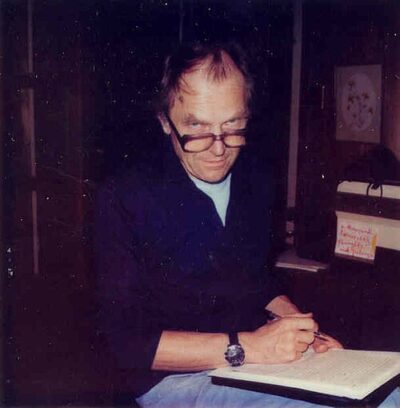
Paul Feyerabend
Paul Feyerabend was an Austrian-born philosopher of science. Born January 13, 1924, in Vienna. Died February 11, 1994, in Genolier. Known for Against Method, Science in a Free Society and Killing Time. Educated at University of Vienna.
Facts
23 facts · 2 confirmed by two sources · 8 cited · 13 from one source
Where this comes from
Papalocal keeps its own record. It started from these sources; what each one said is kept here as it was copied, so a change on their side never changes this page by itself. Tap one to read its version.
What Wikidata says · copied November 13, 2026 · revision 2564037872
- Described as
- Austrian-born philosopher of science
- Other names
- P. K. Feyerabend, Paul Karl Feyerabend
- Born
- January 13, 1924 · 14 references
- Died
- February 11, 1994 · 11 references
- Born in
- Vienna · 3 references
- Died in
- Genolier · 3 references
- Cause of death
- brain cancer
- Citizen of
- Austria · 3 references; United States · 1 reference; Germany · 1 reference
- Occupation
- philosopher · 2 references; university teacher; scholar · 1 reference
- Worked for
- Freie Universität Berlin; London School of Economics and Political Science; University of Cambridge; University of California, Berkeley · 1 reference; ETH Zurich · 1 reference
- Education
- University of Vienna · 1 reference
- Known for
- Against Method; Science in a Free Society; Killing Time; Farewell to Reason
- Field
- philosophy of science
- Spouse
- Grazzia Borrini-Feyerabend
- Wikipedias with a page
- 54
Wikidata item Q78497 (wikidata.org/wiki/Q78497), public domain (CC0). Copied November 13, 2026.
What Wikipedia says · copied November 13, 2026 · revision 1383334977
Paul Karl Feyerabend (; FY-ur-ah-bent; German: [ˈfaɪɐˌʔaːbm̩t]; January 13, 1924 – February 11, 1994) was an Austrian philosopher best known for his work in philosophy of science. He started his academic career as lecturer in philosophy of science at the University of Bristol (1955–1958); afterward, he moved to the University of California, Berkeley, where he taught for three decades (1958–1989). At various points in his life, he held joint appointments at the University College London (1967–1970), the London School of Economics (1967), the FU Berlin (1968), Yale University (1969), the University of Auckland (1972, 1975), the University of Sussex (1974), and the ETH Zurich (1980–1990). He gave lectures and lecture series at the University of Minnesota (1958–1962), Stanford University (1967), the University of Kassel (1977), and the University of Trento (1992).
Feyerabend's most famous work is Against Method (1975), wherein he argues that there are no universally valid methodological rules for scientific inquiry. He also wrote on topics related to the politics of science in several essays and in his book Science in a Free Society (1978). Feyerabend's later works include Wissenschaft als Kunst (Science as Art) (1984), Farewell to Reason (1987), Three Dialogues on Knowledge (1991), and Conquest of Abundance (released posthumously in 1999), which collect essays from the 1970s until Feyerabend's death. The uncompleted draft of an earlier work was released posthumously in 2009 as Naturphilosophie and translated to English in 2016 as Philosophy of Nature. This work contains Feyerabend's reconstruction of the history of natural philosophy from the Homeric period until the mid-20th century. In these works and others, Feyerabend wrote about numerous issues at the interface between history and philosophy of science and ethics, ancient philosophy, philosophy of art, political philosophy, medicine, and physics. His final work was an autobiography, Killing Time, which he completed on his deathbed. Feyerabend's extensive correspondence and other materials from his Nachlass continue to be published.
Feyerabend is recognized as one of the most important 20th-century philosophers of science. In a 2010 poll, he was ranked as the 8th-most significant philosopher of science. He is often mentioned alongside Thomas Kuhn, Imre Lakatos, and N. R. Hanson as a crucial figure in the historical turn in philosophy of science, and his work on scientific pluralism has been markedly influential on the Stanford School and on much contemporary philosophy of science. Feyerabend was also a significant figure in the sociology of scientific knowledge. His lectures were extremely well-attended, attracting international attention. His multifaceted personality is eloquently summarized in his obituary by Ian Hacking: "Humanists, in my old-fashioned sense, need to be part of both arts and sciences. Paul Feyerabend was a humanist. He was also fun."
In line with this humanistic interpretation and the concerns apparent in his later work, the Paul K. Feyerabend Foundation was founded in 2006 in his honour. The Foundation "promotes the empowerment and wellbeing of disadvantaged human communities. By strengthening intra and inter-community solidarity, it strives to improve local capacities, promote the respect of human rights, and sustain cultural and biological diversity." In 1970, the Loyola University of Chicago awarded Feyerabend a Doctor of Humane Letters Degree honoris causa. Asteroid (22356) Feyerabend is named after him.
- Born, in its opening lines
- January 13, 1924
- Died, in its opening lines
- February 11, 1994
From the Wikipedia article “Paul Feyerabend” (en.wikipedia.org/wiki/Paul_Feyerabend), by its contributors, under CC BY-SA 4.0 (creativecommons.org/licenses/by-sa/4.0/). Copied November 13, 2026; not changed.
Confirmed Two sources agree. Cited One source, and it names where it got it. One source One source, without a reference of its own. Sources disagree The sources disagree. We show the best-supported value and keep theirs below.
