
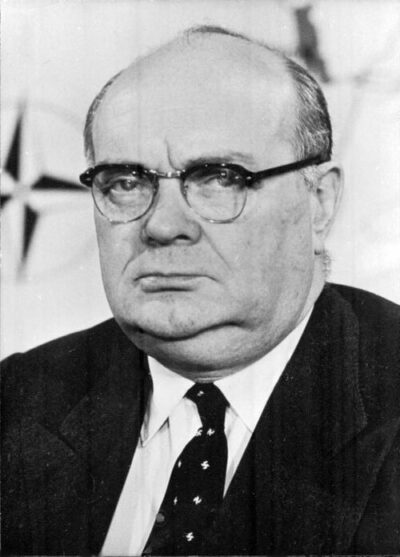
Paul-Henri Spaak
Paul-Henri Spaak was a Belgian politician. Born January 25, 1899, in Schaerbeek. Died July 31, 1972, in Braine-l'Alleud. Positions held include Prime Minister of Belgium (2 times) (1938–1949), Secretary General of NATO (1957–1961) and member of the Chamber of Representatives of Belgium (2 times) (1932–1966). Awards include Grand Cross of the Order of the Crown, Grand Cordon of the Order of Leopold and Grand Cross of the Order of the Southern Cross.
Facts
50 facts · 2 confirmed by two sources · 17 cited · 31 from one source
Where this comes from
Papalocal keeps its own record. It started from these sources; what each one said is kept here as it was copied, so a change on their side never changes this page by itself. Tap one to read its version.
What Wikidata says · copied November 16, 2026 · revision 2567445160
- Described as
- Belgian politician (1899-1972)
- Other names
- Paul-Henri Charles Spaak, Paul Henri Charles Spaak
- Born
- January 25, 1899 · 10 references
- Died
- July 31, 1972 · 9 references
- Born in
- Schaerbeek · 1 reference
- Died in
- Braine-l'Alleud · 1 reference
- Buried in
- Braine-l'Alleud
- Name at birth
- Paul Henri Charles Spaak
- Citizen of
- Belgium
- Occupation
- politician · 1 reference; diplomat; tennis player; lawyer · 1 reference
- Positions held
- Prime Minister of Belgium (2 times) (1938–1949); Secretary General of NATO (1957–1961); member of the Chamber of Representatives of Belgium (2 times) (1932–1966) · 1 reference; President of the United Nations General Assembly (1946–1947); ambassador; president of the Parliamentary Assembly of the Council of Europe (1949–1951) · 1 reference; Representative of the Parliamentary Assembly of the Council of Europe (1949–1954) · 1 reference; Member of the European Parliament; Minister of Foreign Affairs in Belgium (3 times) (1936–1966) · 1 reference; Minister of Development Cooperation (1965); Minister of Mobility (2 times) (1935–1943) · 1 reference; Belgian Minister of Foreign Trade (1936–1939); Mayor of Saint-Gilles - Sint-Gillis (1953–1957)
- Political party
- Belgian Socialist Party · 1 reference; Socialist Party
- Member of
- Parliamentary Assembly of the Council of Europe; Academie Royale de Langue et de littérature Françaises (1945–1972) · 1 reference; American Academy of Arts and Sciences
- Sport
- tennis
- Awards
- Grand Cross of the Order of the Crown; Grand Cordon of the Order of Leopold; Grand Cross of the Order of the Southern Cross (1949); Knight Grand Cross of the Order of St Michael and St George (1937) · 1 reference; doctor honoris causa from the University of Aix-Marseille (1952) · 1 reference; Grand Cross of the Order of Christ (1955) · 1 reference; Knight Grand Cross of the Order of Merit of the Italian Republic (1956) · 1 reference; Grand Cross 1st class of the Order of Merit of the Federal Republic of Germany (1956); Charlemagne Prize (1957) · 2 references; Medal of Freedom (1961) · 1 reference; Companion of Honour (1963) · 1 reference; Knight Grand Cross of the Order of the Falcon (1963) · 1 reference; Grand Cross of the Legion of Honour (1938); Knight Grand Cross in the Order of the Netherlands Lion (1938)
- Children
- Antoinette Spaak; Fernand Spaak
- Father
- Paul Spaak · 1 reference
- Mother
- Marie Janson
- Siblings
- Charles Spaak; Claude Spaak
- Wikipedias with a page
- 57
Wikidata item Q155691 (wikidata.org/wiki/Q155691), public domain (CC0). Copied November 16, 2026.
What Wikipedia says · copied November 16, 2026 · revision 1378198823
Paul-Henri Charles Spaak (French: [pɔl ɑ̃ʁi ʃaʁl spak]; 25 January 1899 – 31 July 1972) was an influential Belgian Socialist politician, diplomat, and statesman who thrice served as the prime minister of Belgium and later as the second secretary general of NATO. Nicknamed "Mr. Europe", he was a leader in the formation of the institutions that evolved into the current European Union, along with Robert Schuman, Alcide De Gasperi and Konrad Adenauer.
A member of the influential Spaak family, he served briefly in World War I before he was captured, and rose to prominence after the war as a tennis player and lawyer, becoming famous for his high-profile defence of an Italian student accused of attempting to assassinate Italy's crown prince in 1929. A convinced socialist, Spaak entered politics in 1932 for the Belgian Workers' Party (later the Belgian Socialist Party) and gained his first ministerial portfolio in the government of Paul Van Zeeland in 1935.
He became the prime minister in 1938 and held the position until 1939. During World War II, he served as foreign minister in the London-based Belgian government in exile under Hubert Pierlot, where he negotiated the foundation of the Benelux Customs Union with the governments of the Netherlands and Luxembourg. After the war, he twice regained the premiership, first for under a month in March 1946 and again between 1947 and 1949. He held various further Belgian ministerial portfolios until 1966. He was Belgium's foreign minister for 18 years between 1939 and 1966.
Spaak, a convinced supporter of multilateralism, became internationally famous for his support of international cooperation, in which he hoped to include geopolitical enemies of Belgium and NATO such as the Soviet Union and its satellite states. In 1945, he was chosen to chair the first session of the General Assembly of the new United Nations. A long-running supporter of European integration, Spaak had been an early advocate of customs union and had negotiated the Benelux agreement in 1944.
He served as the first President of the Consultative Assembly of the Council of Europe between 1949 and 1950 and became the first President of the Common Assembly of the European Coal and Steel Community (ECSC) — which would later become the European Parliament — between 1952 and 1954. In 1955, he was appointed to the so-called Spaak Committee studying the possibility of a common market within Europe and played an influential role in preparing the 1957 Treaty of Rome which established the European Economic Community (EEC). He received the Charlemagne Prize the same year. Between 1957 and 1961, he served as the second secretary general of NATO, becoming the only secretary general to have previously served as prime minister until Anders Fogh Rasmussen in 2009.
Retiring from Belgian politics in 1966, Spaak died in 1972. He remains an influential figure in European politics and his name is carried, among other things, by a charitable foundation, roads and structures, including one of the buildings of the European Parliament, and a method of negotiation.
- Born, in its opening lines
- January 25, 1899
- Died, in its opening lines
- July 31, 1972
From the Wikipedia article “Paul-Henri Spaak” (en.wikipedia.org/wiki/Paul-Henri_Spaak), by its contributors, under CC BY-SA 4.0 (creativecommons.org/licenses/by-sa/4.0/). Copied November 16, 2026; not changed.
Confirmed Two sources agree. Cited One source, and it names where it got it. One source One source, without a reference of its own. Sources disagree The sources disagree. We show the best-supported value and keep theirs below.
