
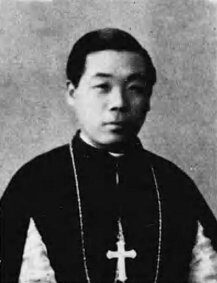
Paul Yoshigorō Taguchi
Paul Yoshigorō Taguchi was a Japanese prelate of the Roman Catholic Church. Born July 20, 1902, in Japan. Died February 23, 1978, in Osaka. Positions held include Roman Catholic Archbishop of Osaka (1969–1978), cardinal (1973–) and Roman Catholic Bishop of Osaka (1941–). Educated at Pontifical Urbaniana University.
Facts
14 facts · 2 confirmed by two sources · 4 cited · 8 from one source
Where this comes from
Papalocal keeps its own record. It started from these sources; what each one said is kept here as it was copied, so a change on their side never changes this page by itself. Tap one to read its version.
What Wikidata says · copied November 18, 2026 · revision 2562719980
- Described as
- Japanese prelate of the Roman Catholic Church (1902–1978)
- Other names
- Paul Yoshigoro Taguchi, Yoshigorō Taguchi, Taguchi Yoshigorō, Taguchi Yoshigoro, Paul Yoshigorou Taguchi, Paul Yoshigoro Cardinal Taguchi
- Born
- July 20, 1902 · 2 references
- Died
- February 23, 1978 · 1 reference
- Born in
- Japan
- Died in
- Osaka
- Citizen of
- Japan; Empire of Japan (–1947)
- Occupation
- Catholic priest (1928–) · 1 reference; Catholic bishop (1941–) · 1 reference
- Positions held
- Roman Catholic Archbishop of Osaka (1969–1978) · 2 references; cardinal (1973–) · 1 reference; Roman Catholic Bishop of Osaka (1941–) · 1 reference; apostolic administrator (1940–) · 1 reference
- Education
- Pontifical Urbaniana University
- Religion
- Catholic Church · 1 reference
- Wikipedias with a page
- 22
Wikidata item Q918663 (wikidata.org/wiki/Q918663), public domain (CC0). Copied November 18, 2026.
What Wikipedia says · copied November 18, 2026 · revision 1357783483
Paul Yoshigoro Taguchi (田口芳五郎, Taguchi Yoshigoro; July 20, 1902 – February 23, 1978) was a Japanese prelate of the Roman Catholic Church. He served as Archbishop of Osaka from 1941 until his death in 1978, and was elevated to the rank of cardinal in 1973.
Taguchi was born in Sotome, Nagasaki (now part of the city of Nagasaki). After graduation from Sapientia University, now St. Thomas University, Japan, he studied at the Pontifical Urbaniana University and Pontifical Athenaeum S. Apollinare in Rome, where he was ordained to the priesthood on December 22, 1928. After finishing his studies in 1931, he returned to the Archdiocese of Tokyo, where he served as a seminary professor and director general of the Catholic Press Centre until 1936. From 1936 to 1940, he was secretary of the Apostolic Delegation to Japan.
On November 25, 1941, Taguchi was appointed Bishop of Osaka by Pope Pius XII. He received his episcopal consecration on the following December 14 from Apostolic Delegate in Japan Archbishop Paolo Marella, with Archbishop Peter Doi and Bishop Johannes Ross, S.J. serving as co-consecrators, at the Cathedral of Tokyo. He attended the Second Vatican Council from 1962 to 1965, and was promoted to the rank of metropolitan archbishop on July 24, 1969. He also served as President of the Japanese Episcopal Conference from 1970 to 1978. Pope Paul VI created him Cardinal Priest of S. Maria in Via in the consistory of March 5, 1973.
During the Second World War, he was mobilized by the Japanese authorities to establish contacts for the government with the Catholics of the Philippines. Apparently, this move alerted the American Archbishop of Manila, Michael J. O'Doherty, who claimed that this was an attempt to supplant his authority as the Primate of the Philippines. Then, correspondence between Washington, Vatican, and Manila cleared up the misunderstanding since Taguchi's visit to Manila served no political purpose.
Taguchi died in Osaka, aged 75; he is buried in the Cathedral of the Blessed Virgin Mary, Osaka.
His most accessible writing in English is "The study of Sacred Scripture".
- Born, in its opening lines
- July 20, 1902
- Died, in its opening lines
- February 23, 1978
From the Wikipedia article “Paul Yoshigoro Taguchi” (en.wikipedia.org/wiki/Paul_Yoshigoro_Taguchi), by its contributors, under CC BY-SA 4.0 (creativecommons.org/licenses/by-sa/4.0/). Copied November 18, 2026; not changed.
Confirmed Two sources agree. Cited One source, and it names where it got it. One source One source, without a reference of its own. Sources disagree The sources disagree. We show the best-supported value and keep theirs below.
