
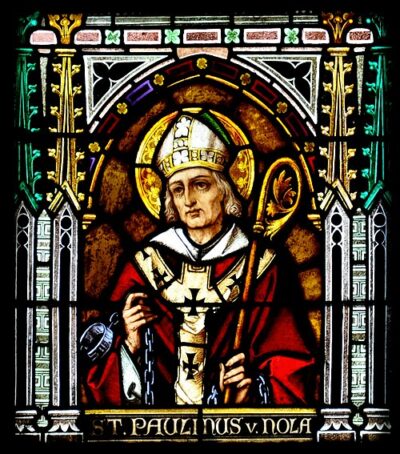
Paulinus of Nola was a Christian bishop and saint. Born 354, in Bordeaux. Died June 22, 431, in Nola. Positions held include Roman consul and Roman Catholic Bishop of Nola (410–431).
Facts
12 facts · 2 confirmed by two sources · 5 cited · 5 from one source
Where this comes from
Papalocal keeps its own record. It started from these sources; what each one said is kept here as it was copied, so a change on their side never changes this page by itself. Tap one to read its version.
What Wikidata says · copied November 16, 2026 · revision 2569123022
- Described as
- Christian bishop and saint
- Other names
- St. Paulinus of Nola, Paulinus Nolanus
- Born
- 354
- Died
- June 22, 431
- Born in
- Bordeaux · 1 reference
- Died in
- Nola · 1 reference
- Occupation
- Catholic bishop · 1 reference; Catholic priest (393–) · 1 reference; writer · 1 reference; poet
- Positions held
- Roman consul; Roman Catholic Bishop of Nola (410–431) · 1 reference
- Spouse
- Therasia of Nola
- Religion
- Catholic Church · 1 reference
- Wikipedias with a page
- 34
Wikidata item Q132473 (wikidata.org/wiki/Q132473), public domain (CC0). Copied November 16, 2026.
What Wikipedia says · copied November 16, 2026 · revision 1385568513
Paulinus of Nola (; Latin: Paulinus Nolanus; also anglicized as Pauline of Nola; c. 354 – 22 June 431) born Pontius Meropius Anicius Paulinus, was a Roman poet, writer, senator, and bishop. He attained the ranks of suffect consul (c. 377) and governor of Campania, (c. 380 – c. 381) but, prompted by the counsels of his Hispanic wife Therasia of Nola and by the assassination of the emperor Gratian, abandoned his career and was baptized as a Christian. Later, probably after Therasia's death, he became bishop of Nola in Campania. While there, he wrote poems in honor of his predecessor Saint Felix and corresponded with other Christian leaders throughout the empire. He is credited with the introduction of bells to Christian worship and helped resolve the disputed election of Pope Boniface I.
His renunciation of his wealth and station in favor of an ascetic and philanthropic life was held up as an example by many of his contemporaries—including Augustine, Jerome, Martin, and Ambrose—and he was subsequently venerated as a saint. His relics became a focus of pilgrimage, but were removed from Nola sometime between the 11th and 20th centuries. His feast day is observed on 22 June in both the Roman Catholic and Eastern Orthodox Churches. In Nola, the entire week around his feast day is celebrated as the Festival of the Lilies.
- Born, in its opening lines
- c. 354
- Died, in its opening lines
- June 22, 431
From the Wikipedia article “Paulinus of Nola” (en.wikipedia.org/wiki/Paulinus_of_Nola), by its contributors, under CC BY-SA 4.0 (creativecommons.org/licenses/by-sa/4.0/). Copied November 16, 2026; not changed.
Confirmed Two sources agree. Cited One source, and it names where it got it. One source One source, without a reference of its own. Sources disagree The sources disagree. We show the best-supported value and keep theirs below.
