
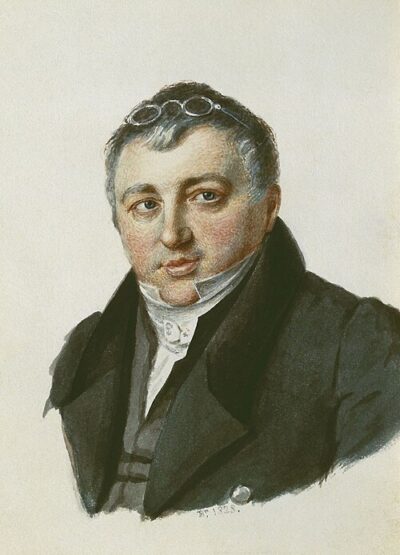
Pavel Schilling
Pavel Schilling was a Russian inventor of Baltic German origin. Born April 5, 1786, in Tallinn. Died July 25, 1837, in Saint Petersburg. Educated at First Cadet Corps. Awards include Order of St. Vladimir 4th degree with a bow, Gold Sword for Bravery and honorary member of the Physics Association (Frankfurt am Main, Germany).
Facts
22 facts · 0 confirmed by two sources · 8 cited · 11 from one source · 3 where the sources disagree
What’s different
- Born: we show April 5, 1786 (Sources disagree). Wikipedia says April 16, 1786
- Died: we show July 25, 1837 (Sources disagree). Wikipedia says August 6, 1837
- Name at birth: we show Paul Ludwig Schilling von Cannstatt (Sources disagree). Wikidata also lists Павел Львович Шиллинг
Where this comes from
Papalocal keeps its own record. It started from these sources; what each one said is kept here as it was copied, so a change on their side never changes this page by itself. Tap one to read its version.
What Wikidata says · copied November 18, 2026 · revision 2563982691
- Described as
- Russian inventor of Baltic German origin (1786-1837)
- Other names
- Paul Schilling, Baron Pavel Lvovitch Schilling von Cannstadt, Baron Pavel Lvovitch Schilling
- Born
- April 5, 1786 · 1 reference
- Died
- July 25, 1837 · 1 reference
- Born in
- Tallinn · 2 references
- Died in
- Saint Petersburg · 2 references
- Buried in
- Smolensky Lutheran Cemetery
- Name at birth
- Paul Ludwig Schilling von Cannstatt; Павел Львович Шиллинг
- Citizen of
- Russian Empire
- Occupation
- engineer · 1 reference; diplomat; inventor · 2 references; historian · 1 reference; electrotechnician · 1 reference; physicist · 1 reference; orientalist · 1 reference; naturalist · 1 reference
- Education
- First Cadet Corps
- Member of
- Saint Petersburg Academy of Sciences
- Awards
- Order of St. Vladimir 4th degree with a bow; Gold Sword for Bravery; honorary member of the Physics Association (Frankfurt am Main, Germany) (1835) · 1 reference
- Father
- Ludwig von Schilling
- Mother
- Katharina Charlotte von Cannstadt
- Wikipedias with a page
- 22
Wikidata item Q717731 (wikidata.org/wiki/Q717731), public domain (CC0). Copied November 18, 2026.
What Wikipedia says · copied November 18, 2026 · revision 1375166327
Baron Paul Schilling (16 April [O.S. 5 April] 1786 – 6 August [O.S. 25 July] 1837), also known as Pavel Lvovitch Schilling, was a Russian inventor, military officer and diplomat of Baltic German origin. The majority of his career was spent working for the imperial Russian Ministry of Foreign Affairs as a language officer at the Russian embassy in Munich. As a military officer, he took part in the War of the Sixth Coalition against Napoleon. In his later career, he was transferred to the Asian department of the ministry and undertook a tour of Mongolia to collect ancient manuscripts.
Schilling is best known for his pioneering work in electrical telegraphy, which he undertook at his own initiative. While in Munich, he worked with Samuel Thomas von Sömmerring who was developing an electrochemical telegraph. Schilling developed the first electromagnetic telegraph that was of practical use. Schilling's design was a needle telegraph using magnetised needles suspended by a thread over a current-carrying coil. His design also greatly reduced the number of wires compared to Sömmerring's system by the use of binary coding. Tsar Nicholas I planned to install Schilling's telegraph on a link to Kronstadt, but cancelled the project after Schilling died.
Other technological interests of Schilling included lithography and remote detonation of explosives. For the latter, he invented a submarine cable, which he later also applied to telegraphy. Work on telegraphy in Russia, and other electrical applications, was continued after Schilling's death by Moritz von Jacobi, his assistant and successor as head of the St. Petersburg electrical engineering workshop.
- Born, in its opening lines
- April 16, 1786
- Died, in its opening lines
- August 6, 1837
From the Wikipedia article “Pavel Schilling” (en.wikipedia.org/wiki/Pavel_Schilling), by its contributors, under CC BY-SA 4.0 (creativecommons.org/licenses/by-sa/4.0/). Copied November 18, 2026; not changed.
Confirmed Two sources agree. Cited One source, and it names where it got it. One source One source, without a reference of its own. Sources disagree The sources disagree. We show the best-supported value and keep theirs below.
