
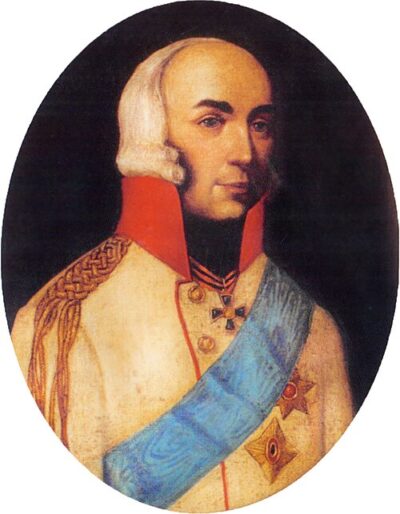
Pavel Tsitsianov
Pavel Tsitsianov was a Russian general. Born September 19, 1754, in Moscow. Died February 8, 1806, in Baku. Awards include Order of St. Vladimir, 3rd class, Order of St. Vladimir, 1st class and Order of Saint Alexander Nevsky.
Facts
16 facts · 1 confirmed by two sources · 2 cited · 12 from one source · 1 where the sources disagree
What’s different
- Died: we show February 8, 1806 (Sources disagree). Wikipedia says February 20, 1806
Where this comes from
Papalocal keeps its own record. It started from these sources; what each one said is kept here as it was copied, so a change on their side never changes this page by itself. Tap one to read its version.
What Wikidata says · copied November 18, 2026 · revision 2524672308
- Described as
- Russian general
- Born
- September 19, 1754 · 1 reference
- Died
- February 8, 1806 · 1 reference
- Born in
- Moscow · 1 reference
- Died in
- Baku
- Buried in
- Sioni Cathedral
- Cause of death
- Assassination of Tsitsianov
- Citizen of
- Russian Empire
- Occupation
- politician; military personnel · 1 reference
- Awards
- Order of St. Vladimir, 3rd class; Order of St. Vladimir, 1st class; Order of Saint Alexander Nevsky; Gold Sword for Bravery; Order of St. George, 3rd class
- Father
- Dmitry Tsitsianov
- Military rank
- General of the Infantry
- Wikipedias with a page
- 22
Wikidata item Q2416269 (wikidata.org/wiki/Q2416269), public domain (CC0). Copied November 18, 2026.
What Wikipedia says · copied November 18, 2026 · revision 1376283154
Prince Pavel Dmitriyevich Tsitsianov (Russian: Па́вел Дми́триевич Цициа́нов; 19 September [O.S. 8 September] 1754–20 February [O.S. 8 February] 1806) was a Russian general of Georgian noble origin who played a prominent role in the Russian conquest of the South Caucasus. He served as the commander-in-chief in the Caucasus from 1802 to 1806 and commanded Russian forces in the Russo-Persian War of 1804–1813 until his assassination near Baku in 1806.
Born in Moscow to a Georgian noble family that had lived in Russia for two generations, he entered military service at a young age and fought in the Russo-Turkish War of 1768–1774, the 1794 Polish uprising and the Persian expedition of 1796. Tsar Alexander I appointed him commander of Russian forces in the Caucasus in 1802. He solidified Russian rule in the region, compelling local rulers and communities to submit to the Tsar and often campaigning against them. He expanded Russian possessions south of the Caucasus westward to the Black Sea and continued Russia's southward expansion. He successfully captured the city of Ganja (in modern-day Azerbaijan), triggering a conflict with Qajar Iran. He then continued south into the Erivan Khanate (in modern-day Armenia), where his outnumbered forces fought a number of battles with the Iranian army but were forced to retreat. He secured the submission of a number of the khanates of the Caucasus to Russian rule. In February 1806, he attempted to negotiate the surrender of the Khanate of Baku but was lured into a trap by the local khan and killed.
Tsitsianov has been credited with playing a foundational role in establishing Russian rule in the South Caucasus; he was universally lauded in Russian sources and often admired by Europeans as well. He has been described as a brave and energetic leader but also as cruel and overbearing. He was despised and feared by many Caucasian Muslims and Iranians for his brutal actions. He held all "Asiatics" in contempt and believed that force and assimilation were the only reliable means to secure Russian control over local populations. Many of his methods were followed by later Russian leaders in the Caucasus. According to Walter Richmond, Tsitsianov "set in motion the brutality that was the hallmark of subsequent Russian efforts to conquer the North Caucasus."
- Born, in its opening lines
- September 19, 1754
- Died, in its opening lines
- February 20, 1806
From the Wikipedia article “Pavel Tsitsianov” (en.wikipedia.org/wiki/Pavel_Tsitsianov), by its contributors, under CC BY-SA 4.0 (creativecommons.org/licenses/by-sa/4.0/). Copied November 18, 2026; not changed.
Confirmed Two sources agree. Cited One source, and it names where it got it. One source One source, without a reference of its own. Sources disagree The sources disagree. We show the best-supported value and keep theirs below.
