
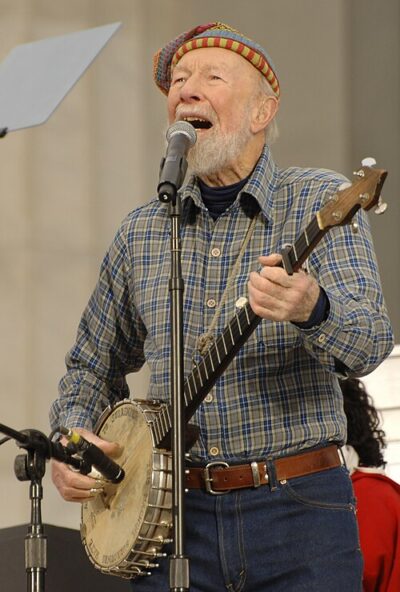
Pete Seeger
Pete Seeger was an American folk singer. Born May 3, 1919, in New York City. Died January 27, 2014, in Manhattan. Known for Where Have All the Flowers Gone?. Educated at Harvard University and Avon Old Farms School. Awards include National Medal of Arts, Grammy Lifetime Achievement Award and War Resisters League Peace Award.
Facts
43 facts · 2 confirmed by two sources · 33 cited · 8 from one source
Where this comes from
Papalocal keeps its own record. It started from these sources; what each one said is kept here as it was copied, so a change on their side never changes this page by itself. Tap one to read its version.
What Wikidata says · copied November 13, 2026 · revision 2565558980
- Described as
- American folk singer (1919–2014)
- Other names
- Pete, Peter Seeger
- Born
- May 3, 1919 · 13 references
- Died
- January 27, 2014 · 12 references
- Born in
- New York City · 2 references
- Died in
- Manhattan · 1 reference
- Name at birth
- Peter Seeger · 1 reference
- Citizen of
- United States · 1 reference
- Occupation
- singer · 1 reference; street artist · 1 reference; banjoist · 2 references; musicologist · 1 reference; singer-songwriter · 1 reference; guitarist · 1 reference; peace activist · 2 references; mandolinist · 1 reference
- Political party
- Communist Party of the United States of America (1942–1949) · 1 reference
- Education
- Harvard University · 1 reference; Avon Old Farms School
- Member of
- The Weavers · 1 reference
- Genre
- traditional folk music · 1 reference
- Instrument
- banjo · 1 reference; guitar · 1 reference; voice
- Record label
- Smithsonian Folkways Recordings · 1 reference; Fast Folk · 1 reference; Folkways Records
- Known for
- Where Have All the Flowers Gone? · 1 reference
- Awards
- National Medal of Arts · 1 reference; Grammy Lifetime Achievement Award (1993) · 1 reference; War Resisters League Peace Award · 1 reference; Library of Congress Living Legend (2000–) · 2 references; Kennedy Center Honors · 1 reference; Paul Robeson Award (1977) · 1 reference; Schneider Family Book Award (2007); Eugene V. Debs Award (1979) · 1 reference; Rock and Roll Hall of Fame (1996) · 1 reference
- Spouse
- Toshi Seeger · 1 reference
- Children
- Mika Seeger · 1 reference
- Father
- Charles Seeger · 1 reference
- Mother
- Constance de Clyver Edson · 1 reference
- Siblings
- Peggy Seeger · 1 reference; Mike Seeger · 1 reference
- Religion
- Unitarian Universalism
- Website
- http://www.peteseeger.net/ · 1 reference
- Wikipedias with a page
- 89
Wikidata item Q244441 (wikidata.org/wiki/Q244441), public domain (CC0). Copied November 13, 2026.
What Wikipedia says · copied November 13, 2026 · revision 1384402496
Peter Seeger (May 3, 1919 – January 27, 2014) was an American singer, songwriter, musician and social activist. He was a fixture on nationwide radio in the 1940s, and had a string of hit records in the early 1950s as a member of The Weavers, especially their recording of Lead Belly's "Goodnight, Irene", which topped the charts for 13 weeks in 1950. Members of the Weavers were blacklisted during the McCarthy Era. In the 1960s, Seeger re-emerged on the public scene as a prominent singer of protest music in support of international disarmament, civil rights, workers' rights, counterculture, environmental causes, and ending the Vietnam War.
Among the prolific songwriter's best-known songs are "Where Have All the Flowers Gone?" (with additional lyrics by Joe Hickerson), "If I Had a Hammer (The Hammer Song)" (with Lee Hays of the Weavers), "Kisses Sweeter than Wine" (also with Hays), and "Turn! Turn! Turn! (To Everything There Is a Season)", which has been recorded by many artists in and outside the folk revival movement. "Flowers" was a hit recording for The Kingston Trio (1962); Marlene Dietrich, who recorded it in English, German and French (1962); and Johnny Rivers (1965). "If I Had a Hammer" was a hit for Peter, Paul and Mary (1962) and Trini Lopez (1963) while The Byrds had a number one hit with "Turn! Turn! Turn!" in 1965.
Seeger was one of the folk singers responsible for popularizing the spiritual "We Shall Overcome" (also recorded by Joan Baez and many other singer-activists), which became the acknowledged anthem of the civil rights movement, soon after folk singer and activist Guy Carawan introduced it at the founding meeting of the Student Nonviolent Coordinating Committee (SNCC) in 1960. In the PBS American Masters episode "Pete Seeger: The Power of Song", Seeger said it was he who changed the lyric from the traditional "We will overcome" to the more singable "We shall overcome".
- Born, in its opening lines
- May 3, 1919
- Died, in its opening lines
- January 27, 2014
From the Wikipedia article “Pete Seeger” (en.wikipedia.org/wiki/Pete_Seeger), by its contributors, under CC BY-SA 4.0 (creativecommons.org/licenses/by-sa/4.0/). Copied November 13, 2026; not changed.
Confirmed Two sources agree. Cited One source, and it names where it got it. One source One source, without a reference of its own. Sources disagree The sources disagree. We show the best-supported value and keep theirs below.
