
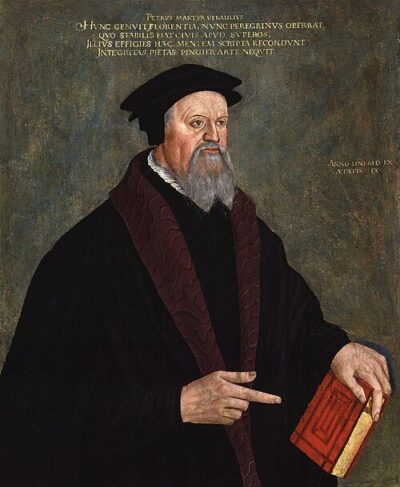
Peter Martyr Vermigli
Peter Martyr Vermigli was an Italian Reformed theologian. Born September 8, 1499, in Florence. Died November 12, 1562, in Zurich. Positions held include Regius Professor of Divinity (1548–1554). Educated at University of Padua.
Facts
16 facts · 2 confirmed by two sources · 6 cited · 8 from one source
Where this comes from
Papalocal keeps its own record. It started from these sources; what each one said is kept here as it was copied, so a change on their side never changes this page by itself. Tap one to read its version.
What Wikidata says · copied November 18, 2026 · revision 2570777034
- Described as
- Italian Reformed theologian (1499-1562)
- Other names
- Pietro Martire Vermigli, Piero Mariano, Pietro Martire Vermiglio, Peter Martyr
- Born
- September 8, 1499
- Died
- November 12, 1562 · 1 reference
- Born in
- Florence · 2 references
- Died in
- Zurich · 2 references
- Name at birth
- Piero Mariano Vermigli
- Citizen of
- Republic of Florence
- Occupation
- theologian · 1 reference; university teacher; writer
- Positions held
- Regius Professor of Divinity (1548–1554)
- Worked for
- University of Oxford
- Education
- University of Padua
- Field
- theology · 1 reference; Protestant Reformation · 1 reference
- Spouse
- Catherine Dammartin · 1 reference
- Religion
- Protestantism
- Wikipedias with a page
- 23
Wikidata item Q598060 (wikidata.org/wiki/Q598060), public domain (CC0). Copied November 18, 2026.
What Wikipedia says · copied November 18, 2026 · revision 1372822124
Peter Martyr Vermigli (; 8 September 1499 – 12 November 1562) was an Italian-born Reformed theologian. His early work as a reformer in Catholic Italy and his decision to flee for Protestant northern Europe influenced some other Italians to convert and flee as well. In England, he influenced the Edwardian Reformation, including the Eucharistic service of the 1552 Book of Common Prayer. He was considered an authority on the Eucharist among the Reformed churches and engaged in controversies on the subject by writing treatises. Vermigli's Loci Communes, a compilation of excerpts from his biblical commentaries, became a standard Reformed theological textbook.
Born in Florence, Vermigli entered a religious order and was appointed to influential posts as abbot and prior. He came in contact with leaders of the Italian spirituali reform movement, and read Protestant theologians such as Martin Bucer and Ulrich Zwingli. He came to accept Protestant beliefs about salvation and the Eucharist. To satisfy his conscience and avoid persecution by the Roman Inquisition, he fled Italy for Protestant northern Europe. He ultimately arrived in Strasbourg, where he taught on the Old Testament of the Bible under Bucer. English reformer Thomas Cranmer invited him to take an influential post at Oxford University where he continued to teach the Bible. He also defended his Eucharistic beliefs against Catholic proponents of transubstantiation in a public disputation. Vermigli was forced to leave England on the accession of the Catholic Queen Mary. As a Marian exile he returned to Strasbourg and his former teaching position. Vermigli's beliefs regarding the Eucharist and predestination clashed with those of leading Lutherans in Strasbourg, so he transferred to Reformed Zürich where he taught until his death in 1562.
Vermigli's best-known theological contribution was defending the Reformed doctrine of the Eucharist against Catholics and Lutherans. Contrary to the Catholic doctrine of transubstantiation, Vermigli did not believe that the bread and wine are changed into Christ's body and blood. He also disagreed with the Lutheran view that Christ's body is ubiquitous and so can be present in the Eucharist. Instead, Vermigli taught that Christ remains in Heaven even though he is offered to those who partake of the Eucharist and received by believers.
Vermigli developed a strong doctrine of predestination independently of John Calvin. His interpretation was that God's will determines election and the reprobation of the non-elect. Vermigli's belief is similar but not identical to Calvin's. Vermigli's political theology was important in the Elizabethan settlement; he provided theological justification for royal supremacy, the doctrine that the king of a territory, rather than any ecclesiastical authority, rules the church.
- Born, in its opening lines
- September 8, 1499
- Died, in its opening lines
- November 12, 1562
From the Wikipedia article “Peter Martyr Vermigli” (en.wikipedia.org/wiki/Peter_Martyr_Vermigli), by its contributors, under CC BY-SA 4.0 (creativecommons.org/licenses/by-sa/4.0/). Copied November 18, 2026; not changed.
Confirmed Two sources agree. Cited One source, and it names where it got it. One source One source, without a reference of its own. Sources disagree The sources disagree. We show the best-supported value and keep theirs below.
