
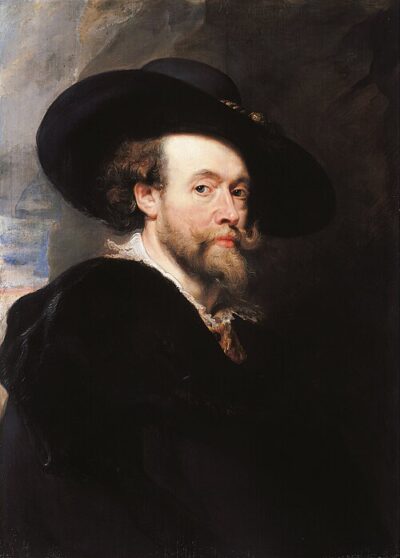
Peter Paul Rubens
Peter Paul Rubens was a Flemish painter. Born June 28, 1577, in Siegen. Died May 30, 1640, in Antwerp. Positions held include court painter (2 times) (1600–). Known for The Fall of the Damned, The Tiger Hunt and Rubens and Isabella Brant in the honeysuckle bower. Educated at University of Cambridge and Old University of Leuven.
Facts
53 facts · 2 confirmed by two sources · 21 cited · 30 from one source
Where this comes from
Papalocal keeps its own record. It started from these sources; what each one said is kept here as it was copied, so a change on their side never changes this page by itself. Tap one to read its version.
What Wikidata says · copied November 16, 2026 · revision 2569377680
- Described as
- Flemish painter (1577–1640)
- Other names
- Pierre Rubens, Petri Paulo Rubbens, Pieter Paul Rubens, Pieter Paul Rubbens, Peter Paul Ruebens, Rubens
- Born
- June 28, 1577 · 3 references
- Died
- May 30, 1640 · 19 references
- Born in
- Siegen · 5 references
- Died in
- Antwerp · 3 references
- Buried in
- St. James' Church, Antwerp · 1 reference
- Cause of death
- heart failure
- Citizen of
- Spanish Netherlands
- Occupation
- diplomat · 2 references; painter · 7 references; graphic artist · 1 reference; printmaker · 3 references; architectural drafter · 1 reference; sculptor · 2 references; visual artist · 1 reference
- Positions held
- court painter (2 times) (1600–) · 1 reference
- Worked for
- Albert VII, Archduke of Austria (1609–); Vincenzo I Gonzaga (1600–1608) · 1 reference; Marie de' Medici (1621–)
- Education
- University of Cambridge; Old University of Leuven
- Member of
- Antwerp Guild of Saint Luke (1598–)
- Genre
- history painting · 1 reference; religious painting; nude; portrait painting · 1 reference; mythological painting; landscape painting · 1 reference
- Known for
- The Fall of the Damned; The Tiger Hunt; Rubens and Isabella Brant in the honeysuckle bower; The Three Graces; The Garden of Love; The Rape of the Daughters of Leucippus; Portrait of Susanna Lunden; The Elevation of the Cross; Henry IV at the Battle of Ivry, 14 March 1590 · 2 references; Drunken Bacchus · 1 reference
- Spouse
- Isabella Brant (1609–1626); Helena Fourment (1630–1640)
- Children
- Albert Rubens; Nicolaas Rubens, Lord of Rameyen · 1 reference; Peter Paul Rubens III; Claire Rubens · 1 reference; Clara Serena Rubens
- Father
- Jan Rubens · 1 reference
- Mother
- Maria Pypelinckx · 1 reference
- Siblings
- Christine von Dietz; Philip Rubens · 1 reference
- Religion
- Catholicism
- Lived in
- Siegen; Cologne · 1 reference; Rome · 1 reference; Antwerp
- Wikipedias with a page
- 175
Wikidata item Q5599 (wikidata.org/wiki/Q5599), public domain (CC0). Copied November 16, 2026.
What Wikipedia says · copied November 16, 2026 · revision 1378127161
Sir Peter Paul Rubens ( ROO-bənz; Dutch: [ˈpeːtər pʌul ˈrybəns]; 28 June 1577 – 30 May 1640) was a Flemish artist and diplomat. He is considered the most influential artist of the Flemish Baroque tradition. Rubens's highly charged compositions reference erudite aspects of classical and Christian history. His unique and immensely popular Baroque style emphasised movement, colour, and sensuality, which followed the immediate, dramatic artistic style promoted in the Counter-Reformation. Rubens was a painter producing altarpieces, portraits, landscapes, and history paintings of mythological and allegorical subjects. He was also a prolific designer of cartoons for the Flemish tapestry workshops and of frontispieces for the publishers in Antwerp.
Rubens was born and raised in the Holy Roman Empire (modern-day Germany) to parents who were refugees from Antwerp in the Duchy of Brabant in the Spanish Netherlands and moved to Antwerp at about 12. In addition to running a large workshop in Antwerp that produced paintings popular with nobility and art collectors throughout Europe, Rubens was a classically educated humanist scholar and diplomat who was knighted by both Philip IV of Spain and Charles I of England. Rubens was a prolific artist. The catalogue of his works by Michael Jaffé lists 1,403 pieces, excluding numerous copies made in his workshop.
His commissioned works were mostly history paintings, which included religious and mythological subjects, and hunt scenes. He painted portraits, especially of friends, and self-portraits, and in later life painted several landscapes. Rubens designed tapestries and prints, as well as his own house. He also oversaw the ephemeral decorations of the royal entry into Antwerp by the Cardinal-Infante Ferdinand of Austria in 1635. He wrote a book with illustrations of the palaces in Genoa, which was published in 1622 as Palazzi di Genova. The book was influential in spreading the Genoese palace style in Northern Europe. Rubens was an avid art collector and had one of the largest collections of art and books in Antwerp. He was also an art dealer and is known to have sold important art objects to George Villiers, 1st Duke of Buckingham.
He was one of the last major artists to make consistent use of wooden panels as a support medium, even for very large works, but used canvas as well, especially when the work needed to be sent a long distance. For altarpieces, he sometimes painted on slate to reduce reflection problems.
- Born, in its opening lines
- June 28, 1577
- Died, in its opening lines
- May 30, 1640
From the Wikipedia article “Peter Paul Rubens” (en.wikipedia.org/wiki/Peter_Paul_Rubens), by its contributors, under CC BY-SA 4.0 (creativecommons.org/licenses/by-sa/4.0/). Copied November 16, 2026; not changed.
Confirmed Two sources agree. Cited One source, and it names where it got it. One source One source, without a reference of its own. Sources disagree The sources disagree. We show the best-supported value and keep theirs below.
