
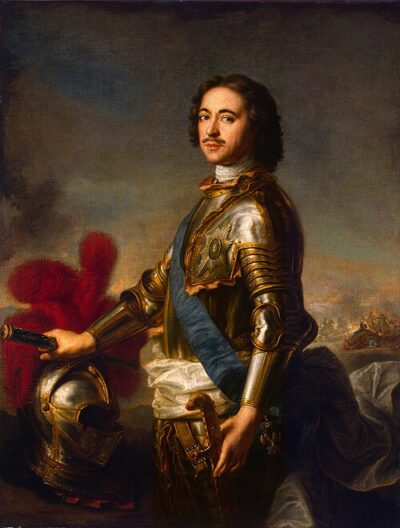
Peter the Great
Peter the Great was a Tsar/Emperor of Russia from 1682 to 1725. Born May 30, 1672, in Moscow. Died January 28, 1725, in Saint Petersburg. Positions held include Tsar of All Russia (1682–1721) and Emperor of all the Russias (1721–1725). Awards include Order of the White Eagle (Polish–Lithuanian Commonwealth), Order of St. Andrew and Knight of the Order of the Elephant.
Facts
49 facts · 0 confirmed by two sources · 18 cited · 29 from one source · 2 where the sources disagree
What’s different
- Born: we show May 30, 1672 (Sources disagree). Wikipedia says June 9, 1672
- Died: we show January 28, 1725 (Sources disagree). Wikipedia says February 8, 1725
Where this comes from
Papalocal keeps its own record. It started from these sources; what each one said is kept here as it was copied, so a change on their side never changes this page by itself. Tap one to read its version.
What Wikidata says · copied November 16, 2026 · revision 2568713004
- Described as
- Tsar/Emperor of Russia from 1682 to 1725
- Other names
- Petr I Alekseevich, Pyotr Velikiy, Petr Alekseevich Romanov, Pyotr Alekseyevich, Pyotr Alexeyevich Romanov, Peter I, Peter I of Russia
- Born
- May 30, 1672 · 4 references
- Died
- January 28, 1725 · 4 references
- Born in
- Moscow · 3 references
- Died in
- Saint Petersburg · 3 references
- Buried in
- Peter and Paul Cathedral
- Cause of death
- gangrene
- Name at birth
- Романов Пётр Алексеевич
- Citizen of
- Tsardom of Russia; Russian Empire
- Occupation
- ruler; statesperson; carpenter; territorial lord · 1 reference
- Positions held
- Tsar of All Russia (1682–1721); Emperor of all the Russias (1721–1725)
- Member of
- French Academy of Sciences (1717–) · 1 reference
- Awards
- Order of the White Eagle (Polish–Lithuanian Commonwealth) (1712); Order of St. Andrew (1703) · 1 reference; Knight of the Order of the Elephant (1713); Order of the White Eagle · 1 reference
- Field
- politics of Russia
- Spouse
- Eudoxia Lopukhina (1689–) · 1 reference; Catherine I of Russia (1707–) · 2 references
- Children
- Alexei Petrovich, Tsarevich of Russia · 1 reference; Anna Petrovna of Russia; Elizabeth I of Russia · 2 references; Natalia Petrovna · 1 reference; Pyotr Petrovich · 1 reference; Natalia Maria Petrovna · 1 reference; Alexander Petrovich · 4 references; Pavel Petrovich Romanov · 1 reference; Katherine Petrovna Romanov · 1 reference; Margaret Petrovna Romanov · 1 reference; Paul Petrovich Romanov · 1 reference
- Father
- Alexei I of Russia · 1 reference
- Mother
- Natalya Naryshkina · 1 reference
- Siblings
- Natalya Alexeevna of Russia; Tsarevna Yevdokia Alekseyevna of Russia; Catherine Alekseyevna of Russia; Maria Alekseyevna of Russia; Marfa Alekseyevna of Russia; Feodosia Alekseyevna of Russia; Ivan V of Russia; Feodor III of Russia; Tsarevich Alexei Alexeyevich of Russia; Tsarevich Dmitry Alexeyevich of Russia
- Religion
- Eastern Orthodoxy; Russian Orthodox Church · 1 reference
- Military rank
- general
- Wikipedias with a page
- 183
Wikidata item Q8479 (wikidata.org/wiki/Q8479), public domain (CC0). Copied November 16, 2026.
What Wikipedia says · copied November 16, 2026 · revision 1385516640
Peter I (9 June 1672 – 8 February 1725), known by the epithet the Great, was the tsar of all Russia from 1682 to 1721, and the first emperor of Russia from 1721 until his death in 1725. He reigned jointly with his brother, Ivan V, from 1682 until Ivan's death in 1696.
Much of Peter's reign was consumed by lengthy wars against the Ottoman and Swedish empires. His Azov campaigns were followed by the foundation of the Russian Navy; after his victory in the Great Northern War, Russia annexed a significant portion of the eastern Baltic coastline and was officially raised from a tsardom to an empire. Peter led a cultural revolution that replaced some of the traditionalist and medieval social and political systems with ones that were modern, scientific, Westernized, and based on the radical Enlightenment.
In December 1699, he introduced the Julian calendar, and in 1703, he introduced the first Russian newspaper, Sankt-Peterburgskie Vedomosti, and ordered the civil script, a reform of Russian orthography largely designed by himself. On the shores of the Neva River, he founded Saint Petersburg, a city famously dubbed by Francesco Algarotti as the "window to the West". In 1712, Peter relocated the capital from Moscow to St. Petersburg, a status it retained until 1918. Peter had a great interest in plants, animals and minerals, in malformed creatures or exceptions to the law of nature for his cabinet of curiosities. He encouraged research of deformities, all along trying to debunk the superstitious fear of monsters. He promoted industrialization in the Russian Empire and higher education. The Russian Academy of Sciences and Saint Petersburg State University were founded in 1724, and invited Christian Wolff and Willem 's Gravesande.
Peter is primarily credited with the modernization of the country, quickly transforming it into a major European power. His administrative reforms, creating a Governing Senate in 1711, the Collegium in 1717 and the Table of Ranks in 1722, had a lasting impact on Russia, and many institutions of the Russian government trace their origins to his reign.
- Born, in its opening lines
- June 9, 1672
- Died, in its opening lines
- February 8, 1725
From the Wikipedia article “Peter the Great” (en.wikipedia.org/wiki/Peter_the_Great), by its contributors, under CC BY-SA 4.0 (creativecommons.org/licenses/by-sa/4.0/). Copied November 16, 2026; not changed.
Confirmed Two sources agree. Cited One source, and it names where it got it. One source One source, without a reference of its own. Sources disagree The sources disagree. We show the best-supported value and keep theirs below.
