
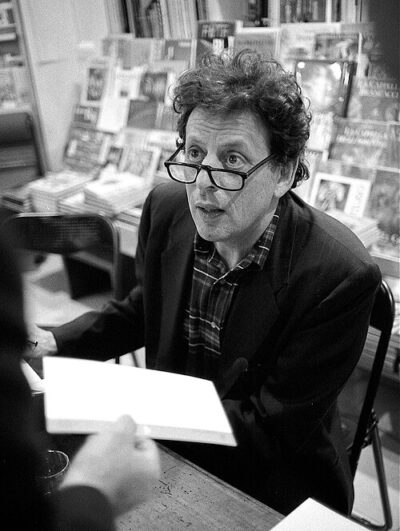
Philip Glass
Philip Glass is an American composer. Born January 31, 1937, in Baltimore. Known for Symphony No. 7, Monsters of Grace and Symphony No. 4. Educated at Juilliard School and University of Chicago. Awards include Chevalier des Arts et des Lettres, Praemium Imperiale and BAFTA Award for Best Original Music.
Facts
44 facts · 1 confirmed by two sources · 10 cited · 33 from one source
Where this comes from
Papalocal keeps its own record. It started from these sources; what each one said is kept here as it was copied, so a change on their side never changes this page by itself. Tap one to read its version.
What Wikidata says · copied November 13, 2026 · revision 2563778798
- Described as
- American composer (born 1937)
- Other names
- Philip Morris Glass, Phil Glass
- Born
- January 31, 1937 · 12 references
- Born in
- Baltimore · 2 references
- Name at birth
- Philip Morris Glass
- Citizen of
- United States · 1 reference
- Occupation
- composer · 3 references; pianist; film score composer; librettist; supporting actor
- Education
- Juilliard School (1956–1959) · 1 reference; University of Chicago (1952–) · 1 reference; Fontainebleau Schools; Peabody Institute
- Member of
- American Academy of Arts and Letters; American Academy of Arts and Sciences; American Philosophical Society
- Genre
- opera; symphony; Dixieland jazz · 1 reference; minimalist music
- Instrument
- piano; bass instrument · 1 reference; drum kit · 1 reference
- Record label
- Virgin Records
- Known for
- Symphony No. 7; Monsters of Grace; Symphony No. 4; La Belle et la Bête
- Awards
- Chevalier des Arts et des Lettres; Praemium Imperiale (2012) · 1 reference; BAFTA Award for Best Original Music (2003); Glenn Gould Prize (2015); James Parks Morton Interfaith Award; Fulbright Scholarship; Fellow of the American Academy of Arts and Sciences; Classic Brit Awards; National Medal of Arts · 1 reference; Kennedy Center Honors · 1 reference
- Spouse
- JoAnne Akalaitis · 1 reference
- Children
- Juliet Glass; Marlowe Glass
- Religion
- Buddhism; Judaism
- Website
- https://philipglass.com/
- Wikipedias with a page
- 64
Wikidata item Q189729 (wikidata.org/wiki/Q189729), public domain (CC0). Copied November 13, 2026.
What Wikipedia says · copied November 13, 2026 · revision 1385111656
Philip Morris Glass (born January 31, 1937) is an American composer and pianist. He is widely regarded as one of the most influential composers of the late 20th century. Glass's work has been associated with minimalism, being built up from repetitive phrases and shifting layers. He described himself as a composer of "music with repetitive structures", which he has helped to evolve stylistically.
Glass founded the Philip Glass Ensemble in 1968. He has written 15 operas, numerous chamber operas and musical theatre works, 15 symphonies, 12 concertos, nine string quartets, various other chamber music pieces, and many film scores. He has received nominations for four Grammy Awards, including two for Best Contemporary Classical Composition for Satyagraha (1987) and String Quartet No. 2 (1988). He has received three Academy Award for Best Original Score nominations for Martin Scorsese's Kundun (1997), Stephen Daldry's The Hours (2002), and Richard Eyre's Notes on a Scandal (2006). He also composed the scores for Koyaanisqatsi (1982), Mishima: A Life in Four Chapters (1985), Hamburger Hill (1987), The Thin Blue Line (1988), Candyman (1992), The Truman Show (1998), and The Illusionist (2006).
Glass is known for composing the operas Einstein on the Beach (1976), Satyagraha (1980), Akhnaten (1983), The Voyage (1992), and The Perfect American (2013). He also wrote the scores for Broadway productions such as the revivals of The Elephant Man (2002), The Crucible (2016), and King Lear (2019). For the last he won the Drama Desk Award for Outstanding Music in a Play.
Glass has received many accolades, including a BAFTA Award, a Drama Desk Award, and a Golden Globe Award, as well as nominations for three Academy Awards, four Grammy Awards, and a Primetime Emmy Award. He has also received the Ordre des Arts et des Lettres in 1995, the National Medal of Arts in 2010, the Kennedy Center Honors in 2018, and the Grammy Trustees Award in 2020.
- Born, in its opening lines
- January 31, 1937
From the Wikipedia article “Philip Glass” (en.wikipedia.org/wiki/Philip_Glass), by its contributors, under CC BY-SA 4.0 (creativecommons.org/licenses/by-sa/4.0/). Copied November 13, 2026; not changed.
Confirmed Two sources agree. Cited One source, and it names where it got it. One source One source, without a reference of its own. Sources disagree The sources disagree. We show the best-supported value and keep theirs below.
