
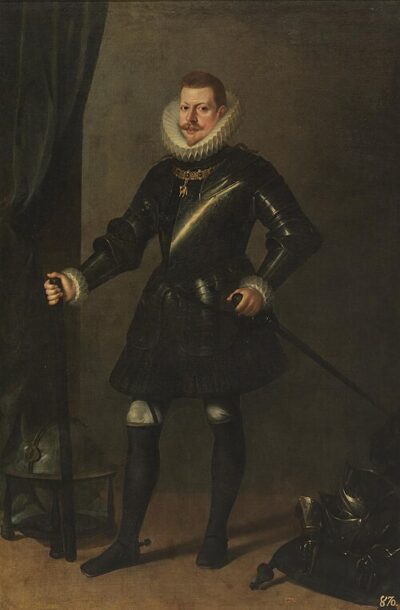
Philip III of Spain
Philip III of Spain was a King of Castilla and León and King of Aragon and Portugal. Born April 14, 1578, in Madrid. Died March 31, 1621, in Madrid. Positions held include Monarch of Castile and Leon (1598–1621), Monarch of Portugal (1598–1621) and monarch of the Crown of Aragon (1598–1621). Known for Cartas autógrafas de Felipe III a su hija D.a Ana, reina de Francia. Awards include Knight of the Order of the Golden Fleece and Grand Master of the Order of the Tower and Sword.
Facts
36 facts · 2 confirmed by two sources · 10 cited · 24 from one source
Where this comes from
Papalocal keeps its own record. It started from these sources; what each one said is kept here as it was copied, so a change on their side never changes this page by itself. Tap one to read its version.
What Wikidata says · copied November 16, 2026 · revision 2567946436
- Described as
- King of Castilla and León and King of Aragon and Portugal (1578-1621)
- Other names
- Philip II of Portugal, Philip III, Phillip III of Spain
- Born
- April 14, 1578 · 4 references
- Died
- March 31, 1621 · 11 references
- Born in
- Madrid · 2 references
- Died in
- Madrid · 2 references
- Buried in
- Royal Crypt of the Royal Monastery of San Lorenzo de El Escorial · 1 reference
- Citizen of
- Spain · 1 reference; Kingdom of Portugal
- Occupation
- ruler
- Positions held
- Monarch of Castile and Leon (1598–1621); Monarch of Portugal (1598–1621); monarch of the Crown of Aragon (1598–1621); Prince of Asturias (1584–1598) · 1 reference; monarch; King of Sardinia (1598–1621)
- Known for
- Cartas autógrafas de Felipe III a su hija D.a Ana, reina de Francia
- Awards
- Knight of the Order of the Golden Fleece; Grand Master of the Order of the Tower and Sword
- Spouse
- Margaret of Austria, Queen of Spain (1599–) · 2 references
- Children
- Anne of Austria · 1 reference; Philip IV of Spain · 1 reference; Maria Anna of Spain; Infante Carlos of Spain; Cardinal-Infante Ferdinand of Austria; Infante Alonso of Austria; Infanta Margarita of Spain · 1 reference; Infanta Maria of Austria · 1 reference
- Father
- Philip II of Spain · 1 reference
- Mother
- Anna of Austria, Queen of Spain · 1 reference
- Siblings
- Isabella Clara Eugenia of Spain; Catalina Micaela of Spain; Carlos, Prince of Asturias; Ferdinand, Prince of Asturias; Diego, Prince of Asturias; Infanta Maria of Spain; Infante Carlos Lorenzo of Spain
- Religion
- Catholic Church
- Wikipedias with a page
- 80
Wikidata item Q34464 (wikidata.org/wiki/Q34464), public domain (CC0). Copied November 16, 2026.
What Wikipedia says · copied November 16, 2026 · revision 1385926181
Philip III (Spanish: Felipe III, Portuguese: Filipe II; 14 April 1578 – 31 March 1621) was King of Spain and Portugal (as Philip II) during the period known as the Iberian Union, reigning from 1598 until his death in 1621. He was also King of Naples and Sicily, Duke of Milan, and Lord of the Seventeen Provinces. A member of the House of Habsburg, he was born in Madrid to King Philip II of Spain and his fourth wife, Anna of Austria. The family was heavily inbred; Philip II and Anna were uncle and niece, as well as cousins.
One year after inheriting the throne, he married his Habsburg cousin Margaret of Austria, the sister of Ferdinand II, Holy Roman Emperor. Philip quickly delegated most of his power and duties to his chief minister, the Duke of Lerma, whose influence shaped much of his reign. In the outskirts of his territories, military power was upheld by successful but capricious proconsuls, such as Ambrogio Spinola and the Duke of Osuna. Philip is associated with a period of relative peace in Western Europe, called the Pax Hispanica by some historians, but his lack of focus contributed to the Spanish Empire's gradual decline.
Although known in Spain as "Philip the Pious", his international political reputation has been negative. Historians C. V. Wedgwood, R. A. Stradling, and J. H. Elliott have described him as an "undistinguished and insignificant man", a "miserable monarch", and a "pallid, anonymous creature, whose only virtue appeared to reside in a total absence of vice." In particular, Philip's reliance on the Duke of Lerma drew much criticism. Many historians trace Spain's decline to the economic difficulties that began early in his reign. Nonetheless, as the ruler of the Spanish Empire at its height, the king who achieved a temporary peace with the Dutch (1609–1621), and who brought Spain into the Thirty Years' War (1618–1648) through an initially successful campaign, his reign remains a pivotal period in Spanish history.
- Born, in its opening lines
- April 14, 1578
- Died, in its opening lines
- March 31, 1621
From the Wikipedia article “Philip III of Spain” (en.wikipedia.org/wiki/Philip_III_of_Spain), by its contributors, under CC BY-SA 4.0 (creativecommons.org/licenses/by-sa/4.0/). Copied November 16, 2026; not changed.
Confirmed Two sources agree. Cited One source, and it names where it got it. One source One source, without a reference of its own. Sources disagree The sources disagree. We show the best-supported value and keep theirs below.
