
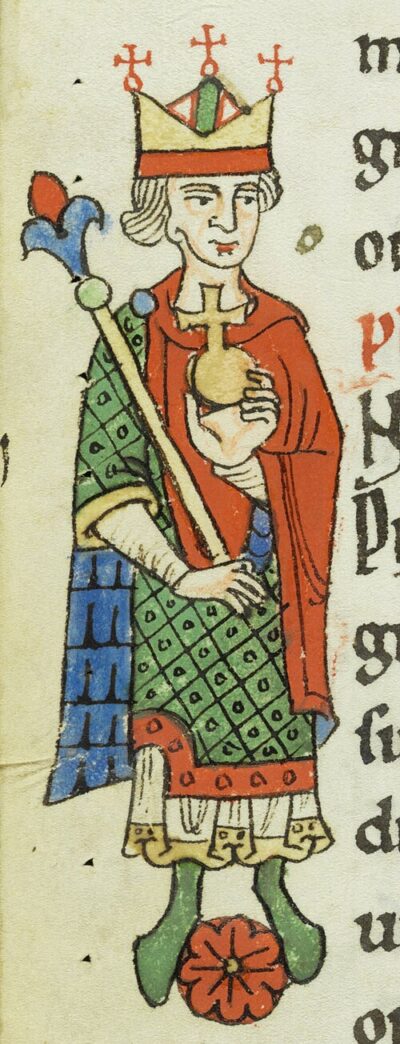
Philip of Swabia
Philip of Swabia was a King of the Germans, Duke of Toscana and Swabia (February/March 1177 – 21 June 1208). Born August 1177, in Pavia. Died June 21, 1208, in Bamberg. Positions held include King of the Romans (1198–1208), Duke of Swabia and Roman Catholic bishop of Würzburg (1190–).
Facts
24 facts · 1 confirmed by two sources · 12 cited · 10 from one source · 1 where the sources disagree
What’s different
- Born: we show August 1177 (Sources disagree). Wikipedia says March 1177
Where this comes from
Papalocal keeps its own record. It started from these sources; what each one said is kept here as it was copied, so a change on their side never changes this page by itself. Tap one to read its version.
What Wikidata says · copied November 16, 2026 · revision 2569145754
- Described as
- King of the Germans, Duke of Toscana and Swabia (February/March 1177 – 21 June 1208)
- Other names
- Philipp von Schwaben, Philipp II
- Born
- August 1177
- Died
- June 21, 1208 · 2 references
- Born in
- Pavia · 2 references
- Died in
- Bamberg · 3 references
- Buried in
- Speyer Cathedral
- Citizen of
- Germany · 1 reference
- Occupation
- Catholic priest; Catholic bishop · 1 reference
- Positions held
- King of the Romans (1198–1208); Duke of Swabia; Roman Catholic bishop of Würzburg (1190–) · 3 references
- Spouse
- Irene Angelina (1197–1208) · 2 references
- Children
- Beatrice of Swabia · 1 reference; Kunigunde of Hohenstaufen · 1 reference; Elisabeth of Swabia · 1 reference; Marie of Hohenstaufen · 1 reference
- Father
- Frederick Barbarossa · 1 reference
- Mother
- Beatrice I, Countess of Burgundy · 1 reference
- Siblings
- Frederick V, Duke of Swabia; Conrad II, Duke of Swabia; Otto I, Count of Burgundy; Frederick VI, Duke of Swabia; Henry VI · 1 reference
- Religion
- Catholic Church · 1 reference
- Wikipedias with a page
- 44
Wikidata item Q121130 (wikidata.org/wiki/Q121130), public domain (CC0). Copied November 16, 2026.
What Wikipedia says · copied November 16, 2026 · revision 1381968975
Philip of Swabia (German: Philipp von Schwaben; February/March 1177 – 21 June 1208), styled Philip II in his charters, was a member of the House of Hohenstaufen and King of Germany from 1198 until his assassination.
The death of Philip's older brother Henry VI, Holy Roman Emperor, in 1197 meant that the Hohenstaufen rule (which reached as far as the Kingdom of Sicily) collapsed in imperial Italy and created a power vacuum to the north of the Alps. Reservations about the kingship of Henry's underage son, Frederick, led to two royal elections in 1198, which resulted in the German throne dispute: the two elected kings, Philip of Swabia and Otto of Brunswick, claimed the throne for themselves. Both opponents tried in the following years through European and papal support, with the help of money and gifts, through demonstrative public appearances and rituals, to decide the conflict for oneself by raising ranks or by military and diplomatic measures. Philip was able to increasingly assert his kingship against Otto in the north part of the Alps. However, at the height of his power, he was assassinated in 1208. This ended the dispute for the throne; his opponent Otto quickly found recognition. Philip was the first German king to be murdered during his reign.
- Born, in its opening lines
- March 1177
- Died, in its opening lines
- June 21, 1208
From the Wikipedia article “Philip of Swabia” (en.wikipedia.org/wiki/Philip_of_Swabia), by its contributors, under CC BY-SA 4.0 (creativecommons.org/licenses/by-sa/4.0/). Copied November 16, 2026; not changed.
Confirmed Two sources agree. Cited One source, and it names where it got it. One source One source, without a reference of its own. Sources disagree The sources disagree. We show the best-supported value and keep theirs below.
