
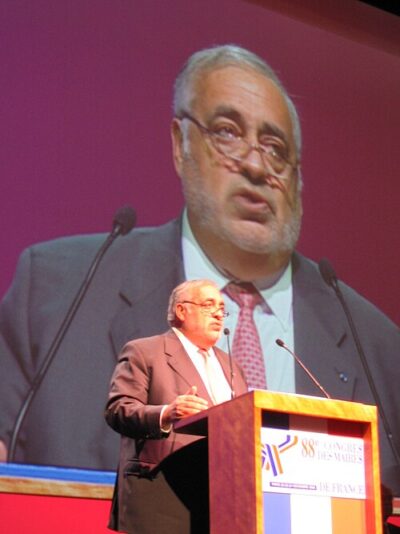
Philippe Séguin
Philippe Séguin was a French politician. Born April 21, 1943, in Tunis. Died January 7, 2010, in 16th arrondissement of Paris. Positions held include Ministry of Labour, Mayor of Épinal (1983–1997) and regional council member. Educated at Sciences Po Aix-en-Provence and École nationale d'administration. Awards include Grand Cross of the National Order of Merit, Officer of Arts and Letters and Knight of the French Order of Academic Palms.
Facts
32 facts · 2 confirmed by two sources · 8 cited · 22 from one source
Where this comes from
Papalocal keeps its own record. It started from these sources; what each one said is kept here as it was copied, so a change on their side never changes this page by itself. Tap one to read its version.
What Wikidata says · copied November 18, 2026 · revision 2569818637
- Described as
- French politician (1943-2010)
- Other names
- Philippe Seguin, Philippe Daniel Alain Seguin
- Born
- April 21, 1943 · 6 references
- Died
- January 7, 2010 · 12 references
- Born in
- Tunis · 3 references
- Died in
- 16th arrondissement of Paris · 1 reference
- Cause of death
- myocardial infarction
- Name at birth
- Philippe Daniel Alain Séguin · 1 reference
- Citizen of
- France
- Occupation
- politician · 1 reference
- Positions held
- Ministry of Labour; Mayor of Épinal (1983–1997); regional council member; First President of the Court of Auditors of France; substitute member of the Parliamentary Assembly of the Council of Europe (1997–2002) · 1 reference
- Political party
- Union of Democrats for the Republic; Union for the New Republic; Rally for the Republic
- Education
- Sciences Po Aix-en-Provence; École nationale d'administration (1968–1970); Paris Institute of Political Studies; Carnot high school Tunis; Paul Cézanne University
- Awards
- Grand Cross of the National Order of Merit; Officer of Arts and Letters; Knight of the French Order of Academic Palms; Officer of the National Order of Quebec (2000) · 1 reference; Knight of the Order of Agricultural Merit; Grand Cross 1st class of the Order of Merit of the Federal Republic of Germany; Order of Stara Planina; Grand Cross of the Order of Civil Merit (2005) · 1 reference; Grand Cross of the Order of Wissam Alaouite (1996) · 1 reference; Marcel Pollitzer Prize (1991) · 1 reference
- Children
- Catherine Séguin
- Wikipedias with a page
- 21
Wikidata item Q543332 (wikidata.org/wiki/Q543332), public domain (CC0). Copied November 18, 2026.
What Wikipedia says · copied November 18, 2026 · revision 1378243337
Philippe Séguin (French pronunciation: [filip seɡɛ̃]; 21 April 1943 – 7 January 2010) was a French political figure who was President of the National Assembly from 1993 to 1997 and President of the Cour des Comptes of France from 2004 to 2010.
He entered the Court of Financial Auditors in 1970, but he began a political career in the Neo-Gaullist party RPR. In 1978, he was elected to the National Assembly as a deputy for the Vosges département. He was Mayor of Épinal between 1983 and 1997.
Representing the social tradition of Gaullism, he was Minister of Social Affairs in Jacques Chirac's cabinet, from 1986 to 1988.
After Chirac's defeat at the 1988 presidential election, he allied with Charles Pasqua and criticized the abandonment of Gaullist doctrine by the RPR executive. He accused Alain Juppé and Édouard Balladur of wanting an alignment on liberal and pro-European policies.
In 1992, he played a leading role in the No campaign against the Maastricht Treaty. On the eve of the vote he opposed President François Mitterrand in a televised debate.
As president of the National Assembly from 1993 to 1997, he supported the winning candidacy of Jacques Chirac at the 1995 presidential election. He inspired the theme of Chirac's campaign which was named "the social fracture".
Their relations deteriorated when he took the lead of the RPR, after the right-wing defeat at the 1997 legislative election. He failed to change the name of the party to "The Rally". He criticized the ascendancy of President Chirac within the party, refusing to be the leader of a "Chirac's fan-club". He resigned in 1999 just before the European elections, leaving his deputy Nicolas Sarkozy in charge.
As the RPR's official candidate, he lost the 2001 mayoral election in Paris, mostly due to a heavily criticized campaign marred by gaffes and controversy. Refusing the merger of the Neo-Gaullist party with the right-wing classical forces in the Union for a Popular Movement, he quit politics in 2002.
He died at the age of 66 on 7 January 2010 from a heart attack.
- Born, in its opening lines
- April 21, 1943
- Died, in its opening lines
- January 7, 2010
From the Wikipedia article “Philippe Séguin” (en.wikipedia.org/wiki/Philippe_Séguin), by its contributors, under CC BY-SA 4.0 (creativecommons.org/licenses/by-sa/4.0/). Copied November 18, 2026; not changed.
Confirmed Two sources agree. Cited One source, and it names where it got it. One source One source, without a reference of its own. Sources disagree The sources disagree. We show the best-supported value and keep theirs below.
