
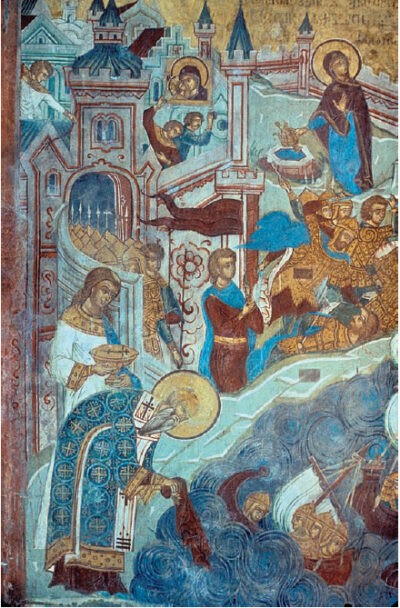
Photios I of Constantinople
Photios I of Constantinople was the 9th Century Ecumenical Patriarch of Constantinople. Born 820, in Constantinople. Died 9th century, in Armenia. Positions held include Ecumenical Patriarch of Constantinople (2 times) (858–886). Known for Bibliotheca and Nomocanon.
Facts
16 facts · 0 confirmed by two sources · 1 cited · 13 from one source · 2 where the sources disagree
What’s different
- Born: we show 820 (Sources disagree). Wikidata also lists 827
- Died: we show 9th century (Sources disagree). Wikipedia says February 6, 893
Where this comes from
Papalocal keeps its own record. It started from these sources; what each one said is kept here as it was copied, so a change on their side never changes this page by itself. Tap one to read its version.
What Wikidata says · copied November 16, 2026 · revision 2568739783
- Described as
- 9th Century Ecumenical Patriarch of Constantinople
- Other names
- Photios the Great, Photius I of Constantinople, Patriarch Photius I of Constantinople, Patriarch Photios I of Constantinople, Photios, Photius
- Born
- 827 · 1 reference; 820 · 2 references
- Died
- 9th century · 1 reference
- Born in
- Constantinople
- Died in
- Armenia
- Citizen of
- Byzantine Empire
- Occupation
- bibliographer; Christian minister; writer; philosopher; patriarch · 1 reference
- Positions held
- Ecumenical Patriarch of Constantinople (2 times) (858–886)
- Known for
- Bibliotheca; Nomocanon
- Father
- Sergios
- Mother
- Irene
- Religion
- Eastern Orthodoxy
- Wikipedias with a page
- 57
Wikidata item Q243187 (wikidata.org/wiki/Q243187), public domain (CC0). Copied November 16, 2026.
What Wikipedia says · copied November 16, 2026 · revision 1376893098
Photios I of Constantinople (; also spelled Photius; Greek: Φώτιος, romanized: Phōtios; c. 815 – 6 February 893) was the Ecumenical Patriarch of Constantinople from 858 to 867 and from 877 to 886. He is recognized in the Eastern Orthodox Church as 'Saint Photius the Great'.
Photios I is widely regarded as the most powerful and influential church leader of Constantinople subsequent to John Chrysostom's archbishopric around the turn of the fifth century. He is also viewed as the most important intellectual of his time—"the leading light of the ninth-century renaissance". He was a central figure in both the conversion of the Slavs to Christianity and the Photian schism, and is considered "[t]he great systematic compiler of the Eastern Church, who occupies a similar position to that of Gratian in the West," and whose "collection in two parts... formed and still forms the classic source of ancient Church Law for the Greek Church".
Photios was a well-educated man from a noble Constantinopolitan family. His mother was the sister of the previous patriarch of Constantinople John VII of Constantinople, and his great-granduncle was another previous patriarch of Constantinople, Saint Tarasius. He intended to be a monk but chose to be a scholar and statesman instead. In 858, Emperor Michael III (r. 842–867) decided to confine Patriarch Ignatius in order to force him into resignation, and Photius, still a layman, was appointed to replace him. Amid power struggles between the pope and the Byzantine emperor, Ignatius was reinstated. Photios I resumed the position when Ignatius died (877), by order of the Byzantine emperor. The new Pope John VIII, approved Photios's reinstatement. Catholics regard as legitimate a Fourth Council of Constantinople (Catholic Church) anathematising Photios I, while Eastern Orthodox regard as legitimate a subsequent Fourth Council of Constantinople (Eastern Orthodox), reversing the former. The contested councils mark the end of unity represented by the first seven Ecumenical Councils.
Photios also worked actively toward reconciliation with the Oriental Orthodox Churches.
- Born, in its opening lines
- c. 815
- Died, in its opening lines
- February 6, 893
From the Wikipedia article “Photios I of Constantinople” (en.wikipedia.org/wiki/Photios_I_of_Constantinople), by its contributors, under CC BY-SA 4.0 (creativecommons.org/licenses/by-sa/4.0/). Copied November 16, 2026; not changed.
Confirmed Two sources agree. Cited One source, and it names where it got it. One source One source, without a reference of its own. Sources disagree The sources disagree. We show the best-supported value and keep theirs below.
