
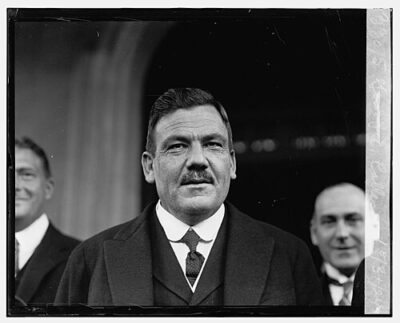
Plutarco Elías Calles
Plutarco Elías Calles was the 47th President of Mexico. Born September 25, 1877, in Heroica Guaymas. Died October 19, 1945, in Mexico City. Positions held include President of Mexico (1924–1928) and minister.
Facts
20 facts · 2 confirmed by two sources · 3 cited · 15 from one source
Where this comes from
Papalocal keeps its own record. It started from these sources; what each one said is kept here as it was copied, so a change on their side never changes this page by itself. Tap one to read its version.
What Wikidata says · copied November 16, 2026 · revision 2562802504
- Described as
- 47th President of Mexico
- Other names
- Francisco Plutarco Elías Campuzano
- Born
- September 25, 1877 · 6 references
- Died
- October 19, 1945 · 7 references
- Born in
- Heroica Guaymas · 1 reference
- Died in
- Mexico City · 2 references
- Citizen of
- Mexico
- Occupation
- politician · 1 reference; military officer; military personnel; president; Secretary of Government
- Positions held
- President of Mexico (1924–1928); minister
- Political party
- Mexican Laborist Party; Institutional Revolutionary Party
- Spouse
- Natalia Chacón · 1 reference
- Children
- Hortensia Elías Calles de Torreblanca; Plutarco Elías Calles Chacón
- Religion
- atheism
- Military branch
- Constitutional Army · 1 reference
- Military rank
- colonel
- Wikipedias with a page
- 50
Wikidata item Q315066 (wikidata.org/wiki/Q315066), public domain (CC0). Copied November 16, 2026.
What Wikipedia says · copied November 16, 2026 · revision 1384003857
Plutarco Elías Calles (born Francisco Plutarco Elías Campuzano; 25 September 1877 – 19 October 1945) was a Mexican politician and military officer who served as the 47th president of Mexico from 1924 to 1928. After the assassination of Álvaro Obregón, Calles founded the Institutional Revolutionary Party and held unofficial power as Mexico's de facto leader from 1929 to 1934, a period known as the Maximato. Previously, he served as a general in the Constitutional Army, as Governor of Sonora, Secretary of War, and Secretary of the Interior. During the Maximato, he served as Secretariat of Public Education, Secretary of War again, and Secretary of the Economy. During his presidency, he implemented many left-wing populist and anticlerical reforms, opposition to which sparked the Cristero War.
Born on 25 September 1877 in Sonora, Calles fought in Venustiano Carranza's Constitutional Army during the Mexican Revolution, which allowed him to rise in politics, joining the cabinets of Presidents Carranza, Adolfo de la Huerta, and Álvaro Obregón. Obregón selected him as the Laborist Party's candidate in the 1924 election. His campaign was the first populist presidential campaign in Mexico's history, as he called for land redistribution and promised equal justice, further labor rights, and democratic governance. He won the election and expanded education, implemented infrastructure projects, and improved public health. After this populist phase (1924–1926) he began to persecute the Catholic Church in Mexico (1926–1928), passing several anticlerical laws that resulted in the Cristero War. He allowed CROM's Luis N. Morones to consolidate unions under the Laborist Party, and launched a failed attempt to cancel the Bucareli Treaty. Obregón still held significant political sway and was Calles's main base of support.
Obregón won the 1928 election but was assassinated as president-elect. Calles prevented political instability by founding the Institutional Revolutionary Party in 1929. During the presidencies of Emilio Portes Gil, Pascual Ortiz Rubio, and Abelardo Rodríguez, Calles served as the kingmaker of Mexican politics, with only Rodríguez able to assert much true influence. During this period, Calles became more ideologically conservative. In 1934, Calles supported Lázaro Cárdenas for president, but Cárdenas exiled him and many of his allies to implement more socialist reforms. Calles was allowed to return to Mexico in 1941, where he died in 1945. His remains are buried in the Monument to the Revolution in Mexico City.
Calles is a controversial figure in Mexican history. Supporters have praised his reforms in areas such as health, infrastructure, and public education, as well as his attempts to separate church and state and to prevent political instability in the wake of Obregón's assassination. Detractors have criticized the escalation of the Cristero War, his crackdowns on labor unions, and for continuing to hold onto power after his presidency. The party he founded, including its two subsequent incarnations, established what Peruvian writer Mario Vargas Llosa would describe as "the perfect dictatorship" and ruled Mexico without democratic opposition for much of the twentieth century through a combination of corruption, repression, and electoral fraud.
- Born, in its opening lines
- September 25, 1877
- Died, in its opening lines
- October 19, 1945
From the Wikipedia article “Plutarco Elías Calles” (en.wikipedia.org/wiki/Plutarco_Elías_Calles), by its contributors, under CC BY-SA 4.0 (creativecommons.org/licenses/by-sa/4.0/). Copied November 16, 2026; not changed.
Confirmed Two sources agree. Cited One source, and it names where it got it. One source One source, without a reference of its own. Sources disagree The sources disagree. We show the best-supported value and keep theirs below.
