
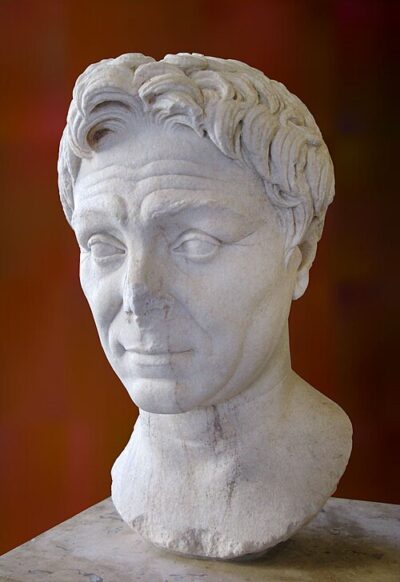
Pompey
Pompey was a Roman general and statesman. Born September 29, 106 BC, in Regio V Picenum. Died September 28, 48 BC, in Pelusium. Positions held include ancient Roman senator, Roman consul (-70) and moneyer (2 times) (-71–-49).
Facts
29 facts · 0 confirmed by two sources · 20 cited · 9 from one source
Where this comes from
Papalocal keeps its own record. It started from these sources; what each one said is kept here as it was copied, so a change on their side never changes this page by itself. Tap one to read its version.
What Wikidata says · copied November 16, 2026 · revision 2569090692
- Described as
- Roman general and statesman (106–48 BC)
- Other names
- Gnaeus Pompeius Magnus, Pompey Magnus, Pompey the Great, Cn. Pompeius Magnus
- Born
- September 29, 106 BC · 3 references
- Died
- September 28, 48 BC · 2 references
- Born in
- Regio V Picenum · 3 references
- Died in
- Pelusium · 1 reference
- Cause of death
- stab wound
- Citizen of
- Ancient Rome · 3 references
- Occupation
- politician · 2 references; military personnel
- Positions held
- ancient Roman senator · 1 reference; Roman consul (-70) · 1 reference; moneyer (2 times) (-71–-49) · 1 reference
- Political party
- optimates
- Member of
- First Triumvirate
- Spouse
- Antistia (-86–-82) · 2 references; Aemilia Scaura (-82) · 2 references; Mucia Tertia (-79–-59) · 2 references; Julia (-59–-54) · 3 references; Cornelia Metella (-52–-48) · 2 references
- Children
- Gnaeus Pompeius Magnus · 3 references; Sextus Pompey · 2 references; Pompeia Magna; Pompeia
- Father
- Gnaeus Pompeius Strabo · 1 reference
- Mother
- Lucilia · 1 reference
- Siblings
- Pompeia · 1 reference; Pompeia · 1 reference
- Religion
- ancient Roman religion
- Military branch
- Roman army · 1 reference
- Military rank
- legatus · 1 reference
- Wikipedias with a page
- 101
Wikidata item Q125414 (wikidata.org/wiki/Q125414), public domain (CC0). Copied November 16, 2026.
What Wikipedia says · copied November 16, 2026 · revision 1385665019
Gnaeus Pompeius Magnus (Latin: [ˈŋnae̯.ʊs pomˈpejʊs ˈmaŋnʊs]; 29 September 106 BC – 28 September 48 BC), known in English as Pompey ( POM-pee) or Pompey the Great, was a Roman general and statesman who was prominent in the final decades of the Roman Republic. As a young man, he was a partisan and protégé of the dictator Sulla, after whose death he achieved significant military and political success.
A member of the senatorial nobility, Pompey entered into a military career at an early age. He rose to prominence serving Sulla as a commander during the civil war of 83–81 BC. His early success as a general allowed him to bypass the traditional cursus honorum (the sequence of public offices required for political advancement), and he was elected as consul on three occasions (70, 55, 52 BC). He celebrated three triumphs and served as a commander in the Sertorian War, the Third Servile War, the Third Mithridatic War, and in various other military campaigns. Pompey's early success led dictator Sulla to grant him the cognomen Magnus – "the Great" – reportedly in reference to Pompey's admiration for Alexander the Great. His adversaries, however, referred to him as adulescentulus carnifex ("teenage butcher") due to his perceived ruthlessness.
In 60 BC, Pompey joined Crassus and Caesar in the informal political alliance known as the First Triumvirate, cemented by Pompey's marriage to Caesar's daughter, Julia. After the deaths of Julia and Crassus (in 54 and 53 BC), Pompey aligned himself with the optimates—a conservative faction of the Roman Senate. Pompey and Caesar subsequently came into conflict over control of the Roman state, which led to Caesar's civil war. Pompey was defeated at the Battle of Pharsalus in 48 BC, and he sought refuge in Ptolemaic Egypt, where he was assassinated by the courtiers of Ptolemy XIII.
From the Wikipedia article “Pompey” (en.wikipedia.org/wiki/Pompey), by its contributors, under CC BY-SA 4.0 (creativecommons.org/licenses/by-sa/4.0/). Copied November 16, 2026; not changed.
Confirmed Two sources agree. Cited One source, and it names where it got it. One source One source, without a reference of its own. Sources disagree The sources disagree. We show the best-supported value and keep theirs below.
