
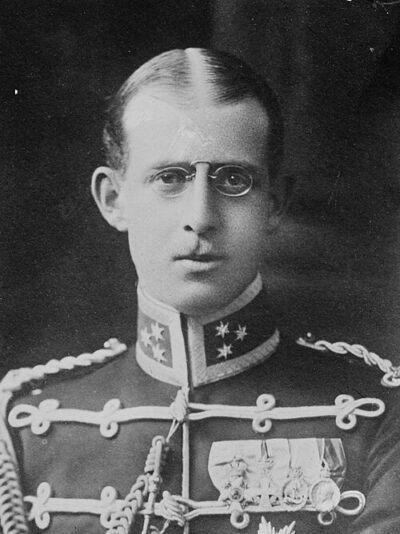
Prince Andrew of Greece and Denmark
Prince Andrew of Greece and Denmark was a Greek prince; father of Prince Philip, Duke of Edinburgh, grandfather Charles III. Born February 2, 1882, in Tatoi Palace. Died December 3, 1944, in Hotel Metropole. Awards include Order of St. Andrew, Order of the Elephant and Order of the Most Holy Annunciation.
Facts
32 facts · 2 confirmed by two sources · 3 cited · 27 from one source
Where this comes from
Papalocal keeps its own record. It started from these sources; what each one said is kept here as it was copied, so a change on their side never changes this page by itself. Tap one to read its version.
What Wikidata says · copied November 16, 2026 · revision 2555571580
- Described as
- Greek prince; father of Prince Philip, Duke of Edinburgh, grandfather Charles III (1882-1944)
- Other names
- Andrew of Greece and Denmark
- Born
- February 2, 1882 · 1 reference
- Died
- December 3, 1944 · 1 reference
- Born in
- Tatoi Palace
- Died in
- Hotel Metropole
- Buried in
- Tatoi Royal Cemetery · 1 reference
- Citizen of
- Greece; Kingdom of Denmark
- Occupation
- military officer · 1 reference
- Awards
- Order of St. Andrew; Order of the Elephant; Order of the Most Holy Annunciation; Knight of the Order of Saints Maurice and Lazarus; Order of the Black Eagle · 1 reference; Royal Victorian Order · 1 reference
- Spouse
- Princess Alice of Battenberg (1903–1944) · 2 references
- Children
- Princess Margarita of Greece and Denmark; Princess Theodora of Greece and Denmark; Princess Cecilie of Greece and Denmark; Princess Sophie of Greece and Denmark; Prince Philip, Duke of Edinburgh · 1 reference
- Father
- George I of Greece
- Mother
- Olga Constantinovna of Russia
- Siblings
- Constantine I of Greece; Prince George of Greece and Denmark; Princess Alexandra of Greece and Denmark; Prince Nicholas of Greece and Denmark; Princess Maria of Greece and Denmark; Princess Olga of Greece and Denmark; Prince Christopher of Greece and Denmark
- Religion
- Eastern Orthodoxy
- Military branch
- Hellenic Army
- Military rank
- general
- Wikipedias with a page
- 48
Wikidata item Q156531 (wikidata.org/wiki/Q156531), public domain (CC0). Copied November 16, 2026.
What Wikipedia says · copied November 16, 2026 · revision 1383654697
Prince Andrew of Greece and Denmark (Greek: Ανδρέας, romanized: Andréas; 2 February [O.S. 21 January] 1882 – 3 December 1944) was the seventh child and fourth son of King George I and Queen Olga of Greece. He was a grandson of King Christian IX of Denmark and the father of Prince Philip, Duke of Edinburgh. He was a prince of Greece and Denmark, both by virtue of his patrilineal descent.
A career soldier, Andrew began military training at an early age and was commissioned as an officer in the Greek army. His command positions were substantive appointments rather than honorary, and he saw service in the Balkan Wars. In 1913, his father was assassinated and Andrew's elder brother Constantine became king. Constantine's neutrality policy during World War I led to his abdication, and most of the royal family, including Andrew, was exiled. On their return a few years later, Andrew saw service as Major General in the Greco-Turkish War (1919–1922), but the war went badly for Greece and Andrew was blamed, in part, for the loss of Greek territory. He was exiled for a second time in 1922 and spent most of the rest of his life in France.
By 1930, Andrew was estranged from his wife, Princess Alice of Battenberg. His only son, Philip, served in the British navy during World War II, while all four of his daughters were married to Germans, three of whom had Nazi connections. Separated from his wife and son by the effects of the war, Andrew died in Monte Carlo in 1944. He had seen neither of them since 1939.
- Born, in its opening lines
- February 2, 1882
- Died, in its opening lines
- December 3, 1944
From the Wikipedia article “Prince Andrew of Greece and Denmark” (en.wikipedia.org/wiki/Prince_Andrew_of_Greece_and_Denmark), by its contributors, under CC BY-SA 4.0 (creativecommons.org/licenses/by-sa/4.0/). Copied November 16, 2026; not changed.
Confirmed Two sources agree. Cited One source, and it names where it got it. One source One source, without a reference of its own. Sources disagree The sources disagree. We show the best-supported value and keep theirs below.
