
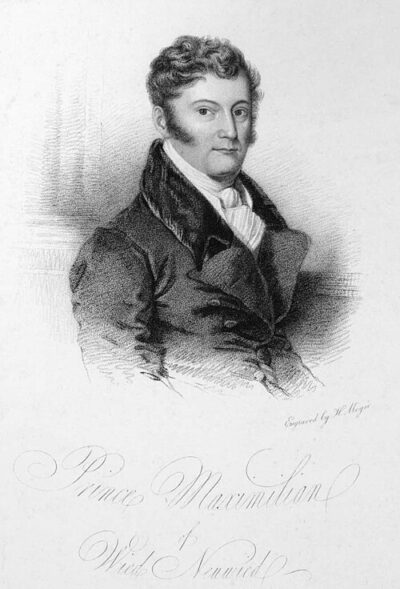
Prince Maximilian of Wied-Neuwied
Prince Maximilian of Wied-Neuwied was a German explorer, ethnologist and naturalist. Born September 23, 1782, in Neuwied. Died February 3, 1867, in Neuwied.
Facts
24 facts · 2 confirmed by two sources · 9 cited · 13 from one source
Where this comes from
Papalocal keeps its own record. It started from these sources; what each one said is kept here as it was copied, so a change on their side never changes this page by itself. Tap one to read its version.
What Wikidata says · copied November 17, 2026 · revision 2568988446
- Described as
- German explorer, ethnologist and naturalist (1782–1867)
- Other names
- Wied-Neuw., Maximilian Alexander Phillipp (Prinz), Wied (zu) M.A.P., Prince Alexander Philipp Maximilian zu Wied-Neuwied, Prince Maximilian von Wied, Prinz Maximilian zu Wied, Prinz zu Wied-Neuwied Maximilian Alexander Philipp
- Born
- September 23, 1782 · 7 references
- Died
- February 3, 1867 · 7 references
- Born in
- Neuwied · 1 reference
- Died in
- Neuwied · 1 reference
- Citizen of
- Kingdom of Prussia; Wied-Neuwied
- Occupation
- explorer · 1 reference; zoologist · 1 reference; ornithologist; naturalist · 2 references; botanist · 1 reference; botanical collector · 5 references; ethnologist · 2 references; draftsperson · 2 references
- Member of
- Bavarian Academy of Sciences and Humanities; Saint Petersburg Academy of Sciences; Russian Academy of Sciences; Royal Prussian Academy of Sciences; German Academy of Sciences Leopoldina; Göttingen Academy of Sciences and Humanities in Lower Saxony
- Field
- ethnology · 1 reference; natural history · 1 reference
- Father
- Friedrich Karl zu Wied-Neuwied
- Mother
- Marie Luise Wilhelmine Gräfin zu Sayn-Wittgenstein-Berleburg
- Wikipedias with a page
- 25
Wikidata item Q61282 (wikidata.org/wiki/Q61282), public domain (CC0). Copied November 17, 2026.
What Wikipedia says · copied November 17, 2026 · revision 1375773433
Prince Alexander Philipp Maximilian zu Wied-Neuwied (23 September 1782 – 3 February 1867) was a German explorer, ethnologist and naturalist. He led a pioneering expedition to southeast Brazil between 1815 and 1817, from which the album Reise nach Brasilien, which first revealed to Europe real images of Brazilian Indians, was the ultimate result. It was translated into several languages and recognized as one of the greatest contributions to the European knowledge of Brazil at the beginning of the nineteenth century. In 1832 he embarked on another expedition, this time to the United States, together with the Swiss painter Karl Bodmer.
Prince Maximilian collected many examples of ethnography, and many specimens of flora and fauna of the area, still preserved in museum collections, notably in the Linden Museum, Stuttgart. The genus Neuwiedia Blume (Orchidaceae) was named for him. Also, Prince Maximilian is honored in the scientific names of eight species of reptiles: Hydromedusa maximiliani, Micrablepharus maximiliani, Bothrops neuwiedi, Polemon neuwiedi, Pseudoboa neuwiedi, Dipsas neuwiedi, Xenodon neuwiedii, and Ramphotyphlops wiedii.
- Born, in its opening lines
- September 23, 1782
- Died, in its opening lines
- February 3, 1867
From the Wikipedia article “Prince Maximilian of Wied-Neuwied” (en.wikipedia.org/wiki/Prince_Maximilian_of_Wied-Neuwied), by its contributors, under CC BY-SA 4.0 (creativecommons.org/licenses/by-sa/4.0/). Copied November 17, 2026; not changed.
Confirmed Two sources agree. Cited One source, and it names where it got it. One source One source, without a reference of its own. Sources disagree The sources disagree. We show the best-supported value and keep theirs below.
