
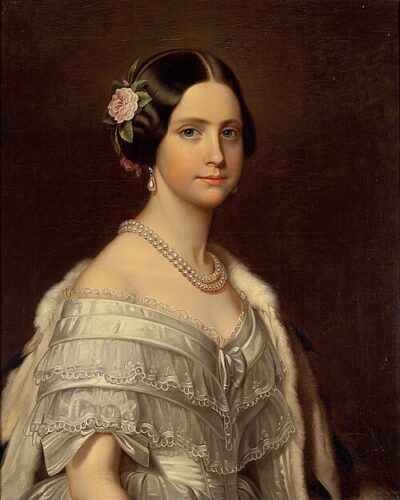
Princess Maria Amélia of Brazil
Princess Maria Amélia of Brazil was a Princess of the Empire of Brazil. Born December 1, 1831, in Paris. Died February 4, 1853, in Funchal. Awards include Order of Saint Elisabeth, Imperial Order of the Rose and Order of Pedro I.
Facts
27 facts · 2 confirmed by two sources · 2 cited · 23 from one source
Where this comes from
Papalocal keeps its own record. It started from these sources; what each one said is kept here as it was copied, so a change on their side never changes this page by itself. Tap one to read its version.
What Wikidata says · copied November 17, 2026 · revision 2567746819
- Described as
- Princess of the Empire of Brazil
- Other names
- Princess Maria Amelia of Brazil
- Born
- December 1, 1831
- Died
- February 4, 1853 · 1 reference
- Born in
- Paris · 1 reference
- Died in
- Funchal · 1 reference
- Buried in
- Rio de Janeiro
- Cause of death
- tuberculosis
- Citizen of
- Brazil
- Awards
- Order of Saint Elisabeth; Imperial Order of the Rose; Order of Pedro I · 1 reference; Order of the Immaculate Conception of Vila Viçosa · 1 reference; Order of Saint Isabel · 1 reference; Order of Queen Maria Luisa · 1 reference; Order of the Starry Cross · 1 reference
- Father
- Pedro I of Brazil
- Mother
- Amélie of Leuchtenberg
- Siblings
- Maria II of Portugal; Princess Paula of Brazil; Isabel Maria de Alcântara, Duchess of Goiás; Princess Francisca of Brazil; Princess Januária, Countess of Aquila; Infante Miguel of Portugal; Prince João Carlos, Prince of Beira; Pedro II of Brazil; Pedro de Alcántara Brasileiro; Maria Isabel de Alcântara, Countess of Iguaçu
- Religion
- Catholicism
- Wikipedias with a page
- 28
Wikidata item Q235815 (wikidata.org/wiki/Q235815), public domain (CC0). Copied November 17, 2026.
What Wikipedia says · copied November 17, 2026 · revision 1358673294
Dona Maria Amélia (1 December 1831 – 4 February 1853) was a princess of the Empire of Brazil and a member of the Brazilian branch of the House of Braganza. Her parents were Emperor Pedro I, the first ruler of Brazil, and Amélie of Leuchtenberg. The only child of her father's second marriage, Maria Amélia was born in France after Pedro I abdicated the Brazilian throne in favor of his son Dom Pedro II. Before Maria Amélia was a month old, Pedro I went to Portugal to restore the crown of the eldest daughter of his first marriage, Dona Maria II. He fought a successful war against his brother Miguel I, who had usurped Maria II's throne.
Only a few months after his victory, Pedro I died from tuberculosis. Maria Amélia's mother took her to Portugal, where she remained for most of her life without ever visiting Brazil. The Brazilian government refused to recognize Maria Amélia as a member of Brazil's Imperial House because she was foreign-born, but when her elder half-brother Pedro II was declared of age in 1840, he successfully intervened on her behalf.
Maria Amélia became engaged to Archduke Maximilian of Austria in early 1852, but before the marriage could take place she contracted tuberculosis, and was taken to the town of Funchal on the Portuguese island of Madeira. Despite its reputedly healthy climate, her health continued to deteriorate, and she died on 4 February 1853. Her body was taken to mainland Portugal and interred in the Pantheon of the House of Braganza; almost 130 years later, her remains were taken to Brazil. In honor of her daughter, Maria Amélia's mother financed the construction of the "Princesa D. Maria Amélia" hospital in Funchal. Maria Amélia's fiancé, Maximilian, made a pilgrimage to Brazil and Madeira, a journey that influenced his acceptance of the throne of Mexico in 1864.
- Born, in its opening lines
- December 1, 1831
- Died, in its opening lines
- February 4, 1853
From the Wikipedia article “Princess Maria Amélia of Brazil” (en.wikipedia.org/wiki/Princess_Maria_Amélia_of_Brazil), by its contributors, under CC BY-SA 4.0 (creativecommons.org/licenses/by-sa/4.0/). Copied November 17, 2026; not changed.
Confirmed Two sources agree. Cited One source, and it names where it got it. One source One source, without a reference of its own. Sources disagree The sources disagree. We show the best-supported value and keep theirs below.
