
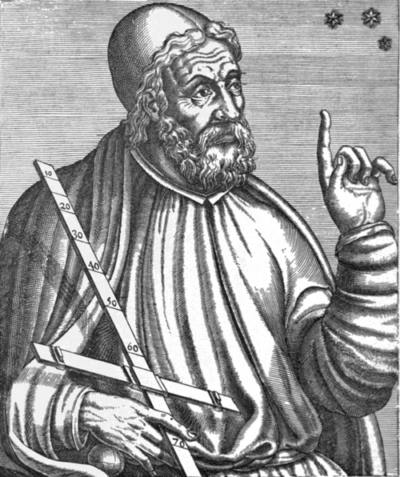
Ptolemy
Ptolemy was the 2nd-century Roman mathematician, astronomer, geographer. Born 100, in Ptolemais Hermiou. Died 170, in Alexandria. Known for Almagest, Geography and List of Roman emperors.
Facts
32 facts · 0 confirmed by two sources · 9 cited · 23 from one source
Where this comes from
Papalocal keeps its own record. It started from these sources; what each one said is kept here as it was copied, so a change on their side never changes this page by itself. Tap one to read its version.
What Wikidata says · copied November 16, 2026 · revision 2568745223
- Described as
- 2nd-century Roman mathematician, astronomer, geographer
- Other names
- Klaudios Ptolemaios, Claudius Ptolemaeus, Claudius Ptolemy, Claudius Ptolemeus
- Born
- 100 · 5 references
- Died
- 170 · 4 references
- Born in
- Ptolemais Hermiou · 1 reference
- Died in
- Alexandria · 1 reference
- Name at birth
- Κλαύδιος Πτολεμαῖος
- Citizen of
- Ancient Rome
- Occupation
- mathematician · 2 references; geographer · 2 references; astronomer · 2 references; astrologer · 1 reference; music theorist; philosopher · 1 reference; musicologist; epigrammatist
- Worked for
- Library of Alexandria
- Known for
- Almagest; Geography; List of Roman emperors; Ptolemaic map; Ptolemy's intense diatonic scale; Ptolemy's table of chords; Ptolemy's inequality; Ptolemy's theorem; equant; quadrant
- Field
- astronomy; astrology; mathematics; mechanics; optics; geography
- Lived in
- Alexandria
- Wikipedias with a page
- 138
Wikidata item Q34943 (wikidata.org/wiki/Q34943), public domain (CC0). Copied November 16, 2026.
What Wikipedia says · copied November 16, 2026 · revision 1380852947
Claudius Ptolemy (; Ancient Greek: Πτολεμαῖος, Ptolemaios; Latin: Claudius Ptolemaeus; c. 100 – 160s/170s AD), better known mononymously as Ptolemy, was a Greco-Roman who wrote about a dozen scientific treatises, three of which were important to later Byzantine, Islamic, and Western European science. The first was his astronomical treatise now known as the Almagest, originally entitled Mathēmatikḗ Syntaxis (Μαθηματικὴ Σύνταξις, 'Mathematical Treatise'). The second is the Geography, which is a thorough discussion on maps and the geographic knowledge of the Greco-Roman world. The third is the astrological treatise in which he attempted to adapt horoscopic astrology to the Aristotelian natural philosophy of his day. This is sometimes known as the Apotelesmatika (Αποτελεσματικά, 'On the Effects') but more commonly known as the Tetrábiblos (from the Koine Greek meaning 'four books'; Latin: Quadripartitum).
The Catholic Church promoted his work, which included the only mathematically sound geocentric model of the Solar System. Unlike that of most Greek mathematicians, Ptolemy's writings (foremost the Almagest) were copied or evaluated in late antiquity and into the Middle Ages. However, it is likely that only a few truly mastered the mathematics necessary to understand his works, as evidenced particularly by the many abridged and watered-down introductions to Ptolemy's astronomy that were popular among the Arabs and Byzantines.
From the Wikipedia article “Ptolemy” (en.wikipedia.org/wiki/Ptolemy), by its contributors, under CC BY-SA 4.0 (creativecommons.org/licenses/by-sa/4.0/). Copied November 16, 2026; not changed.
Confirmed Two sources agree. Cited One source, and it names where it got it. One source One source, without a reference of its own. Sources disagree The sources disagree. We show the best-supported value and keep theirs below.
