
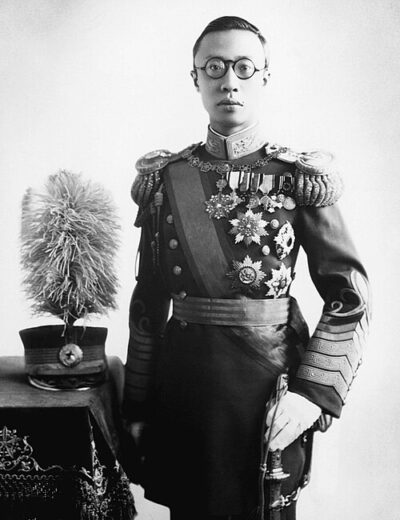
Puyi
Puyi was a Last Emperor of Qing dynasty and Manchukuo. Born February 7, 1906, in Xicheng District. Died October 17, 1967, in Dongcheng District. Positions held include Emperor of China (2 times) (1908–1917), emperor of Manchukuo (1934–1945) and member of the National Committee of the Chinese People's Political Consultative Conference. Awards include Order of the Orchid Blossom, Order of the Illustrious Dragon and Order of the Auspicious Clouds.
Facts
46 facts · 2 confirmed by two sources · 2 cited · 41 from one source · 1 where the sources disagree
What’s different
- Name at birth: we show ᡦᡠ ᡳ (Sources disagree). Wikidata also lists 溥儀
Where this comes from
Papalocal keeps its own record. It started from these sources; what each one said is kept here as it was copied, so a change on their side never changes this page by itself. Tap one to read its version.
What Wikidata says · copied November 16, 2026 · revision 2566037900
- Described as
- Last Emperor of Qing dynasty and Manchukuo (1906–1967)
- Other names
- Henry Puyi, Xuantong, Yaozhi, Kangde, Henry Pu-yi, Kang-te Emperor, Haoran, Aixinjueluo Puyi
- Born
- February 7, 1906 · 9 references
- Died
- October 17, 1967 · 4 references
- Born in
- Xicheng District
- Died in
- Dongcheng District
- Buried in
- grave of Puyi
- Cause of death
- kidney cancer
- Name at birth
- ᡦᡠ ᡳ; 溥儀
- Citizen of
- Qing dynasty · 1 reference; Republic of China; Manchukuo; People's Republic of China
- Occupation
- gardener (1959–1963); archivist; aristocrat; writer · 1 reference; autobiographer
- Positions held
- Emperor of China (2 times) (1908–1917); emperor of Manchukuo (1934–1945); member of the National Committee of the Chinese People's Political Consultative Conference
- Political party
- Chinese Communist Party (1960–)
- Worked for
- China National Botanical Garden (North Garden) (1959–1963); National Library of China (1963–1967)
- Awards
- Order of the Orchid Blossom; Order of the Illustrious Dragon; Order of the Auspicious Clouds; Order of the Rising Sun; Knight of the Order of the Most Holy Annunciation; Knight Grand Cross of the Order of Saints Maurice and Lazarus; Collar of the Supreme Order of the Chrysanthemum (1934); Grand Cordon of the Order of the Paulownia Flowers (1924); Knight Grand Cross with Collar of the Order of Carol I (1941); Knight grand cross of the order of the crown of Italy
- Spouse
- Empress Wanrong; Tan Yuling; Wenxiu; Li Yuqin; Li Shuxian
- Father
- Zaifeng, Prince Chun · 1 reference
- Mother
- Youlan
- Siblings
- Yunhuan; Jin Yunying; Pujie; Jin Youzhi; Yunhe
- Religion
- Buddhism
- Military rank
- generalissimo
- Wikipedias with a page
- 85
Wikidata item Q185152 (wikidata.org/wiki/Q185152), public domain (CC0). Copied November 16, 2026.
What Wikipedia says · copied November 16, 2026 · revision 1384167963
Puyi (Chinese: 溥儀; pinyin: Pǔ Yí; Wade–Giles: P'u-i; 7 February 1906 – 17 October 1967) was the last emperor of China, having reigned as the Xuantong Emperor of the Qing dynasty (1908–1912, with a brief restoration in 1917) and later as the Kangde Emperor of Manchukuo, a Japanese puppet state during World War II. After the war, he was held as a war criminal in the Soviet Union and China until 1959, when the Chinese Communist Party granted him amnesty and presented him as a model of successful reeducation.
In 1908, chosen by Empress Dowager Cixi to succeed the childless Guangxu Emperor, Puyi ascended the throne at age two with his father Prince Chun as regent. Following the Xinhai Revolution, Empress Dowager Longyu signed the abdication edict on Puyi's behalf; in return, the Articles of Favorable Treatment allowed him to retain his imperial title and remain in the Forbidden City. From 1 to 12 July 1917, the loyalist general Zhang Xun restored him to the throne. In 1924, warlord Feng Yuxiang expelled him from the palace, and Puyi took refuge in Tianjin.
Following the Japanese invasion of Manchuria, Puyi was installed as chief executive of Manchukuo in 1932 and he was crowned emperor of Manchukuo in 1934. At the end of the Second Sino-Japanese War in 1945, he was captured by the Soviet Red Army, testified at the Tokyo War Crimes Tribunal in 1946, and he was repatriated to the People's Republic of China in 1950. After his release in 1959, Puyi published an autobiography (ghostwritten by Li Wenda) and he worked as a gardener before he became a researcher at the Central Research Institute of Culture and History. In 1964, he was selected as a member of 4th Chinese People's Political Consultative Conference. After the Cultural Revolution broke out in 1966, he was protected by Zhou Enlai, and he died without issue in 1967.
- Born, in its opening lines
- February 7, 1906
- Died, in its opening lines
- October 17, 1967
From the Wikipedia article “Puyi” (en.wikipedia.org/wiki/Puyi), by its contributors, under CC BY-SA 4.0 (creativecommons.org/licenses/by-sa/4.0/). Copied November 16, 2026; not changed.
Confirmed Two sources agree. Cited One source, and it names where it got it. One source One source, without a reference of its own. Sources disagree The sources disagree. We show the best-supported value and keep theirs below.
