
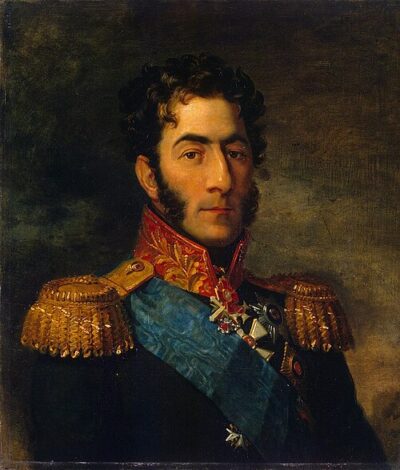
Pyotr Bagration
Pyotr Bagration was a General of the Imperial Russian Army. Born July 10, 1765, in Kizlyar. Died September 24, 1812, in Sima, Vladimir Oblast. Awards include Commander Cross of the Military Order of Maria Theresa, Knight of the Order of St. Alexander Nevsky and Order of the Black Eagle.
Facts
34 facts · 2 confirmed by two sources · 4 cited · 28 from one source
What’s different
- Died: we show September 24, 1812 (Confirmed). Wikidata also lists September 12, 1812
Where this comes from
Papalocal keeps its own record. It started from these sources; what each one said is kept here as it was copied, so a change on their side never changes this page by itself. Tap one to read its version.
What Wikidata says · copied November 16, 2026 · revision 2567628922
- Described as
- General of the Imperial Russian Army (1765–1812)
- Other names
- Petre Bagratiomi, Prince Pyotr Ivanovich Bagration, Prince Bagration
- Born
- July 10, 1765 · 2 references
- Died
- September 12, 1812 · 3 references; September 24, 1812 · 2 references
- Born in
- Kizlyar · 2 references
- Died in
- Sima, Vladimir Oblast
- Buried in
- Yuryev-Polsky District
- Cause of death
- gangrene
- Citizen of
- Russian Empire
- Occupation
- military officer; royalty · 1 reference; military personnel · 2 references
- Awards
- Commander Cross of the Military Order of Maria Theresa; Knight of the Order of St. Alexander Nevsky; Order of the Black Eagle; Order of Saint Anna, 1st class; Order of St. Vladimir, 2nd class; Order of St. Vladimir, 1st class; Order of St. Andrew; Gold Sword for Bravery; Order of St. George, 2nd class; Order of Saint John of Jerusalem; Order of St. George · 1 reference; Order of Saint Alexander Nevsky · 1 reference; Order of Saints Maurice and Lazarus · 1 reference; Military Order of Maria Theresa · 1 reference; Order of Saint John · 1 reference
- Spouse
- Catherine Bagration (1800–) · 4 references
- Children
- Marie-Clementine Bagration
- Father
- Ivan Aleksandrovich Bagration
- Siblings
- Roman Bagration; Alexander Ivanovich Bagration
- Religion
- Georgian Orthodox Church
- Military branch
- Imperial Russian Army
- Military rank
- general; General of the Infantry
- Wikipedias with a page
- 53
Wikidata item Q239260 (wikidata.org/wiki/Q239260), public domain (CC0). Copied November 16, 2026.
What Wikipedia says · copied November 16, 2026 · revision 1383930022
Prince Pyotr Ivanovich Bagration (10 July 1765 – 24 September 1812) was a Russian general and prince of Georgian origin, prominent during the French Revolutionary and Napoleonic Wars.
Bagration, a member of the Bagrationi dynasty, was born in Kizlyar. His father, Ivan (Ivane), served as an officer in the Imperial Russian Army, in which Bagration also enlisted in 1782. Pyotr Ivanovich Bagration began his military career serving in the Russo-Circassian War of 1763–1864. He later participated in a war against the Ottomans and the capture of Ochakov in 1788. Later, he helped suppress the Kościuszko Uprising of 1794 in Poland and capture Warsaw. During Russia's Italian and Swiss campaigns of 1799 against the French, he served with distinction under Field Marshal Alexander Suvorov.
In 1805, Russia joined the coalition against Napoleon. After the collapse of the Austrians at Ulm in October 1805, Bagration won praise for his successful defense in the Battle of Schöngrabern (November 1805) that allowed Russian forces to withdraw and unite with the main Russian army of Mikhail Kutuzov. In December 1805, the combined Russo-Austrian army suffered defeat at the Battle of Austerlitz, where Bagration commanded the allied right wing against the French under Jean Lannes. He commanded Russian troops in the Finnish War (1808–1809) against Sweden and in another war against the Turks (1806–1812) on the Danube.
During the French invasion of Russia in 1812, Bagration commanded one of two large Russian armies (Barclay de Tolly commanded the other) fighting a series of rear-guard actions. The Russians failed to stop the French advance at the Battle of Smolensk in August 1812. Barclay had proposed a scorched-earth retreat that the emperor Alexander I of Russia had approved, although Bagration preferred to confront the French in a major battle. Kutuzov succeeded Barclay as commander-in-chief but continued his policy until the Battle of Borodino (7 September [O.S. 26 August] 1812) near Moscow. Bagration commanded the left wing around what became known as the Bagration flèches at Borodino, where he was mortally wounded; he died two weeks later. Originally buried at a local church, in 1839 he was reburied on the battlefield of Borodino.
- Born, in its opening lines
- July 10, 1765
- Died, in its opening lines
- September 24, 1812
From the Wikipedia article “Pyotr Bagration” (en.wikipedia.org/wiki/Pyotr_Bagration), by its contributors, under CC BY-SA 4.0 (creativecommons.org/licenses/by-sa/4.0/). Copied November 16, 2026; not changed.
Confirmed Two sources agree. Cited One source, and it names where it got it. One source One source, without a reference of its own. Sources disagree The sources disagree. We show the best-supported value and keep theirs below.
