
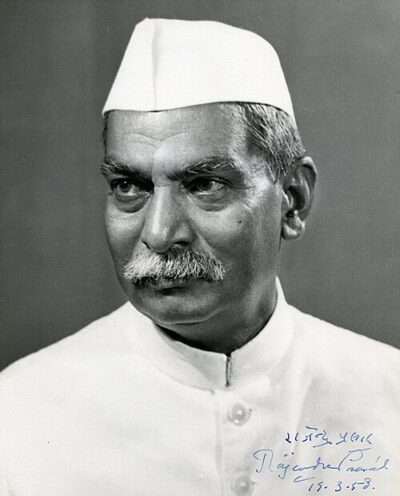
Rajendra Prasad
Rajendra Prasad was an Indian statesman, lawyer and writer (1884–1963); first President of India. Born December 3, 1884, in Ziradei Block. Died February 28, 1963, in Patna. Positions held include President of India (1950–1962), Member of the Constituent Assembly of India (1946–1950) and chairperson (1946–1950). Educated at University of Calcutta and Surendranath College. Awards include Bharat Ratna, honorary doctor of the University of Calcutta and Kai Hansen.
Facts
27 facts · 2 confirmed by two sources · 4 cited · 20 from one source · 1 where the sources disagree
What’s different
- Died in: we show Patna (Sources disagree). Wikidata also lists Craniopagus parasiticus
Where this comes from
Papalocal keeps its own record. It started from these sources; what each one said is kept here as it was copied, so a change on their side never changes this page by itself. Tap one to read its version.
What Wikidata says · copied November 16, 2026 · revision 2563962444
- Described as
- Indian statesman, lawyer and writer (1884–1963); first President of India
- Other names
- Babu Rajendra Prasad, Rajendra Babu, Dr. Rajendra Prasad
- Born
- December 3, 1884 · 6 references
- Died
- February 28, 1963 · 7 references
- Born in
- Ziradei Block · 1 reference
- Died in
- Patna · 1 reference; Craniopagus parasiticus
- Citizen of
- British Raj (–1947); India (1950–); Dominion of India (1947–1950)
- Occupation
- lawyer · 1 reference; politician · 2 references; teacher · 1 reference; scholar · 1 reference; writer
- Positions held
- President of India (1950–1962); Member of the Constituent Assembly of India (1946–1950) · 1 reference; chairperson (1946–1950)
- Political party
- Indian National Congress
- Worked for
- University of Calcutta
- Education
- University of Calcutta; Surendranath College; Presidency University; Surendranath Law College
- Awards
- Bharat Ratna (1962); honorary doctor of the University of Calcutta; Kai Hansen
- Spouse
- Rajavanshi Devi Prasad
- Religion
- Hinduism
- Lived in
- Dr. Rajendra Prasad house
- Wikipedias with a page
- 83
Wikidata item Q197736 (wikidata.org/wiki/Q197736), public domain (CC0). Copied November 16, 2026.
What Wikipedia says · copied November 16, 2026 · revision 1378220236
Rajendra Prasad (3 December 1884 – 28 February 1963) was an Indian politician, lawyer, journalist and scholar who served as the first president of India from 1950 to 1962 for two terms. He joined the Indian National Congress during the Indian independence movement and became a major leader from the region of Bihar. A supporter of Mahatma Gandhi, Prasad was imprisoned by British authorities during the Salt Satyagraha of 1930 and the Quit India movement of 1942. After the constituent assembly 1946 elections, Prasad served as 1st Minister of Food and Agriculture in the central government from 1947 to 1948. Upon independence in 1947, Prasad was elected as President of the Constituent Assembly of India, which prepared the Constitution of India and which served as its provisional Parliament.
When India became a republic in 1950, Prasad was elected as its first president by the Constituent Assembly. As president, Prasad established a tradition for non-partisanship and independence for the office-bearer and retired from Congress party politics. Although a ceremonial head of state, Prasad encouraged the development of education in India and advised government on several occasions. In 1957, Prasad was re-elected to the presidency, becoming the only president to serve two full terms. Prasad stayed in office for the longest term of around 12 years. Post the completion of his tenure, he quit the Congress and set up new guidelines for parliamentarians which are still followed.
- Born, in its opening lines
- December 3, 1884
- Died, in its opening lines
- February 28, 1963
From the Wikipedia article “Rajendra Prasad” (en.wikipedia.org/wiki/Rajendra_Prasad), by its contributors, under CC BY-SA 4.0 (creativecommons.org/licenses/by-sa/4.0/). Copied November 16, 2026; not changed.
Confirmed Two sources agree. Cited One source, and it names where it got it. One source One source, without a reference of its own. Sources disagree The sources disagree. We show the best-supported value and keep theirs below.
