
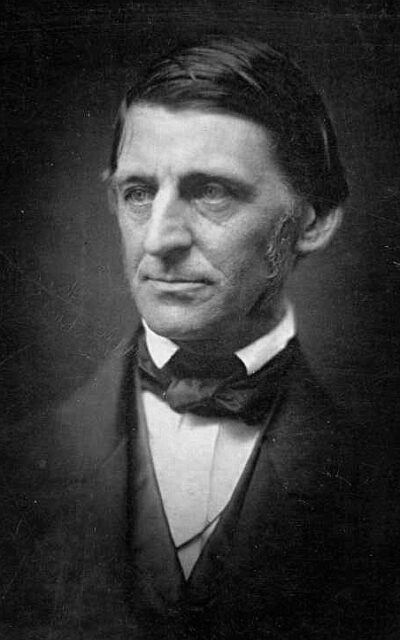
Ralph Waldo Emerson
Ralph Waldo Emerson was an American philosopher. Born May 25, 1803, in Boston. Died April 27, 1882, in Concord. Known for Concord Hymn, The Humble-Bee and Music. Educated at Harvard Divinity School and Harvard College. Awards include Fellow of the American Academy of Arts and Sciences.
Facts
45 facts · 2 confirmed by two sources · 12 cited · 31 from one source
Where this comes from
Papalocal keeps its own record. It started from these sources; what each one said is kept here as it was copied, so a change on their side never changes this page by itself. Tap one to read its version.
What Wikidata says · copied November 13, 2026 · revision 2568219357
- Described as
- American philosopher (1803–1882)
- Other names
- Waldo Emerson, R. W. Emerson
- Born
- May 25, 1803 · 13 references
- Died
- April 27, 1882 · 12 references
- Born in
- Boston · 1 reference
- Died in
- Concord · 1 reference
- Buried in
- Sleepy Hollow Cemetery · 1 reference
- Cause of death
- pneumonia
- Citizen of
- United States
- Occupation
- philosopher · 1 reference; poet · 1 reference; writer · 2 references; essayist; diarist; biographer; Unitarian pastor; Christian minister · 1 reference
- Education
- Harvard Divinity School; Harvard College; Harvard University
- Member of
- American Academy of Arts and Sciences; American Philosophical Society (1867–)
- Genre
- transcendentalism
- Known for
- Concord Hymn; The Humble-Bee; Music; Thine Eyes still shined; Waldeinsamkeit; Woodnotes I
- Awards
- Fellow of the American Academy of Arts and Sciences
- Field
- philosophy; capitalism · 1 reference; individualism · 1 reference; mysticism · 1 reference; creative and professional writing · 1 reference; pastoral care · 1 reference
- Spouse
- Lidian Jackson Emerson · 1 reference; Ellen Louisa Tucker · 1 reference
- Children
- Edith Emerson Forbes; Edward Waldo Emerson · 1 reference
- Father
- William Emerson
- Mother
- Ruth Haskins
- Siblings
- William Emerson; Edward Bliss Emerson; Robert Bulkeley Emerson; Charles Chauncey Emerson
- Religion
- Unitarianism
- Wikipedias with a page
- 156
Wikidata item Q48226 (wikidata.org/wiki/Q48226), public domain (CC0). Copied November 13, 2026.
What Wikipedia says · copied November 13, 2026 · revision 1383340557
Ralph Waldo Emerson (May 25, 1803 – April 27, 1882), who went by his middle name Waldo, was an American essayist, lecturer, philosopher, minister, abolitionist, and poet who led the transcendentalist movement of the mid-19th century. He was seen as a prescient critic of the countervailing pressures of society and conformity.
Emerson gradually moved away from the religious and social views of his contemporaries, formulating and expressing the philosophy of Transcendentalism in his 1836 essay, Nature. His speech "The American Scholar", given in 1837, was called America's "intellectual Declaration of Independence" by Oliver Holmes.
Emerson wrote most of his important essays as lectures, and then revised them for print. His first two collections of essays, Essays: First Series and Essays: Second Series represent the core of his thinking. They include the well-known essays "Self-Reliance", "The Over-Soul", "Circles", "The Poet", and "Experience". Together with "Nature", these essays made the mid-1830s to the mid-1840s Emerson's most fertile period.
Emerson wrote on a number of subjects, never espousing fixed philosophical tenets. He instead developed ideas such as individuality, freedom, the ability for mankind to achieve almost anything, and the relationship between the soul and the surrounding world. Emerson's conception of "nature" was more philosophical than naturalistic: "Philosophically considered, the universe is composed of Nature and the Soul." He was one of several major figures who "took a more pantheist or pandeist approach, by rejecting views of God as separate from the world".
Emerson remains among the linchpins of the American romantic movement, and his work has greatly influenced the thinkers, writers, and poets that followed him. "In all my lectures," he wrote, "I have taught one doctrine, namely, the infinitude of the private man." Emerson is also well-known as a mentor and close friend of his fellow transcendentalist Henry David Thoreau.
- Born, in its opening lines
- May 25, 1803
- Died, in its opening lines
- April 27, 1882
From the Wikipedia article “Ralph Waldo Emerson” (en.wikipedia.org/wiki/Ralph_Waldo_Emerson), by its contributors, under CC BY-SA 4.0 (creativecommons.org/licenses/by-sa/4.0/). Copied November 13, 2026; not changed.
Confirmed Two sources agree. Cited One source, and it names where it got it. One source One source, without a reference of its own. Sources disagree The sources disagree. We show the best-supported value and keep theirs below.
