
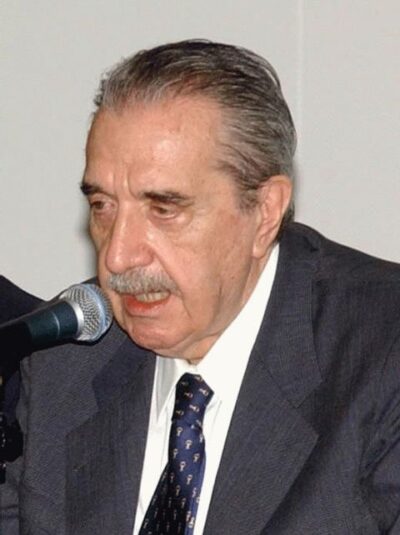
Raúl Alfonsín
Raúl Alfonsín was an Argentine politician. Born March 12, 1927, in Chascomús. Died March 31, 2009, in Buenos Aires. Positions held include President of Argentina (1983–1989), member of the Argentine Chamber of Deputies (1963–1967) and member of the Argentine Chamber of Senators (2001–2002). Educated at University of Buenos Aires and National University of La Plata. Awards include Princess of Asturias Award for International Cooperation, European Human Rights Prize and Knight Grand Cross of the Order of Merit of the Italian Republic.
Facts
28 facts · 2 confirmed by two sources · 4 cited · 22 from one source
Where this comes from
Papalocal keeps its own record. It started from these sources; what each one said is kept here as it was copied, so a change on their side never changes this page by itself. Tap one to read its version.
What Wikidata says · copied November 16, 2026 · revision 2560484750
- Described as
- Argentine politician
- Other names
- Raúl Ricardo Alfonsín, Raul Alfonsin, Raul Ricardo Alfonsin, Raul Alfonsin Foulknes, Raul Alfonsin Foulkes
- Born
- March 12, 1927 · 8 references
- Died
- March 31, 2009 · 8 references
- Born in
- Chascomús
- Died in
- Buenos Aires · 1 reference
- Buried in
- Recoleta Cemetery
- Cause of death
- lung cancer
- Citizen of
- Argentina · 1 reference
- Occupation
- lawyer; politician · 1 reference
- Positions held
- President of Argentina (1983–1989); member of the Argentine Chamber of Deputies (1963–1967) · 1 reference; member of the Argentine Chamber of Senators (2001–2002) · 1 reference
- Political party
- Radical Civic Union
- Education
- University of Buenos Aires; National University of La Plata · 1 reference
- Awards
- Princess of Asturias Award for International Cooperation (1985); European Human Rights Prize; Knight Grand Cross of the Order of Merit of the Italian Republic; Collar of the Order of Isabella the Catholic (1984) · 1 reference; gold Medal of the Community of Madrid (1986); Knight Grand Cross with Collar of the Order of Merit of the Italian Republic; honorary doctorate of the University of Santiago de Compostela; honorary doctor of the University of Brasília; honorary doctor of the University of Madrid Complutense (1988); Grand Cross, Special Class of the Order of the Sun of Peru
- Spouse
- María Lorenza Barreneche
- Children
- Ricardo Alfonsín
- Religion
- Catholic Church
- Wikipedias with a page
- 65
Wikidata item Q193062 (wikidata.org/wiki/Q193062), public domain (CC0). Copied November 16, 2026.
What Wikipedia says · copied November 16, 2026 · revision 1385507415
Raúl Ricardo Alfonsín (Spanish pronunciation: [raˈul riˈkaɾðo alfonˈsin] ; 12 March 1927 – 31 March 2009) was an Argentine lawyer and statesman who served as president of Argentina from 10 December 1983 to 8 July 1989. He was the first democratically elected president after the National Reorganization Process. Ideologically, he identified as a radical and a social democrat, serving as the leader of the Radical Civic Union from 1983 to 1991, 1993 to 1995, 1999 to 2001 . His political approach was known as "Alfonsinism".
Born in Chascomús, Buenos Aires Province, Alfonsín began his studies of law at the National University of La Plata and was a graduate of the University of Buenos Aires. He was affiliated with the Radical Civic Union (UCR), joining the faction of Ricardo Balbín after the party split. He was elected a deputy in the legislature of the Buenos Aires province in 1958, during the presidency of Arturo Frondizi, and a national deputy during the presidency of Arturo Umberto Illia. He opposed both sides of the Dirty War, and several times filed a writ of Habeas corpus, requesting the freedom of victims of forced disappearances, during the National Reorganization Process. He denounced the crimes of the military dictatorships of other countries and opposed the actions of both sides in the Falklands War as well. He became the leader of the UCR after Balbín's death and won the presidency in the 1983 elections as the Radical candidate.
After being elected president, Alfonsín revoked the self-amnesty law established by the military. He established the National Commission on the Disappearance of Persons to investigate the crimes committed by the military, which led to the Trial of the Juntas and resulted in the sentencing of the heads of the former regime. Discontent within the military led to the mutinies of the Carapintadas, which Alfonsín appeased with the full stop law and the law of Due Obedience. He also had conflicts with the unions, which were controlled by the opposing Justicialist Party. He resolved the Beagle conflict, increased trade with Brazil, and proposed the creation of the Contadora support group to mediate between the United States and Nicaragua. He passed the first divorce law of Argentina. He initiated the Austral plan to improve the national economy, but that plan, as well as the Spring plan, failed. The resulting hyperinflation and riots led to his party's defeat in the 1989 presidential elections, which was won by Peronist Carlos Menem.
Alfonsín continued as the leader of the UCR and opposed the presidency of Carlos Menem. He initiated the Pact of Olivos with Menem to negotiate the terms for the 1994 amendment of the Argentine Constitution. Fernando de la Rúa led a faction of the UCR that opposed the pact, and eventually became president in 1999. Following de la Rúa's resignation during the December 2001 riots, Alfonsín's faction provided the support needed for the Peronist Eduardo Duhalde to be appointed president by the Congress. He died of lung cancer on 31 March 2009, at the age of 82, and was given a large state funeral.
- Born, in its opening lines
- March 12, 1927
- Died, in its opening lines
- March 31, 2009
From the Wikipedia article “Raúl Alfonsín” (en.wikipedia.org/wiki/Raúl_Alfonsín), by its contributors, under CC BY-SA 4.0 (creativecommons.org/licenses/by-sa/4.0/). Copied November 16, 2026; not changed.
Confirmed Two sources agree. Cited One source, and it names where it got it. One source One source, without a reference of its own. Sources disagree The sources disagree. We show the best-supported value and keep theirs below.
