
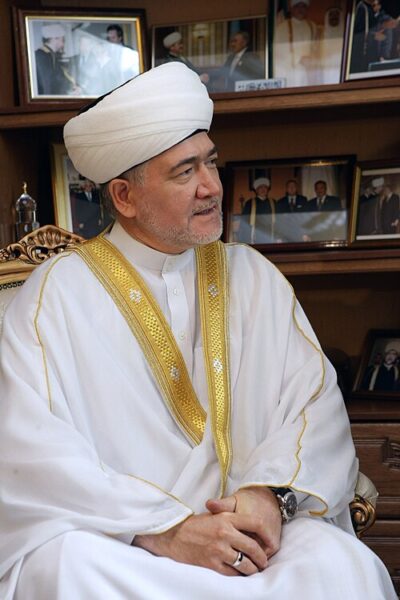
Rawil Ğäynetdin
Rawil Ğäynetdin is a Russian mufti and religious leader. Born August 25, 1959, in Pestrechinsky District. Positions held include Grand Mufti (1994–) and chairperson (1996–). Educated at Shäükät Kh. Biktimerov Kazan Theater College and Mir-i-Arab madrasah. Awards include Order of Honour, Order "For Merit to the Fatherland", 4th class and Order of Friendship.
Facts
28 facts · 0 confirmed by two sources · 2 cited · 26 from one source
Where this comes from
Papalocal keeps its own record. It started from these sources; what each one said is kept here as it was copied, so a change on their side never changes this page by itself. Tap one to read its version.
What Wikidata says · copied November 18, 2026 · revision 2508078246
- Described as
- Russian mufti and religious leader
- Other names
- Rawil Gaynutdin
- Born
- August 25, 1959
- Born in
- Pestrechinsky District
- Citizen of
- Soviet Union; Russia
- Occupation
- mufti · 1 reference; public figure; cleric · 1 reference
- Positions held
- Grand Mufti (1994–); chairperson (1996–)
- Education
- Shäükät Kh. Biktimerov Kazan Theater College; Mir-i-Arab madrasah
- Member of
- first Civic Chamber of the Russian Federation; second Civic Chamber of the Russian Federation
- Awards
- Order of Honour; Order "For Merit to the Fatherland", 4th class; Order of Friendship; Order "For Merit to the Fatherland", 3rd class; Medal "10 years of Astana"; medal "for 20 years of Kazakhstan's independence"; Order "For Merit to the Fatherland", 2nd class · 1 reference; Order "Duslyk" · 1 reference; Medal "For Valiant Labor" · 1 reference; Crimean Republic's awards · 1 reference; Medal of the Order of Merits for the Republic of Tatarstan · 1 reference; Russian Federation Presidential Certificate of Gratitude · 1 reference; Order 'For Valiant Labor' · 1 reference
- Religion
- Sunni Islam; Islam · 1 reference
- Wikipedias with a page
- 22
Wikidata item Q1397219 (wikidata.org/wiki/Q1397219), public domain (CC0). Copied November 18, 2026.
What Wikipedia says · copied November 18, 2026 · revision 1374369341
Ravil Gaynutdin (or Gainutdin; Russian: Рави́ль Исмаги́лович Гайнутди́нов, romanized: Ravil Ismagilovich Gaynutdinov, Tatar: Равил Исмәгыйл улы Гайнетдин, romanized: Rawil İsmäğil ulı Ğäynetdin) is a Moscow-based Mufti and scholar, an ethnic Volga Tatar born in the village of Shali of Pestrechinsky District of the Tatar ASSR, Soviet Union on August 25, 1959.
Gaynutdin has served as one of the Grand Muftis of Russia and the Chairman of the Russian Council of Muftis since July 1, 1996. He is one of the signatories of A Common Word Between Us and You, an open letter by Islamic scholars to Christian leaders, calling for peace and understanding. Gaynutdin has been called a key figure in relations between the Kremlin and Russia's Muslim population and one of the most important people in the Islamic World in Russia.Gaynutdin has put forward ideas such as the following: "I agree with (Nikolay) Karamzin, the excellent Russian historian of the 19th century, who said that Moscow owes its greatness to the khans of the Golden Horde. However, this also applies to all of Russia, because thanks to the political will of the khans, the gathering of the scattered principalities around Moscow began".
From the Wikipedia article “Rawil Ğaynetdin” (en.wikipedia.org/wiki/Rawil_Ğaynetdin), by its contributors, under CC BY-SA 4.0 (creativecommons.org/licenses/by-sa/4.0/). Copied November 18, 2026; not changed.
Confirmed Two sources agree. Cited One source, and it names where it got it. One source One source, without a reference of its own. Sources disagree The sources disagree. We show the best-supported value and keep theirs below.
