
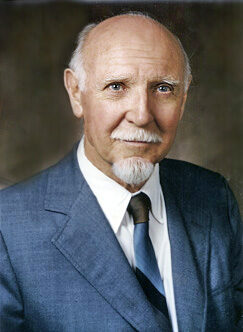
Raymond Cattell
Raymond Cattell was a British-American psychologist. Born March 20, 1905, in West Bromwich. Died February 2, 1998, in Honolulu. Known for 16PF questionnaire and Cattell Culture Fair Intelligence Test. Educated at University College London and King's College London. Awards include Honorary Fellow of the British Psychological Society.
Facts
21 facts · 2 confirmed by two sources · 3 cited · 16 from one source
Where this comes from
Papalocal keeps its own record. It started from these sources; what each one said is kept here as it was copied, so a change on their side never changes this page by itself. Tap one to read its version.
What Wikidata says · copied November 13, 2026 · revision 2560317092
- Described as
- British-American psychologist (1905–1998)
- Other names
- Raymond Bernard Cattell, Raymond B. Cattell
- Born
- March 20, 1905 · 5 references
- Died
- February 2, 1998 · 5 references
- Born in
- West Bromwich · 1 reference
- Died in
- Honolulu · 1 reference
- Citizen of
- United Kingdom; United States
- Occupation
- psychologist · 1 reference; university teacher
- Worked for
- Harvard University; Columbia University; Clark University; University of Hawaiʻi System · 1 reference
- Education
- University College London (–1929); King's College London; Torquay Boys' Grammar School
- Known for
- 16PF questionnaire; Cattell Culture Fair Intelligence Test
- Awards
- Honorary Fellow of the British Psychological Society
- Field
- personality psychology
- Religion
- atheism
- Lived in
- England · 1 reference
- Wikipedias with a page
- 41
Wikidata item Q353133 (wikidata.org/wiki/Q353133), public domain (CC0). Copied November 13, 2026.
What Wikipedia says · copied November 13, 2026 · revision 1371987765
Raymond Bernard Cattell (20 March 1905 – 2 February 1998) was a British-American psychologist, known for his psychometric research into intrapersonal psychological structure. His work also explored the basic dimensions of personality and temperament, the range of cognitive abilities, the dynamic dimensions of motivation and emotion, the clinical dimensions of abnormal personality, patterns of group syntality and social behavior, applications of personality research to psychotherapy and learning theory, predictors of creativity and achievement, and many multivariate research methods including the refinement of factor analytic methods for exploring and measuring these domains. Cattell authored, co-authored, or edited almost 60 scholarly books, more than 500 research articles, and over 30 standardized psychometric tests, questionnaires, and rating scales. According to a widely cited ranking, Cattell was the 16th most eminent, 7th most cited in the scientific journal literature, and among the most productive psychologists of the 20th century.
Cattell was an early proponent of using factor analytic methods instead of what he called "subjective verbal theorizing" to explore empirically the basic dimensions of personality, motivation, and cognitive abilities. One of the results of Cattell's application of factor analysis was his discovery of 16 separate primary trait factors within the normal personality sphere (based on the trait lexicon). He called these factors "source traits". This theory of personality factors and the self-report instrument used to measure them are known respectively as the 16 personality factor model and the 16PF Questionnaire (16PF).
Cattell also undertook a series of empirical studies into the basic dimensions of other psychological domains: intelligence, motivation, career assessment and vocational interests. Cattell theorized the existence of fluid and crystallized intelligence to explain human cognitive ability, investigated changes in Gf and Gc over the lifespan, and constructed the Culture Fair Intelligence Test to minimize the bias of written language and cultural background in intelligence testing.
- Born, in its opening lines
- March 20, 1905
- Died, in its opening lines
- February 2, 1998
From the Wikipedia article “Raymond Cattell” (en.wikipedia.org/wiki/Raymond_Cattell), by its contributors, under CC BY-SA 4.0 (creativecommons.org/licenses/by-sa/4.0/). Copied November 13, 2026; not changed.
Confirmed Two sources agree. Cited One source, and it names where it got it. One source One source, without a reference of its own. Sources disagree The sources disagree. We show the best-supported value and keep theirs below.
