
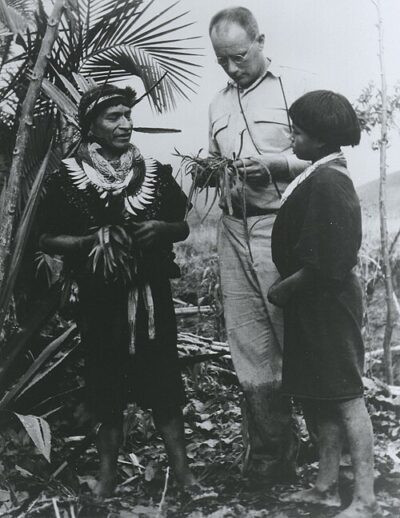
Richard Evans Schultes
Richard Evans Schultes was an American ethnobotanist. Born January 12, 1915, in Boston. Died April 10, 2001, in Boston. Educated at Harvard University. Awards include Guggenheim Fellowship, Tyler Prize for Environmental Achievement and Linnean Medal.
Facts
23 facts · 2 confirmed by two sources · 10 cited · 11 from one source
Where this comes from
Papalocal keeps its own record. It started from these sources; what each one said is kept here as it was copied, so a change on their side never changes this page by itself. Tap one to read its version.
What Wikidata says · copied November 16, 2026 · revision 2561566362
- Described as
- American ethnobotanist (1915-2001)
- Other names
- Schultes, R.E., R. E. Schult., R. E. Schultes, Richard E. Schultes, R.E.Schult.
- Born
- January 12, 1915 · 5 references
- Died
- April 10, 2001 · 4 references
- Born in
- Boston · 2 references
- Died in
- Boston
- Citizen of
- United States
- Occupation
- anthropologist; botanist · 2 references; ethnobotanist; botanical collector · 8 references; scientific collector · 1 reference; biologist · 1 reference
- Worked for
- Harvard University (1953–1985) · 2 references; United States Department of Agriculture · 1 reference
- Education
- Harvard University · 1 reference
- Member of
- American Academy of Arts and Sciences; National Academy of Sciences; The World Academy of Sciences
- Awards
- Guggenheim Fellowship (1942) · 1 reference; Tyler Prize for Environmental Achievement (1987) · 1 reference; Linnean Medal (1992); Fellow of the American Academy of Arts and Sciences
- Field
- ethnobotany · 1 reference
- Lived in
- Cambridge · 1 reference
- Wikipedias with a page
- 21
Wikidata item Q1124975 (wikidata.org/wiki/Q1124975), public domain (CC0). Copied November 16, 2026.
What Wikipedia says · copied November 16, 2026 · revision 1385376857
Richard Evans Schultes (SHULL-tees; January 12, 1915 – April 10, 2001) was an American biologist, considered to be the father of modern ethnobotany. He is known for his studies of the uses of plants by indigenous peoples, especially the indigenous peoples of the Americas. He worked on entheogenic or hallucinogenic plants, particularly in Mexico and the Amazon, involving lifelong collaborations with chemists. He had charismatic influence as an educator at Harvard University; several of his students and colleagues went on to write popular books and assume influential positions in museums, botanical gardens, and popular culture.
His book Plants of the Gods: Origins of Hallucinogenic Use (1979), co-authored with chemist Albert Hofmann, the discoverer of LSD, is considered his greatest popular work: it has never been out of print and was revised into an expanded second edition, based on a German translation by Christian Rätsch (1998), in 2001.
- Born, in its opening lines
- January 12, 1915
- Died, in its opening lines
- April 10, 2001
From the Wikipedia article “Richard Evans Schultes” (en.wikipedia.org/wiki/Richard_Evans_Schultes), by its contributors, under CC BY-SA 4.0 (creativecommons.org/licenses/by-sa/4.0/). Copied November 16, 2026; not changed.
Confirmed Two sources agree. Cited One source, and it names where it got it. One source One source, without a reference of its own. Sources disagree The sources disagree. We show the best-supported value and keep theirs below.
