
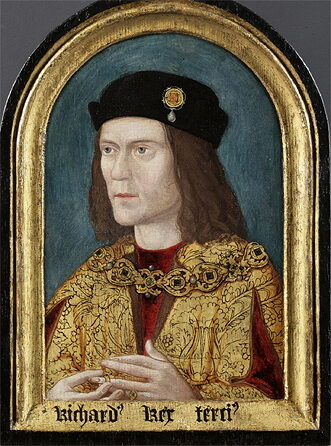
Richard III of England
Richard III of England was a king of England from 1483 to 1485. Born October 2, 1452, in Fotheringhay Castle. Died August 22, 1485, in Bosworth Field site. Positions held include Monarch of England (1483–1485), Duke of Gloucester (1461–1483) and Lord of Ireland (1483–1485). Awards include Order of the Garter.
Facts
29 facts · 2 confirmed by two sources · 14 cited · 13 from one source
Where this comes from
Papalocal keeps its own record. It started from these sources; what each one said is kept here as it was copied, so a change on their side never changes this page by itself. Tap one to read its version.
What Wikidata says · copied November 16, 2026 · revision 2558224738
- Described as
- king of England from 1483 to 1485
- Other names
- King Richard III, Richard III
- Born
- October 2, 1452 · 1 reference
- Died
- August 22, 1485 · 1 reference
- Born in
- Fotheringhay Castle
- Died in
- Bosworth Field site
- Buried in
- Greyfriars, Leicester (–2012) · 1 reference; Leicester Cathedral (2015–)
- Cause of death
- combat
- Citizen of
- Kingdom of England
- Occupation
- monarch
- Positions held
- Monarch of England (1483–1485); Duke of Gloucester (1461–1483) · 1 reference; Lord of Ireland (1483–1485); Lord High Admiral (1471–1483)
- Awards
- Order of the Garter · 1 reference
- Spouse
- Anne Neville (1472–1485) · 2 references
- Children
- Edward of Middleham, Prince of Wales · 2 references; John of Gloucester · 1 reference; Richard Plantagenet · 1 reference; Catherine Plantagenet · 1 reference
- Father
- Richard of York, 3rd Duke of York · 1 reference
- Mother
- Cecily Neville, Duchess of York · 1 reference
- Siblings
- Elizabeth of York, Duchess of Suffolk · 1 reference; Margaret of York · 1 reference; Anne of York, Duchess of Exeter · 1 reference; Edward IV of England · 1 reference; George Plantagenet, 1st Duke of Clarence · 1 reference; Edmund, Earl of Rutland; Thomas Plantagenet of York · 1 reference
- Religion
- Catholicism
- Wikipedias with a page
- 88
Wikidata item Q133028 (wikidata.org/wiki/Q133028), public domain (CC0). Copied November 16, 2026.
What Wikipedia says · copied November 16, 2026 · revision 1385490629
Richard III (2 October 1452 – 22 August 1485) was King of England from 26 June 1483 until his death in 1485. He was the last king of the Plantagenet dynasty and its cadet branch, the House of York; the former had ruled England since 1154. His defeat and death at the Battle of Bosworth Field marked the end of the Middle Ages in England.
Richard was created Duke of Gloucester in 1461 after the accession to the throne of his older brother Edward IV. This was during the period known as the Wars of the Roses, an era when two branches of the royal family contested the throne; Edward and Richard were Yorkists, and their side of the family were in conflict with their Lancastrian relatives. In 1472, Richard married his cousin, Anne Neville, daughter of Richard Neville, 16th Earl of Warwick, and widow of Edward of Lancaster, son of Henry VI, a Lancastrian. He governed northern England during Edward's reign, and played a role in the invasion of Scotland in 1482. When Edward IV died in April 1483, Richard was named Lord Protector of the realm for Edward's eldest son and successor, the 12-year-old Edward V. Before arrangements were complete for Edward V's coronation, scheduled for 22 June 1483, the marriage of his parents was declared bigamous and therefore invalid. Now officially illegitimate, Edward and his siblings were barred from inheriting the throne. On 25 June, an assembly of lords and commoners endorsed a declaration to this effect, and proclaimed Richard as the rightful king. He was crowned on 6 July 1483. Edward and his younger brother Richard of Shrewsbury, Duke of York, called the "Princes in the Tower", disappeared from the Tower of London around August 1483.
There were two major rebellions against Richard during his reign. In October 1483, an unsuccessful revolt was led by staunch allies of Edward IV and Richard's former ally, Henry Stafford, 2nd Duke of Buckingham. Then, in August 1485, Henry Tudor and his uncle, Jasper Tudor, landed in Wales with a contingent of French troops, and marched through Pembrokeshire, recruiting soldiers. Henry's forces defeated Richard's army near the Leicestershire town of Market Bosworth. Richard was slain, making him the last English king to die in battle. Henry Tudor then ascended the throne as Henry VII.
Richard's corpse was taken to the nearby town of Leicester and buried without ceremony. His original tomb monument is believed to have been removed during the English Reformation, and his remains were wrongly thought to have been thrown into the River Soar. In 2012, an archaeological excavation was commissioned by Ricardian author Philippa Langley with the assistance of the Richard III Society on the site previously occupied by Grey Friars Priory. The University of Leicester identified the human skeleton found at the site as that of Richard III as a result of radiocarbon dating, comparison with contemporary reports of his appearance, identification of trauma sustained at Bosworth and comparison of his mitochondrial DNA with that of two matrilineal descendants of his sister Anne. He was reburied in Leicester Cathedral in 2015.
- Born, in its opening lines
- October 2, 1452
- Died, in its opening lines
- August 22, 1485
From the Wikipedia article “Richard III of England” (en.wikipedia.org/wiki/Richard_III_of_England), by its contributors, under CC BY-SA 4.0 (creativecommons.org/licenses/by-sa/4.0/). Copied November 16, 2026; not changed.
Confirmed Two sources agree. Cited One source, and it names where it got it. One source One source, without a reference of its own. Sources disagree The sources disagree. We show the best-supported value and keep theirs below.
